
- Printed Journal
- Indexed Journal
- Refereed Journal
- Peer Reviewed Journal


P-ISSN: 2664-6064
E-ISSN: 2664-6072

Hadeel A Almamoory
Pages: 100-104 | 71 Views 42 Downloads

Keywords: Spirulina platensis, Ovarian histology, Follicular dynamics, Laying hens, Reproductive physiology
Regardless of laying style, the rate of lay is the number of eggs laid in a given time. A chicken laying 50% for 60 days produces 30 eggs, the same as one laying 75% for 40 days. At sexual maturity (20-22 weeks), the domestic hen lays erratically (two or more pause days or more than one egg each day). Six to 10 weeks after egg laying begins, output peaks (often at 80-90%) and subsequently drops over 40-50 weeks, depending on the breed. Then, egg production plummets and the hen molts. Typical laying chickens produce 280+ eggs in 50 weeks. Egg production has increased rapidly in most countries due to consumer demand for fresh, healthy, tasty food free of hormones, antibiotics, and harmful chemicals, produced sustainably, and without genetically modified ingredients (Blair, 2008) [1]. High in carotenoids, protein, minerals, and vitamins, spirulina has a great nutrition profile (Ross et al., 1990) [2]. Spirulina extracts boost the endocrine system and intermediate nutrient metabolites (Hannan et al., 2020) [3]. Spirulina-fed laying hens produced more eggs and converted feed better than the control group (Mariey et al., 2012) [4]. Feeding layers chlorella vulgaris improved crop and ceca beneficial microbial diversity (Janczyk et al., 2009) [5]. The important nutrients in microalgae and alterations in the gut microbial population may be implicated in egg production metabolism (Park et al., 2015) [6]. This investigation examined how eating spirulina affects female reproductive organs.
The average age of the 120 ISA-Brown laying hens is 65 weeks, and their mean live weight is 1725 ± 50gm. Throughout their adaption and upbringing, all of the chickens were fed the same basic meal and kept in wire cages with clean litter in a home that was both well-ventilated and climate-controlled. Following the rules laid down in the producing company's handbook, the hens were fed and cared for. Plenty of fresh water was available. A licensed private poultry business in Babylon province raised the experimental chicks for 12 weeks. Layer hen basal diet meets nutritional needs (Table 1). All trial weeks used 16h light/8h dark lighting. Three mercury thermometers placed around the house at hen back level measured house temperature daily. The hens were randomly assigned to three treatments with three replicates (10 hens per replication) and put in 12 pens with dimensions of 200 cm×175 cm×150 cm (length, breadth, and height) after a seven-day adaption period. Treatments were as follows:
"Table )1 :(Composition and Chemical Analysis of Experimental Diet
| N | Ingredients | % |
|---|---|---|
| 1 | Yellow corn | 37 |
| 2 | Wheat | 20 |
| 3 | Barley | 5 |
| 4 | Wheat bran | 5 |
| 5 | Soya bean meal (44%) | 18 |
| 6 | Concentrate protein (40%) * | 5 |
| 7 | Vegetable oil(sunflower oil) | 1 |
| 8 | Limonstone | 7.5" |
| 9 | Di-Calcium phosphate | 1 |
| 10 | Salt (Nacl) | 0.3 |
| 11 | Plant concentrate** | 0.2 |
| 12 | Total | 100 |
| Chemical analysis*** | ||
| 1 | Crude protein | 17 .24 % |
| 2 | Metabolizable energy (kcal/kg diet) | 2750 |
| 3 | Calcium | 3.54 % |
| 4 | Available phosphorous | 2.04 % |
| 5 | Methionine | 0.39 % |
| 6 | Methionine +cysteine | 0.69 % |
| 7 | Cystine | 0.29 % |
| 8 | Lysine | 89. |
"Al-wafi (Holand): each kg contain: - metabolisable energy 2100kcal/kg, crude protein 40%, crude fat 5%, fibers 2%, Ca 8%, P 2%, Methionine 2.85%, Metionine+cyctine 3.20%, Lysine 2.85%, Na 2.20%.
**Provimi (Jordan): each kg contain metabolisable energy 660kcal/kg, crude protein 8%, Fat 1%, Ash 85%, Ca 15-18%, Ava P 12%, Na 5.2-5.6%, Cl 6%, Meth 8.5, Lys 2.3%, vit A 40000 iu,vit D3 80000, B1 140 mg, B2 24 mg, B6 1000 mg, B12 72 mg, K3 800 mg, Niacin 280 mg, Biotin 20 mg, Pantothenic acid 200 mg, Folic acid 800 mg, Choline 2000 mg, Mn 4000 mg, Mn 4000 mg, Zinc 2000 mg, Mn 4000 mg, Se 200 mg, I 1760 mg, Antioxidant 2000 mg.
*** According to NRC, (1994)".
Following the slaughter of the chickens and the removal of their internal viscera, the entire reproductive system was promptly excised. Using precise surgical instruments (scissors and scalpel) the ovary was carefully removed while preserving ovarian follicles. The specimens were fixed in a solution of formalin and then transferred to a 70% solution of ethyl alcohol. The histological sections were then studied at the College of Veterinary Medicine at University of Kufa.
Ovarian follicular hierarchy, specifically the availability and development of large yellow follicles (LYFs), are closely associated with the production of eggs in laying hens. The basal laying performance was reflected in the limited number of follicles observed in the control hens, which is usually one pre-ovulatory (F1) follicle. However, both T2 and T3 treatments led to significant improvement in ovarian follicular dynamics without disturbing normal histological architecture. The follicular pool of the T2 group was significantly increased with a majority increase at the F2 stage, suggesting better follicular recruitment which would aid in the maintenance of egg production persistence. In contrast the T3 group had more pre-ovulatory F1 follicles, suggesting greater ovulatory readiness and a direct association with greater egg production rate. Overall, these histological changes support the morphological evidence for a positive modulation of ovarian functions following the treatments and therefore a positive effect on the efficiency of egg production in laying hens without resulting pathological changes. In this study, it was observed that egg quality and ovarian histology of laying hens improved after supplementing them with Spirulina platensis. Follicular development and egg quality parameters were improved together, which indicated a good correlation between ovarian function and productive performance. Hens fed spirulina (T2 and T3) showed significant increase in the number of large yellow follicles (LYFs) especially mature F2 and pre-ovulatory F1 follicles compared with the control group when the ovarian tissues were examined histologically. This improved follicular hierarchy may indicate better follicular recruitment and maturation, fundamental for maintaining egg production and quality. The control group, on the other hand, exhibited a small number of hierarchical follicles, which is indicative of normal but less active ovarian function, as described in laying hens by Etches (1996) [7] and Johnson (2015) [8]. The improved egg quality parameters with spirulina fed hens (weight of egg, thickness of egg shell, quality of egg yolk) reported in the present study may be due to the increase in number of pre-ovulatory follicles observed in the hens fed spirulina. Previous studies have shown that improvements in ovarian activity and follicular growth are associated with greater egg size and internal egg quality associated with better yolk deposition and nutrient transfer (Renema et al., 2001; Williams et al., 1978) [9, 10]. Furthermore, the development of granulosa and theca cell layers in the treated groups suggest increased steroidogenic activity. Granulosa and theca cells are crucial for estrogen and progesterone production which are important for regulating yolk precursor production in liver and calcium metabolism for eggshell formation (Johnson et al., 2009) [11]. This could therefore result in better eggshell quality and albumen features due to better cellular organisation in ovarian follicles. Spirulina contains high quality protein, essential amino acids, vitamins (especially vitamins A and E), minerals, phycocyanin and carotenoids. These components have been shown to improve nutrient use efficiency and antioxidant status of laying hens and subsequently improve egg quality such as yolk color, shell strength and albumen height (Mariey et al., 2012; Shanmugapriya et al., 2015) [4, 12]. The enhanced yolk colour seen in hens fed spirulina is believed to be due to the increased carotenoid content of the feed, which is readily deposited in the egg yolk. Furthermore, the antioxidant activity of spirulina is crucial in decreasing the oxidative stress in ovarian tissues and enhancing reproductive efficiency. The supplementation with spirulina protected the reproductive organs from oxidative damage and thus improved follicular viability and function (Abdel-Daim et al., 2018) [13]. This may also enhance egg quality by preserving albumen protein and yolk lipids and consequently internal egg quality. In addition, Selim et al. (2018) [14] and Selim et al. (2020) [15] found that the supplementation of Spirulina significantly increased eggshell thickness and shell percentage, and this effect can be attributed to its potential on improving calcium metabolism and hormonal regulation. The more mature follicles found and the better endocrine activity in the present study probably helped to make more efficient use of the calcium during eggshell formation. In general, the ovarian histology and egg quality parameters showed an improvement with the addition of spirulina in the diet of laying hens, which indicates an improvement in the reproductive physiology and productive performance of these birds. These results agree with the results of past studies and justify the application of natural feed additives such as Spirulina platensis for enhancement of egg quality and reproductive efficiency in commercial laying hens.
Figure 1 shows the typical or normal basic ovarian appearance for the control group (T1). At 40x and 100x (Figure 1) the ovarian parenchyma has a conservative follicular distribution. Three completely developed F2-subtype Large Yellow Follicules (LYFs) and a single pre-ovulatory F1-subtype LYF as well as a void erupted follicle cavity. Two F2-subtype LYFs and one F3-subtype LYF are illustrated in an adjacent field in Figure 2 (100x and 400x). At a higher magnification (Figure 2B), there are still fewer larger subtypes (F4, F5, and F6) but they are more numerous. This indicates the standard "late-life" production decline of unsupplemented 65-week-old hens, with a slower physiological recruitment rate.
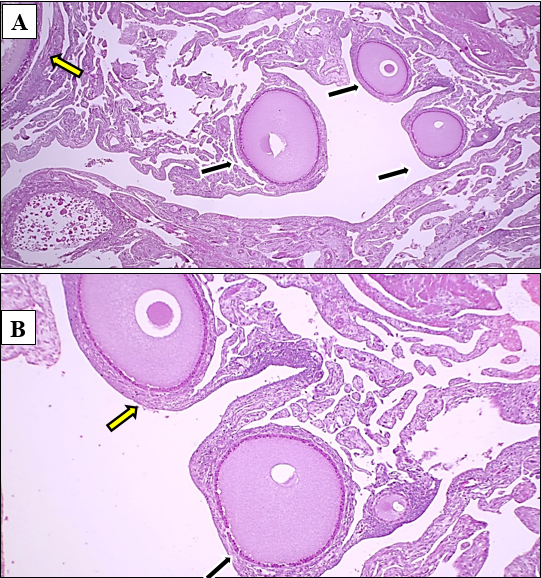
A and B/ Normal histological architectures of ovary. Note the large yellow follicles (LYF) were observed within ovarian parenchyma. However, three hierarchical mature F2-subtype LYF (black arrow) and one pre-ovulatory F1-subtype LYF (yellow arrow) with one erupted follicle (blue arrow) were evident in the examined section. H&E. A: 40x and B: 100x.
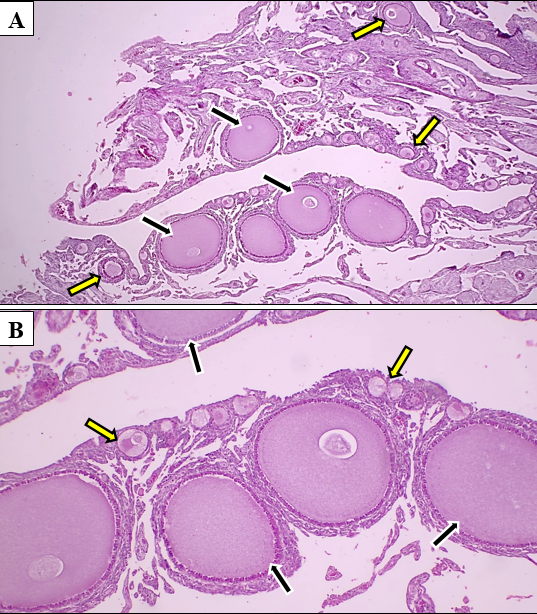
A and B/ Normal histological architectures of ovary. However, five F2-subtype LYF (black arrow) were observed in area compared with only three F2-subtypes were observed in control group. Also, more than twenty LYF at different stage of maturation (yellow arrow) were noted in the same area compared with five LYFs were observed in control group. H&E. A: 100x and B: 400x.
Figures 2 demonstrate the tissue response to 1 mg/kg Spirulina platensis supplementation (T2 group). Figure 3 (100x and 400x) reveals a sharp increase in follicle numbers. The number of robust F2-subtype LYFs is 5 in a single localized sector, which is far more than the control number, while over 20 growing follicles of various stages are found in a single localized sector. This expansion is confirmed by figure 4 which reveals that there is a high density of developing yellow follicles. Under high magnification (Figure 4B, 400x), the structural integrity of the pre-ovulatory F1 follicle is clear. It features a continuous, uniform row of cuboidal epithelial granulosa cells neatly enclosed by two well-defined functional layers: the theca interna and theca externa. This structural pattern indicates efficient lipid yolk precursor accumulation and active cellular development.
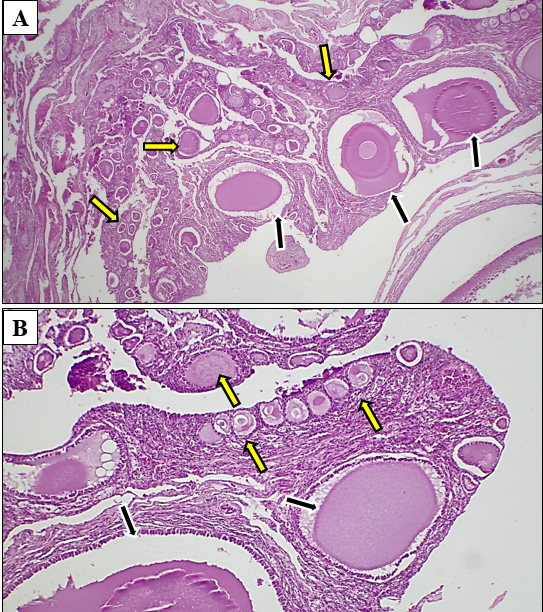
A and B/ Normal histological architectures of ovary. However, three F1-subtype LYF (pre-ovulatory follicles) were observed in area compared with only one F1-subtype was observed in control group. Also, more than twenty LYF at different stage of maturation were noted in the same area compared with five LYFs were observed in control group. H&E. A: 40x and B: 100x.
Figures 3 present the tissue changes observed with the higher dosage of 2 mg/kg Spirulina platensis (T3 group). In Figure 5 (40x and 100x), there are three fully developed and mature pre-ovulatory F1-subtype follicles in the same scanning field while there are more than twenty active follicles in the background matrix in a large scanning field. These observations are confirmed at higher magnification, in Figure 6 (x100, x400). The mature F1 & F2 follicles have well-organized, dense cuboidal granulosa epithelial structures surrounded by vascularized theca cellular envelopes.
In all the parts supplemented with spirulina (T2 and T3), there is no sign of cell degeneration, infiltration by leukocytes, necrosis in tissues or apoptotic follicular atresia. This illustrates that the Spirulina platensis is a safe natural potent bio-stimulant which maintains the integrity of ovarian tissue and active pathways of follicular recruitment during late laying.
| Experimental Group | Histological Structure of Follicular Pool | Primary Physiological Impact |
|---|---|---|
| Control Group | Limited pool; standard baseline tissue structure; usually a single pre-ovulatory F1 follicle visible. | Normal, standard reproductive performance; representative of less active baseline ovarian function. |
| T1 Treatment Group | Pronounced expansion of the hierarchical pool; significant accumulation of mature F2 follicles. | Improved follicular recruitment; sustained tissue viability supporting long-term egg production persistence. |
| T2 Treatment Group | Advanced follicular development; high count of mature, pre-ovulatory F1 follicles. | Heightened ovulatory readiness; immediate, direct acceleration of the flock's daily egg production rate. |
The microscopic histological examination showed very good cell integrity and organization in the spirulina-supplemented groups (T1 and T2) besides the gross macroscopic counts of hierarchical follicles. A well developed and organised granulosa and theca cell layer in these groups indicate a significant improvement in the activity of ovarian steroidogenesis. The granulosa and internal theca cells are the main functional cells of the ovary that regulate the synthesis and secretion of reproductive hormones, specifically estrogen and progesterone, (Elleithy et al., 2022) [16]. Estrogen is absolutely vital to its systemic function, by telling the avian liver to produce and release vitellogenin and very-low-density lipoproteins (VLDL); these are the necessary yolk precursors that are carried by the blood and deposited in the growing follicles as soon as they are released. At the same time, progesterone is the dominant neuroendocrine stimulus of the luteinizing hormone (LH) surge that causes ovulation. Thus, this high organization of the cells is a direct link to the higher number of mature large yellow follicles (LYF) noticed, and is a direct observation of the improvement of the cellular health: production ratio. [Abdel-Daim.,etal.,2018]
These stimulating micro-anatomical changes are closely linked to the complex chemical composition of Spirulina platensis and are the physiological basis of these changes. Spirulina is one of the best protein sources, micro-mineral source and a rich source of essential amino acids and fat soluble vitamins (such as vitamins A and E). Importantly, its rich bioactive pigment content, including phycocyanin and carotenoids, serve as powerful free-radical scavengers with important cytoprotective effects in the highly metabolic, vascularized ovarian tissue. High production rates cause the ovarian stroma and developing follicles to be exposed to high levels of metabolic oxidative stress and when ROS levels are not controlled, they can trigger apoptosis in the granulosa cells, resulting in a shorter egg production cycle and follicular atresia. This risk can be effectively reduced by diet supplementation with spirulina. Spirulina effectively reduces this risk when supplemented as a diet. Spirulina also protects the female reproductive organs from oxidative insult by preserving the integrity of cell membranes and the integrity of delicate tissues against lipid peroxidation. This antioxidant defense in the end results in improved overall follicular viability, the greatest amount of nutrient transfer across the blood-follicle barrier, and a highly active, youthful ovarian tissue architecture. Moreover, organic phytosterols and steroid-like compounds that are naturally present in microalgae possess an enhancing effect on this complete development of the follicular pool and structure in a synergistic manner, Johnson, and Woods. (2009) The bioactive phytosterols present in Spirulina species are measurable; such as β-sitosterol and campesterol (Shamima etal., 2019) [17]. These molecules have a strong structural similarity to cholesterol, the essential chemical base of all the steroid hormones, and can therefore be involved in complex biological pathways or affect peripheral hormone receptors (Ramadan et al., 2008) [18]. The exact concentrations of such phytosterols and the specific binding to them in this particular feed formulation have not been analysed yet, however, their existence correlates with the increased endocrine activity, advanced cell organization and strong follicular hierarchy as seen from the histological examination. [Samah and Ashraf, 2015].
P-ISSN: 2664-6064
E-ISSN: 2664-6072

International Journal of Agriculture and Nutrition