Physico-chemical characterization, rumen buffering kinetics, and formulation dynamics of a calcified red algae marine mineral complex for ruminant nutrition
Author(s):
Nikhil Kumar Gupta, Gaurav Singh, PKS Yadav
Abstract:
The modern dairy systems rely on high concentrate carbohydrate diets which pose a challenge in terms of the prevalence of Sub-Acute Ruminal Acidosis (SARA). This paper evaluates the structural, elemental and functional characteristics of calcified red algae (Lithothamnion spp.) marine mineral complex treated with active pH-correcting inorganic salts and micro-coatings. Inductively Coupled Plasma Optical Emission Spectrometry (ICP-OES) confirms high elemental density with 28.89% Ca and 8.32% Mg (Ca:Mg ≈ 3.47:1) corresponding to mineralized ash structure of 91.16%. Fourier-Transform Infrared (FTIR) analysis revealed dominant polymorphic calcite/aragonite lattices (1392.6 cm−1, 871.8 cm−1, 711.7 cm−1), combined with a biological polysaccharide matrix (1020.3 cm−1). The porous honeycomb cellular geometry allows acid-triggered, targeted dissolution in acidifying environments (pH < 6.0) and maintains buffering for > 8 hours without dietary sodium stress. A commercial formulation and standard operating procedure (SOP) integrating micronization, zeolite-mediated ion exchange, and sodium alginate-assisted controlled release are presented
Nikhil Kumar Gupta, Gaurav Singh, PKS Yadav. Physico-chemical characterization, rumen buffering kinetics, and formulation dynamics of a calcified red algae marine mineral complex for ruminant nutrition. Int. J. Agric. Nutr. 2026;8(10):105-109. DOI: 10.33545/26646064.2026.v8.i10b.777
Starch-rich diets are essential for high-yielding ruminant production systems, as they are rapidly fermented into volatile fatty acids (VFAs) and lactic acid. Sub-Acute Ruminal Acidosis (SARA) occurs when acid accumulation exceeds endogenous neutralization by salivary bicarbonate, leading to a ruminal pH below 5.8 and making animals vulnerable to the condition. Traditional synthetic buffers (e.g., sodium bicarbonate (NaHCO3)) provide immediate neutralization but are rapidly washed out (1–2 hours) and contribute to high dietary sodium loads.
Calcified marine Rhodophyta (Lithothamnion spp.) provide a biogenic alternative. Porous honeycomb structural framework and slow release mineral complexes are calcified red algae. The present study was designed to evaluate the elemental composition, molecular structural fingerprint, microbiological safety, dynamic ruminal buffering mechanism and optimized multi-component formulation of a red algae based buffer developed by Skystellar Minerals Pvt. Ltd.
2. Materials and methods material sourcing and analytical testing
Test protocols of SGS India Pvt. Ltd. (GG26-012087.001-A, GG26-012087.001-B)[1] and FTIR spectroscopy were used for sample evaluation at Indian Institute of Technology (IIT) Kanpur. Elemental determination was performed by ICP-OES (SO-IN-ICP-OES H&N-MNR-C-TE-006). Total ash was determined as per IS 7874: Part 1: 1975 and moisture content by Karl Fischer titration (IS 2362-1993). FTIR spectra were recorded in the spectral range from 400 cm−1 to 4000 cm−1 with Happ-Genzel apodization.
2. Premix formulation and SOP
To achieve functional nano-like behavior via fine dispersion (< 50 micron particle size) and matrix stabilization, a composite 100 kg batch premix was engineered according to the following Standard Operating Procedure (SOP) for Batch Preparation:
A total of 50.0 kg of ultra-fine CaCO3 was charged into a cleaned 1000 ml laboratory vessel or industrial paddle mixer.
Into the mixture, weighed amounts of MgO (10.0 kg) and Mg (OH)2 (8.0 kg) were added to the mixture.
Potassium carbonate was then added into the mixture, with a quantity of 2.0 kg.
Citric acid of 2.0 kg was added and finally 18.0 kg of fine micronized red algae powder.
The mixture was then mixed manually with a spatula for 5 minutes until the dry mixture was homogenous.
The mixture was then transferred into a high-shear mixer jar and mixed at high speed for 7-8 minutes.
Finally, the mixture was checked for quality visually and chemically before being packed into a moisture barrier bag.
3. Results and discussion elemental composition & stoichiometry
ICP-OES analysis of the red algae mineral base reveals a Total Ash content of 91.16%, reflecting an inorganic mineral complex. The product contains 28.89% elemental Calcium (≈ 72.2% CaCO3 equivalent) and 8.32% elemental Magnesium (≈ 28.8% MgCO3 equivalent).
Ca : Mg Ratio = = 3.47 : 1
This 3.47 : 1 elemental ratio is tailored for high-yielding dairy cattle feeds. It supplies bioavailable magnesium to offset hypomagnesemic tetany without compromising intestinal calcium uptake. Combined elemental Ca and Mg account for 37.21% of total mass, representing a total carbonate payload (CaCO3 + MgCO3) of 90–91%, matching the observed ash mass. Trace zinc (1.9 ppm) contributes to enzymatic processes. Moisture content remains low (2.38%, Karl Fischer), guaranteeing particle flowability and shelf stability.
2. FTIR spectroscopic interpretation
Spectroscopic analysis reveals structural evidence of biological origin and polymorph mineralogy:
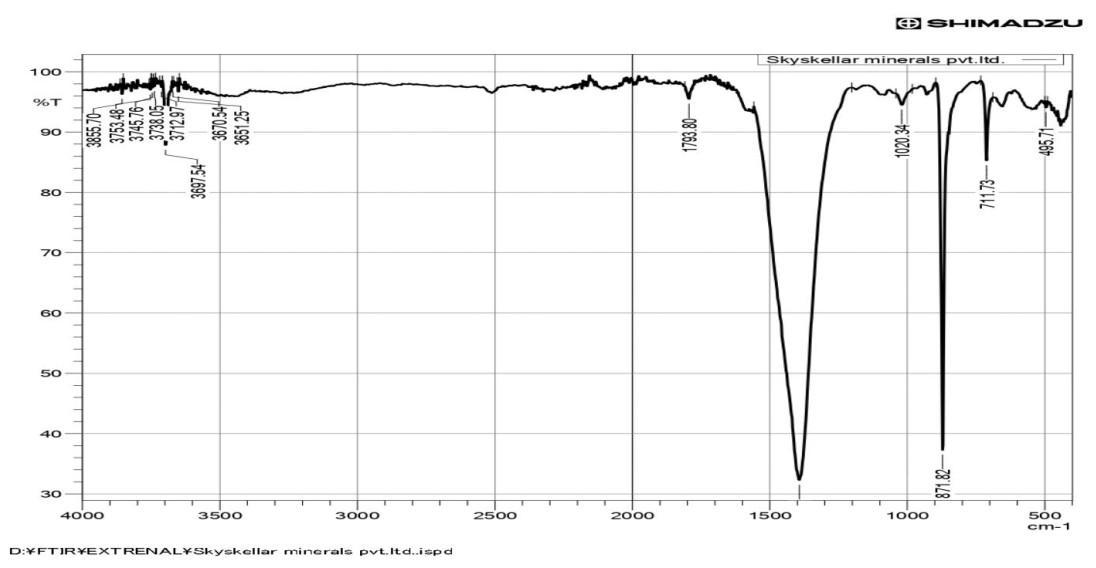
Polymorphic Carbonate Matrix (1392.6 cm−1, 871.8 cm−1, 711.7 cm−1): Strong CO2− stretching and in-plane/out-of-plane bending vibrations indicative of a predominant calcite/aragonite crystal lattice typical of calcified Rhodophyta.
Organic Matrix Signature (1020.3 cm−1): The absorption feature at 1020.3 cm−1 points to C-O/C-O-C glycosidic linkages characteristic of seaweed cell-wall polysaccharides (e.g., alginates, floridean starch), distinguishing this as a biogenic algal complex rather than mined terrestrial limestone.
Hydroxyl & Carbonyl Contributions (3855–3650 cm−1, 1793.8 cm−1): Hydroxyl bands suggest structural water/surface O-H linkages while 1793.8 cm−1 indicates organic carbonyl contributions from the embedded cell matrix.
Figure 1. FTIR spectrum of the calcified red algae mineral complex
3. X-ray diffraction (XRD) interpretation
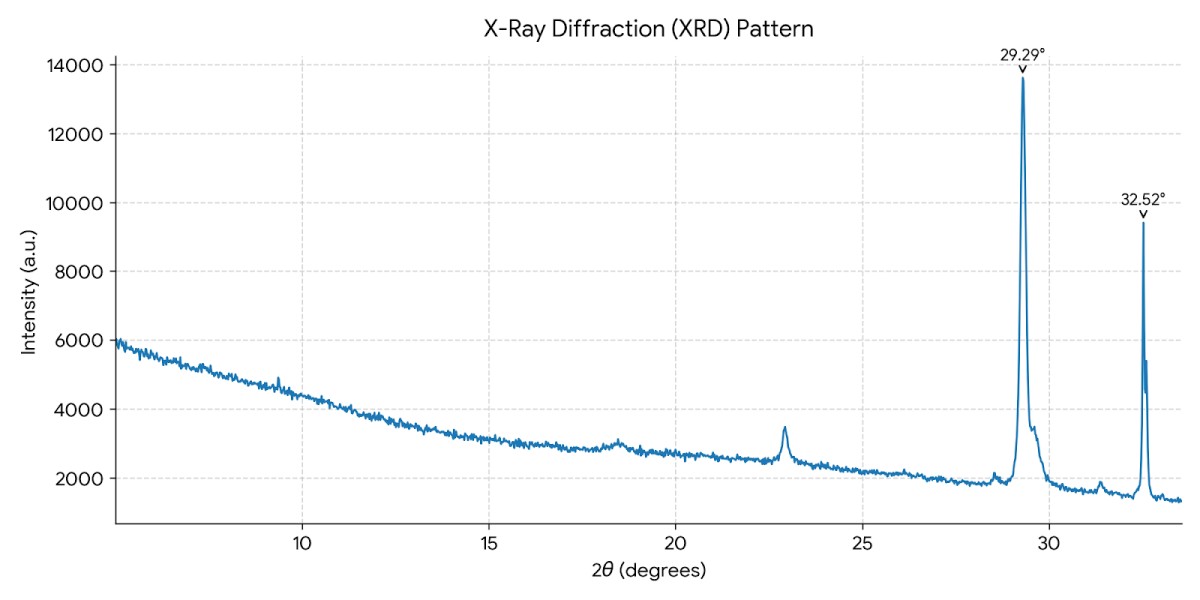
This X-Ray Diffraction (XRD) done from Center for Nanoscience Indian Institute of Technology, Kanpur. XRD pattern represents the mineral structure of a calcified red algae-based acid buffer (Lithothamnion species).
The X-ray diffraction pattern (XRD) revealed a dominant peak centered at 2θ = 29.29°, corresponding to high-magnesian calcite ((Ca,Mg)CO3). Pure calcite is known to exhibit its characteristic (104) peak at 2θ = 29.4°. Thus, the observed peak at 29.29° suggests magnesium incorporation into the calcium carbonate lattice. The high-magnesian calcite is the major active buffering component of calcified red seaweeds, playing a significant role in the neutralization of stomach and rumen acids.
A secondary intense peak was observed at 2θ = 32.52°, corresponding to the calcium/magnesium carbonate crystalline phases, possibly representing either aragonite or a minor fraction of dolomite/magnesite structures precipitated naturally by marine red algae. It is likely that these secondary mineral phases enhance the structural stability and offer a range of dissolution behaviors by contributing different dissolution pH profiles.
A minor peak was observed at 2θ ≈ 23.0°, corresponding to minor calcite planes, confirming the presence of the major carbonate mineral with a rhombohedral crystal system. In addition to the distinct diffraction peaks, the XRD pattern revealed a broad rising baseline between 5° and 15° 2θ. The rising trend of the baseline in the low-angle region suggests the possible presence of an amorphous (non-crystalline) organic phase characteristic of the organic matrix associated with the calcified red algae.
Figure 2. X-ray diffraction (XRD) pattern of the calcified red algae-based acid buffer
4. Dynamic rumen buffering & action mechanism
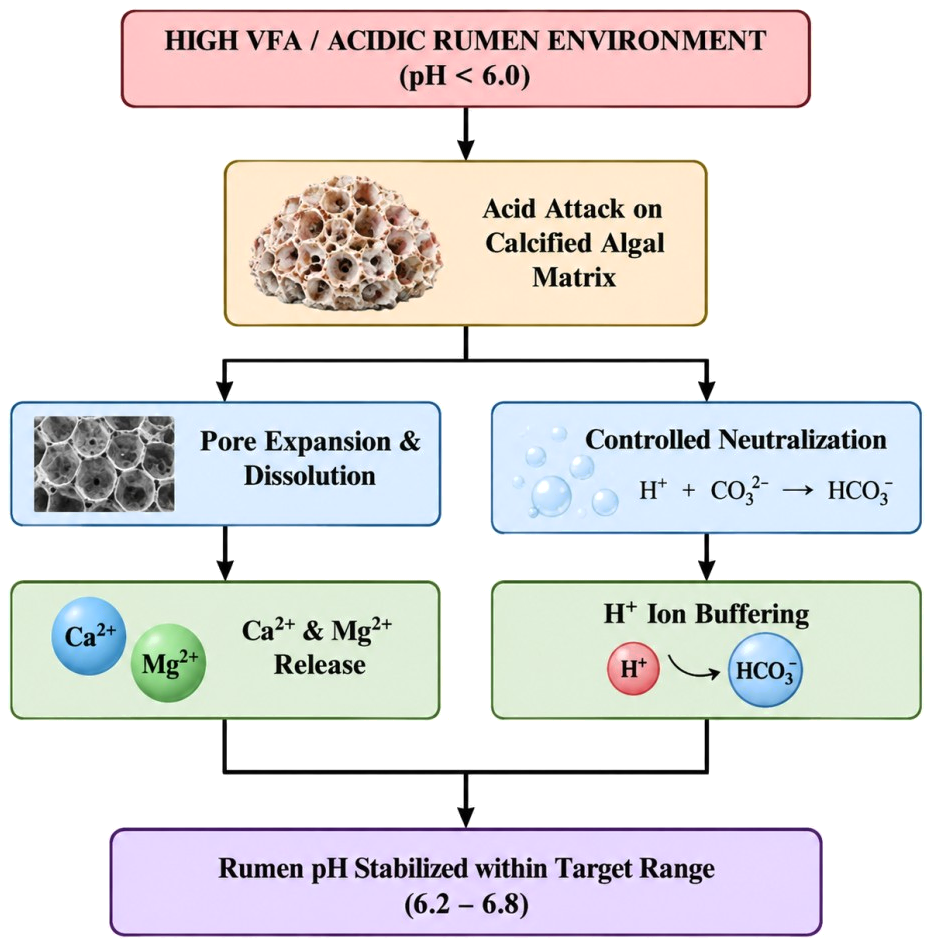
The reserve alkalinity of a 10% aqueous solution registers at pH 11.05. However, the powder is physically insoluble in pure water, preventing instantaneous dissolution and rapid washout. Neutralization is acid-triggered: as ruminal VFAs drop the local pH below 6.0, the mineral matrix dissolves:
This sustained release stabilizes ruminal pH within the physiological target window (6.2–6.8 standalone, or 5.8–6.3 within multi-component formulations).
Figure 3. Schematic representation of the acid-triggered rumen buffering mechanism of the calcified red algae mineral complex.
Microbiological safety standards
Pathogen analysis confirmed strict safety parameters as given below:
Total Plate Count (TPC): 70 cfu/g (ISO 4833:Part 1:2013; limit: 10, 000 cfu/g)
Enterobacteriaceae: < 10 cfu/g (ISO 21528:Part 2:2017; limit: 300 cfu/g)
Salmonella spp.: Absent in 25 g (ISO 6579:Part 1:2017)
5. Comparative analysis: marine buffer vs. conventional compounds
Red algae-based formulations overcome the limitations of single-agent buffers:
Table 1. Comparative characteristics of the calcified red algae-based buffer, sodium bicarbonate, and ground limestone.
Property / Feature
Skystellar Red Algae Acid Buffer
Synthetic Sodium Bicarbonate(NaHCO3)
Commercial Ground Limestone (CaCO3)
Buffering Duration
Sustained (up to 8 hrs)
Short-lived (1-2 hrs)
Low reactivity in mild acid
Neutralizing Capacity
2.5 times higher than NaHCO3
Baseline
Low
Magnesium Contribution
High (8.32% bioavailable Mg)
None (0%)
Negligible (< 0.5%)
Rumen Na Load Impact
Zero Sodium addition
Increases dietary Na stress
Zero Sodium addition
Structure
Porous Honeycomb Matrix
Soluble Salt
Dense Crystalline Rock
6. Applied nano-effect and formulation strategy
While raw red algae provides bioavailable Ca/Mg, full neutralization efficacy requires secondary active pH correctors. By combining fine micronization (< 50 micron) with sodium alginate coating and clinoptilolite zeolite, the premix yields functional nano-behavior without relying on free nanoparticles:
Increased Surface Area & Dispersion: Micronizing red algae to 200–400 mesh accelerates particle dispersion in fluid.
I Controlled-Release Hydrocolloid Coating: Sodium alginate coats MgO and Mg(OH)2 particles, modulating their hydration rate to prevent rapid pH spikes.
Ion Exchange and Toxin Binding: Zeolite lattices exchange cations to stabilize fluid ionic strength while binding dietary mycotoxins.
Dosing Guidelines:
Per Animal: 150–300 g per head per day.
TMR Inclusion: 1.0–1.2% of Total Mixed Ration on a dry matter basis.
7. Conclusion
The calcified red algae mineral complex created by Skystellar Minerals Pvt. Ltd. is a biogenic marine buffer for ruminant diets. The biological origin of this compound was established via FTIR spectroscopy (1020.3 cm−1), which demonstrated that it consists of high elemental density (28.89% Ca, 8.32% Mg) and a porous lattice structure.
The red algae derived acid buffer innovated by Skystellar Minerals Pvt. Ltd. is an amalgamation of biogenic high-magnesian calcite, cell-wall polysaccharides, active magnesium oxide/hydroxide and functional zeolite. These were characterized to have high crystallinity, mineral purity (91.16% ash), safety and structural integrity. By providing 2.5× higher buffering capacity than sodium bicarbonate over an extended 8-hour window without the addition of dietary sodium this formulation offers a solution for SARA prevention in high-output dairy systems. The XRD pattern establishes that the product is a natural biogenic carbonate rich in magnesian calcite. The sharp intense peaks confirm the high crystallinity for efficient acid reaction and the curvature of the baseline assures that the organic matrix elements of the raw red algae are intact.
2.Aikman PC, Henning PH, Humphries DJ, Horn CH. Rumen pH and fermentation characteristics in dairy cows supplemented with Megasphaera elsdenii NCIMB 41125 in early lactation. Journal of Dairy Science. 2011;94:2840–2849.
3.Aitchison EM, Rowe JB, Rix GS. Effect of bentonite clays on rumen fermentation and diet digestibility. Proceedings of the Nutrition Society of Australia. 1986;11:111–114.
4.Alhiday IA, Abdelrahman MM, Elsabagh M. A comparative study of four rumen buffering agents on productive performance, rumen fermentation and meat quality in growing lambs fed a total mixed ration. Animal. 2019;13:2252–2259.
5.Alhidary IA, Abdelrahman MM, Aljumaah RS, Alyemni AH, Ayadi MA, Al-Saiady MY. Rumen discoloration of growing lambs fed with diets containing different levels of neutral detergent fibre. Pakistan Journal of Zoology. 2017;49:1847–1855.
6.Ameen KA, Safwat M, Salama R, Awad AA. Effect of sodium bicarbonate and ionophore supplementation on nutrients digestibility and growth performance of lambs fed high concentrate diets. Egyptian Journal of Nutrition and Feeds. 2023;26:261–271.
7.Andrade PVD, Schmidely P. Influence of percentage of concentrate in combination with rolled canola seeds on performance, rumen fermentation and milk fatty acid composition in dairy goats. Livestock Science. 2006;104:77–90.
8.AOAC International. Official methods of analysis of the Association of Official Analytical Chemists International (18th ed.). AOAC International; 2005.
9.Asadi M, Toghdoory A, Ghoorchi T, Kargr S. The effects of diet concentrate and mineral buffer types on fattening lambs performance, nutrient digestibility, blood metabolites, rumen fermentation and carcass traits. Iranian Journal of Applied Animal Science. 2024;14(2):215–225.
10.Aydin OD, Merhan O, Yildiz G. The effect of sodium bentonite on growth performance and some blood parameters in post-weaning Tuj breed lambs. Ankara Üniversitesi Veteriner Fakültesi Dergisi. 2020;67:235–241.
11.Chen GJ, Song SD, Wang BX, Zhang ZF, Peng ZL, Guo CH, Wang Y. Effects of forage:concentrate ratio on growth performance, ruminal fermentation and blood metabolites in housing-feeding yaks. Asian-Australasian Journal of Animal Sciences. 2015;28:1736.
12.Cruywagen CW, Swiegers JP, Taylor SJ, Coetzee E. The effect of Acid Buf in dairy cow diets on production response and rumen parameters. Journal of Dairy Science. 2004;87(Suppl. 1):46.
13.Cruywagen CW, Taylor S, Beya MM, Calitz T. The effect of buffering dairy cow diets with limestone, calcareous marine algae, or sodium bicarbonate on ruminal pH profiles, production responses, and rumen fermentation. Journal of Dairy Science. 2015;98:5506.
14.Department of Chemistry & Center for Nanoscience, Indian Institute of Technology Kanpur. FTIR & XRD spectroscopic analysis reports.
15.Dutta TK, Chatterjee A, Bhakat C, Mandal D, Rai S, Mohammad A, Satpathy D, Yadav SK, Das AK. Effect of different levels of concentrate supplementation on feed intake, growth performance, carcass traits and composition in finisher Barbari kids reared under intensive system. Indian Journal of Animal Sciences. 2023;93:82–89.
16.Enemark JM. The monitoring, prevention and treatment of sub-acute ruminal acidosis (SARA): A review. The Veterinary Journal. 2008;176:32–43.
17.Erdman RA. Dietary buffering requirements of the lactating dairy cow: A review. Journal of Dairy Science. 1988;71:3246–3266.
18.Farghaly MM, Hassan EH, Abdo SG. Influence of sodium bicarbonate supplementation on nutrients digestibility, milk production, rumen fermentation and some blood parameters in sheep. Egyptian Journal of Animal Production. 2019;56:71–77.
19.Goetsch AL, Galykan M. Effect of dietary concentrate level on rumen fluid dilution rate. Canadian Journal of Animal Science. 1982;62:649–652.
20.Grabherr H, Spolders M, Furll M, Flachowsky G. Effect of several doses of zeolite A on feed intake, energy metabolism and on mineral metabolism in dairy cows around calving. Journal of Animal Physiology and Animal Nutrition. 2009;93:221–236.
21.Koul V, Kumar U, Sareen VK, Singh S. Effect of sodium bicarbonate supplementation on ruminal microbial populations and metabolism in buffalo calves. Indian Journal of Animal Science. 1998;68:629–631.
22.Le Ruyet P, Tucker WB. Ruminal buffers: Temporal effects on buffering capacity and pH of ruminal fluid from cows fed a high concentrate diet. Journal of Dairy Science. 1992;75:1069–1077.
23.Minuti A, Ahmed S, Trevisi E, Pocciolicappelli F, Bertoni G, Jahan N, Bani P. Experimental acute rumen acidosis in sheep: Consequences on clinical, rumen, and gastrointestinal permeability conditions and blood chemistry. Journal of Animal Science. 2014;92:3966–3977.
24.Santra A, Chaturvedi OH, Tripathi MK, Kumar R, Karim SA. Effect of dietary sodium bicarbonate supplementation on fermentation characteristics and ciliate protozoal population in rumen of lambs. Small Ruminant Research. 2003;47:203–212.
25.Seema S, Uddin M, Tamanna S, Esha K, AlNoman K, Hoque S, Selim A, Rahman M. Potential of ionophores as a feed additive for sustainable beef cattle production: Review article. Journal of Applied Veterinary Sciences. 2025;10:35–46.