
- Printed Journal
- Indexed Journal
- Refereed Journal
- Peer Reviewed Journal


P-ISSN: 2664-6064
E-ISSN: 2664-6072

Abhishek BS, Rohith L Shankar
Pages: 08-14 | 81 Views 56 Downloads

Keywords: Bombyx mori, Bivoltine silkworm, YCM14, YCM15, FC1, FC2, Seasonal performance, Economic traits, Tropical conditions
The mulberry silkworm, Bombyx mori L. (Lepidoptera: Bombycidae), is an economically important domesticated insect and the principal species used for commercial mulberry silk production. Quantity and quality silk productivity are influenced by the genetic constitution of the silkworm, quality of mulberry leaves, and rearing management interacting with environmental condition. (Krishnaswami et al., 1973; Benchamin et al., 1986) [2, 1]. Silkworm breeding programmes primarily focus on developing breeds and hybrids with superior productivity, viability and silk quality. Selection of suitable parental stocks followed by systematic hybridization and evaluation is an effective approach for improving economically important traits. Bivoltine silkworms have received considerable attention in breeding programmes because of their superior cocoon and silk quality compared with tropical multivoltine stocks. Several productive bivoltine breeds and hybrids have been developed in India through systematic breeding programmes involving suitable exotic and indigenous genetic resources (Basavaraja, 1995: Uma Shankar and subramanya, 2001) [3].
The successful utilization of bivoltine silkworms under tropical conditions remains a major challenge because of environmental conditions vary considerably among seasons. The environmental activities like, temperature and relative humidity strongly influence the larval growth, feeding activity, survival, cocoon formation and silk production (Sing et al., 2010) [4]. Bivoltine silkworms are relatively sensitive to high temperature and unfavourable environmental conditions, which can adversely affect several quantitative economic traits. Therefore, the development of bivoltine genetic stocks capable of maintaining desirable productivity under variable tropical environments is an important objective of silkworm breeding programmes (Shankar, 2008; Rahmathulla, 2012) [5, 6]. Earlier breeding programmes emphasized the importance of developing robust bivoltine genetic stocks suitable for tropical conditions (Suresh Kumar et al., 2006) [7]. Shankar (2008) [5] reported that the performance of conventional bivoltine breeds may vary under fluctuating tropical climatic conditions and highlighted the importance of identifying genotypes capable of maintaining stable cocoon production (Rao et al., 2006) [8]. Therefore, comparative evaluation of newly developed genetic stocks with established commercial hybrids under different seasons can provide valuable information regarding their adaptability, productivity and breeding potentiality for commercial utilization.
In the present breeding programme, several new bivoltine combinations developed (published) and evaluated through successive generations for desirable economic traits resulted in the isolation of two promising lines YCM14 and YCM15 based on their desirable commercial traits. The systematic evaluation of these newly developed lines across different tropical seasons namely, summer, rainy and winter to assess their consistency of performance and comparative suitability over control breeds FC1 and FC2 as controls were under taken to adjudicate the suitability of the selection and further breeding programme.
The experiment was conducted using two newly isolated bivoltine silkworm lines, YCM14 and YCM15, developed through a systematic silkworm breeding programme. YCM14 was derived from the cross J2 × H281, while YCM15 was derived from H281 × CSR53. The newly isolated lines were evaluated against their respective control hybrids, FC1 and FC2, respectively. The experimental material was maintained under standard conditions before undertaking the seasonal evaluation.
The performance of YCM14 and YCM15 was evaluated under tropical conditions during three major rearing seasons, namely summer, rainy and winter. Each newly isolated line was compared with its respective control hybrid in each season to assess the performance of important economic and silk-related traits under different seasonal conditions.
The silkworms were reared following standard recommended practices for bivoltine silkworms (Krishnaswami et al., 1973) [2]. Observations were recorded on important biological, larval, cocoon and silk-related traits. The characters considered for study were, fecundity (number of eggs/female), hatching percentage, effective rate of rearing (ERR), larval weight, larval duration, cocoon weight, shell weight, shell percentage, cocoon yield per 10,000 larvae, pupation rate, filament length, denier and raw silk percentage.
The experiment was conducted using a completely randomized design (CRD) with three replications for each treatment. The observations recorded for each trait were subjected to analysis of variance (ANOVA). The significance of differences among the genotypes was tested using the critical difference (CD) at the 5% probability level. Standard error of the mean [SEm], coefficient of variation (CV), F-value and critical difference (CD) were calculated for the respective traits. Statistical analysis was performed using SPSS statistical software. The seasonal performance of YCM14 and YCM15 was assessed by comparing their respective trait values with those of FC1 and FC2 across summer, rainy and winter seasons.
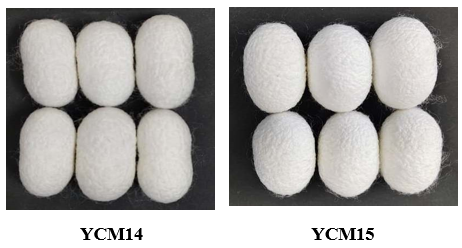
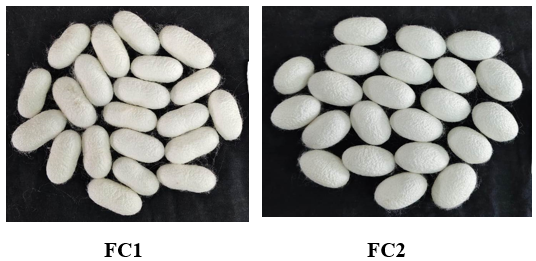
The commercial performance of the newly developed bivoltine silkworm hybrids YCM14 and YCM15 (Plate.1) was evaluated against their respective control hybrids, FC1 and FC2 (Plate.2) under three different seasons, viz., summer, rainy and winter. The comparative performance of YCM14 and YCM15 with their respective controls during the summer, rainy and winter seasons is presented in Tables 1, 2, 3 and 4, respectively.
Fecundity varied across seasons and between the newly developed lines and their respective control hybrids. During summer, YCM14 recorded 494 eggs/female compared with 470 eggs/female in FC1, while YCM15 recorded 508 eggs/female compared with 497 eggs/female in FC2. During the rainy season, YCM14 recorded 502 eggs/female against 498 eggs/female in FC1, whereas YCM15 recorded 521 eggs/female against 499 eggs/female in FC2. In winter, YCM14 maintained a higher fecundity of 510 eggs/female than FC1 (496 eggs/female), while FC2 recorded 545 eggs/female compared with 538 eggs/female in YCM15. The analysis showed a significant difference between the genotypes in winter, whereas the differences were non-significant during summer and rainy seasons. The higher fecundity expressed by YCM14 over FC1 across all three seasons and by YCM15 over FC2 during summer and rainy seasons indicates favourable reproductive performance of the newly developed lines under variable tropical environments. Seasonal variation in fecundity and other quantitative traits of bivoltine silkworms has also been reported by Anantha et al. (2010) [9], emphasizing the influence of seasonal environment on the expression of economically important traits. The mean fecundity was YCM14 and YCM15 recorded 502 and 522 eggs/female, respectively, compared with 488 and 508 eggs/female in FC1 and FC2 (controls). YCM15 recorded the highest fecundity.
Hatching percentage was consistently higher in both newly developed lines than their respective controls in all three seasons. YCM14 recorded 90.63, 88.21 and 87.20% hatching during summer, rainy and winter seasons, respectively, compared with 88.77, 87.74 and 86.74% in FC1. Similarly, YCM15 recorded 92.77, 90.56 and 89.57%, whereas FC2 recorded 86.99, 88.00 and 85.00% during the respective seasons. The differences were highly significant in all seasons. The consistently higher hatching percentage of YCM14 and YCM15 indicates improved egg viability and reproductive fitness. This is particularly relevant for tropical bivoltine breeding because high temperature and fluctuating environmental conditions can adversely affect viability and productivity. Singh et al. (2010) [4] emphasized the importance of developing bivoltine breeds with improved viability and tolerance to tropical environmental stress. The mean hatching percentage was YCM14 and YCM15 recorded 88.68 and 90.97%, respectively, while FC1 and FC2 recorded 87.75 and 86.66%, respectively. YCM15 showed the highest hatching percentage.
Effective rate of rearing (ERR) showed a clear advantage for the newly developed lines over their corresponding controls. YCM14 recorded ERR values of 90.12, 86.10 and 88.13% during summer, rainy and winter, respectively, compared with 87.00, 85.99 and 84.99% in FC1. YCM15 recorded 91.95, 90.97 and 89.98%, whereas FC2 recorded 87.84, 86.88 and 85.88%, respectively. The differences were highly significant in all seasons. The higher ERR indicates better larval survival and rearing stability of the newly developed lines. The ability to maintain viability under changing temperature and humidity is a major breeding objective for bivoltine silkworms intended for tropical conditions. Singh et al. (2010) [4] reported that improvement in viability and stability under high-temperature conditions is an important component of tropical bivoltine breeding. The mean ERR was YCM14 and YCM15 recorded 88.12 and 90.97%, respectively, while FC1 and FC2 recorded 85.99 and 86.87%, respectively. YCM15 showed the highest ERR.
Larval weight showed seasonal variation and genotype-dependent expression. In summer, YCM14 recorded 4.086 g compared with 4.050 g in FC1, while YCM15 recorded 4.163 g compared with 4.107 g in FC2. During the rainy season, YCM14 and YCM15 recorded 4.180 and 4.441 g, respectively, compared with 4.113 and 4.210 g in their respective controls. In winter, YCM14 recorded 4.123 g compared with 4.150 g in FC1, whereas YCM15 recorded 4.366 g compared with 4.237 g in FC2. The differences were significant in all three seasons. The comparatively higher larval weight of YCM15, particularly during the rainy season, reflects favourable larval growth and biomass accumulation. Seasonal differences in the expression of quantitative traits have been documented in bivoltine silkworms, with environmental conditions influencing growth and productivity traits (Ananta & Subramanya, 2010) [9]. The mean larval weight was YCM14 and YCM15 recorded 4.130 and 4.323 g, respectively, compared with 4.104 and 4.185 g in FC1 and FC2. YCM15 recorded the highest larval weight.
Larval duration exhibited relatively small differences between the newly developed lines and their controls, and the differences were non-significant in all seasons. YCM14 required 25, 25 and 25 days during summer, rainy and winter, respectively, whereas FC1 required 24, 24 and 25 days. YCM15 required 25, 25 and 25 days, compared with 24, 25 and 25 days in FC2. Although YCM15 required slightly longer larval duration during summer and rainy seasons, it reached the same duration as FC2 during winter. Larval duration is an important component of tropical silkworm breeding because shorter or stable larval development can facilitate efficient crop scheduling without compromising productivity. Sudhakara Rao et al. (2004) [10] demonstrated the importance of selecting bivoltine hybrids combining productive traits with shorter larval duration under tropical seasonal conditions. The mean larval duration was YCM14 and YCM15 recorded 25 days, respectively, while FC1 and FC2 recorded 24 days, respectively.
Cocoon weight was consistently higher in both YCM14 and YCM15 than in their respective controls in all seasons. YCM14 recorded 1.768, 1.841 and 1.822 g during summer, rainy and winter, respectively, compared with 1.698, 1.752 and 1.750 g in FC1. YCM15 recorded 1.830, 1.940 and 1.900 g, whereas FC2 recorded 1.707, 1.842 and 1.861 g, respectively. The differences were significant in all seasons. The highest cocoon weight was observed in YCM15 during the rainy season (1.940 g). Increased cocoon weight is an important productivity attribute because it contributes directly to shell production and overall cocoon yield. The development of robust bivoltine hybrids with improved cocoon productivity under tropical conditions has been emphasized in earlier breeding programmes (Suresh Kumar et al., 2002) [11]. The mean cocoon weight was YCM14 and YCM15 recorded 1.810 and 1.890 g, respectively, while FC1 and FC2 recorded 1.733 and 1.803 g, respectively. YCM15 recorded the highest cocoon weight.
Shell weight showed a favourable performance of the newly developed hybrids, particularly YCM15. YCM14 recorded 0.368, 0.393 and 0.343 g during summer, rainy and winter, respectively, compared with 0.350, 0.323 and 0.363 g in FC1. Thus, YCM14 exceeded FC1 during summer and rainy seasons but was lower during winter. YCM15 recorded 0.391, 0.397 and 0.398 g compared with 0.372, 0.358 and 0.372 g in FC2 during the three seasons, respectively. The difference was significant for YCM14 during summer and for the comparative genotype effect in the rainy season, while other seasonal comparisons were non-significant according to the supplied analysis. The consistently higher shell weight of YCM15 indicates its favourable silk-producing potential. Cocoon shell weight is an important selection criterion in bivoltine breeding because it contributes directly to silk productivity (Suresh Kumar et al., 2002) [11]. The mean shell weight was YCM14 and YCM15 recorded 0.368 and 0.395 g, respectively, compared with 0.345 and 0.367 g in FC1 and FC2. YCM15 recorded the highest shell weight.
Shell percentage was higher in the newly developed lines than their respective controls in all three seasons. YCM14 recorded 20.86, 20.65 and 20.30%, compared with 20.13, 20.08 and 19.88% in FC1 during summer, rainy and winter, respectively. YCM15 recorded 21.21, 21.14 and 21.05%, compared with 20.55, 20.65 and 20.74% in FC2. The genotype differences were significant in all seasons. The consistently higher shell percentage indicates a greater proportion of cocoon biomass being allocated to the silk-bearing shell. Seasonal variation in shell-related traits among bivoltine breeds has been reported previously, demonstrating the importance of environmental conditions in the expression of cocoon traits (Maribashetty et al., 1992) [12]. The mean shell percentage was YCM14 and YCM15 recorded 20.60 and 21.13%, respectively, while FC1 and FC2 recorded 20.03 and 20.65%, respectively. YCM15 showed the highest shell percentage.
Cocoon yield per 10,000 larvae showed variable seasonal responses. During summer, YCM14 recorded 16.00 kg compared with 15.00 kg in FC1, while YCM15 recorded 17.00 kg compared with 16.00 kg in FC2. During the rainy season, YCM14 recorded 15.67 kg, which was lower than FC1 (16.67 kg), whereas YCM15 recorded 17.67 kg compared with 17.00 kg in FC2. During winter, YCM14 recorded 16.00 kg compared with 15.33 kg in FC1, while YCM15 recorded 17.67 kg compared with 17.33 kg in FC2. The differences were non-significant according to the supplied analysis. The comparatively stable yield of YCM15 across seasons and its higher yield than FC2 during summer and rainy seasons indicate promising productivity under variable tropical environments. Seasonal genotype × environment effects for yield per 10,000 larvae have been documented in bivoltine hybrid evaluations, demonstrating the importance of testing breeding materials across seasons (Sudhakara Rao et al., 2001) [13]. The mean cocoon yield was YCM14 and YCM15 recorded 15.89 and 17.45, respectively, compared with 15.67 and 16.78 in FC1 and FC2. YCM15 recorded the highest cocoon yield.
Pupation rate showed seasonal differences between the new lines and controls. YCM14 recorded 89.16, 85.14 and 87.14% during summer, rainy and winter, respectively, compared with 86.54, 86.55 and 89.54% in FC1. Thus, YCM14 exceeded FC1 during summer and rainy seasons but was lower during winter. YCM15 recorded 89.22, 89.96 and 90.21%, compared with 87.90, 89.86 and 91.88% in FC2. YCM15 was higher than FC2 during summer and rainy seasons but slightly lower during winter. The genotype differences were significant during summer and winter but non-significant during the rainy season for the supplied analysis. Pupation and other viability traits are strongly influenced by environmental conditions, and their maintenance is important in the development of robust bivoltine material for tropical conditions (Mal Reddy et al., 2004) [14]. The mean pupation rate was YCM14 and YCM15 recorded 87.15 and 89.80%, respectively, while FC1 and FC2 recorded 87.54 and 89.88%, respectively. FC2 recorded the highest pupation rate.
Filament length was consistently higher in YCM14 and YCM15 than in their respective controls across all seasons. YCM14 recorded 1023, 1038 and 1045 m compared with 1013, 1014 and 1044 m in FC1 during summer, rainy and winter, respectively. YCM15 recorded 1040, 1049 and 1075 m compared with 1027, 1026 and 1063 m in FC2. The highest filament length was recorded by YCM15 during winter (1075 m). Although the supplied statistical analysis indicated non-significant differences for filament length, the numerical superiority of the new lines across seasons is relevant from a breeding perspective. Longer filament length is a desirable silk-quality trait, and breeding programmes have specifically targeted increased filament length together with finer denier in bivoltine silkworms (Kalpana et al., 2004) [15]. The seasonal expression of filament length has also been reported in evaluations of promising bivoltine hybrids for tropical conditions (Sudhakara Rao et al., 2001) [13]. The mean filament length was YCM14 and YCM15 recorded 1035 and 1054 m, respectively, while FC1 and FC2 recorded 1023 and 1054 m, respectively. YCM15 and FC2 recorded the highest filament length.
Denier showed relatively stable expression in YCM14, with values of 2.88, 2.90 and 2.97 during summer, rainy and winter, respectively, compared with 2.89, 2.81 and 2.85 in FC1. YCM15 recorded 2.93, 3.18 and 3.22 denier compared with 3.05, 3.13 and 3.18 in FC2. Thus, YCM14 showed slightly finer denier than FC1 during summer and winter but was marginally coarser during the rainy season. YCM15 recorded finer denier than FC2 during summer but slightly higher denier during rainy and winter seasons. The differences were significant for YCM14 and YCM15 during summer and rainy seasons according to the supplied analysis, while the winter comparison was non-significant. Denier is an important silk-quality parameter, and breeding programmes have specifically emphasized the development and maintenance of bivoltine breeds possessing longer filament length and fine denier (Mal Reddy et al., 2003) [16]. The mean denier was YCM14 and YCM15 recorded 2.92 and 3.22, respectively, compared with 2.85 and 3.11 in FC1 and FC2. YCM15 recorded the highest denier.
Raw silk percentage showed contrasting seasonal responses between the two newly developed lines. YCM14 recorded 19.19, 18.68 and 18.25% during summer, rainy and winter, respectively, compared with 19.30, 18.86 and 18.44% in FC1. Thus, YCM14 was slightly lower than FC1 in all seasons. In contrast, YCM15 recorded 20.49, 20.36 and 19.80%, compared with 19.55, 19.87 and 19.90% in FC2. YCM15 therefore exceeded FC2 during summer and rainy seasons, while FC2 was marginally higher during winter. The supplied analysis showed significant genotype differences for raw silk percentage in all three seasons. Raw silk percentage is an important measure of the ultimate silk conversion efficiency of cocoons, and previous evaluation of bivoltine hybrids under tropical conditions identified raw silk percentage as one of the traits showing significant genotype × environment interaction (Raju et al., 1993; Sudhakara Rao et al., 2001) [17, 13]. The mean raw silk percentage was YCM14 and YCM15 recorded 18.71 and 20.22%, respectively, while FC1 and FC2 recorded 18.87 and 19.77%, respectively. YCM15 recorded the highest raw silk percentage.
The observed seasonal fluctuations demonstrate that the expression of quantitative traits in bivoltine silkworms is influenced by environmental conditions and genotype × environment interaction (Uma Shankar and subramanya, 2001) [18]. Earlier studies have similarly emphasized the need to evaluate promising bivoltine material across different tropical seasons before recommending it for wider utilization. Sudhakara Rao et al. (2001) [13] reported significant genotype × environment interaction for fecundity, yield per 10,000 larvae, filament length and raw silk percentage during seasonal evaluation of newly evolved bivoltine hybrids. Likewise, Singh et al. (2010) [4] emphasized that successful tropical bivoltine breeding requires a balance between viability, productivity and adaptation to adverse environmental conditions.
The newly developed bivoltine silkworm lines YCM14 and YCM15 exhibited promising performance across summer, rainy and winter seasons under tropical conditions. YCM14 showed consistently higher hatching percentage, effective rate of rearing, cocoon weight and shell percentage than FC1 across the three seasons, together with favourable fecundity and filament length. YCM15 exhibited superior performance over FC2 for several important economic traits, particularly hatching percentage, effective rate of rearing, larval weight, cocoon weight, shell weight, shell percentage and filament length. The seasonal evaluation also revealed that the expression of individual traits varied with environmental conditions, highlighting the importance of multi-season testing in bivoltine breeding programmes.
Among the evaluated traits, YCM15 showed a particularly favourable combination of reproductive, larval, cocoon and silk-related characters, while YCM14 demonstrated good viability and productivity with comparatively stable performance across seasons. Therefore, both the newly developed hybrid lines can be considered as promising new bivoltine genetic resources for further breeding programmes under tropical conditions. Further multi-location and multi-season evaluation, together with assessment of disease tolerance, rearing stability and silk-reeling quality, is recommended before their wider commercial utilization.
Lines/ Breeds | Fecundity (No) | Hatching percentage (%) | ERR (%) | Larval weight (g) | Larval duration (Days) | Cocoon weight (g) | Shell weight (g) | Shell percentage (%) | Cocoon yield /10,000 larvae | Pupation rate (%) | Filament Length (M) | Denier | Raw silk percentage (%) |
|---|---|---|---|---|---|---|---|---|---|---|---|---|---|
| YCM14 | 494 ± 10 | 90.63 ± 0.03 | 90.12 ± 0.05 | 4.086 ± 0.03 | 25 ± 01 | 1.768 ± 0.03 | 0.368 ± 0.01 | 20.86 ± 0.04 | 16 ± 1.4 | 89.16 ± 0.05 | 1023 ± 10.54 | 2.88 ± .01 | 19.19 ± 0.03 |
| YCM15 | 508 ± 10 | 92.77 ± 0.02 | 91.95 ± 0.03 | 4.163 ± 0.02 | 25 ± 02 | 1.830 ± 0.03 | 0.391 ± 0.02 | 21.21 ± 0.03 | 17 ± 1.3 | 89.22 ± 0.03 | 1040 ± 10.11 | 2.93 ± .01 | 20.49 ± 0.02 |
FC1 (Control) | 470 ± 11 | 88.77 ± 0.01 | 87.00 ± 0.05 | 4.050 ± 0.03 | 24 ± 01 | 1.698 ± 0.02 | 0.350 ± 0.01 | 20.13 ± 0.02 | 15 ± 1.4 | 86.54 ± 0.03 | 1013 ± 9.21 | 2.89 ± 0.02 | 19.30 ± 0.02 |
FC2 (Control) | 497 ± 10 | 86.99 ± 0.03 | 87.84 ± 0.02 | 4.107 ± 0.04 | 25 ± 01 | 1.707 ± 0.02 | 0.372 ± 0.01 | 20.55 ± 0.02 | 16 ± 1.2 | 87.90 ± 0.02 | 1027 ± 10.38 | 3.05 ± 0.01 | 19.55 ± 0.01 |
| F-value | 2.582 | 5731. 806 | 2186. 900 | 3.161 | 0.235 | 3.317 | 30.034 | 152.560 | 0.236 | 543.786 | 1.080 | 189.671 | 287.613 |
| Significance | N/S | ** | ** | ** | N/S | ** | ** | ** | N/S | ** | N/S | ** | ** |
| SE(m) | 10.03 | 0.03 | 0.05 | 0.027 | 1.30 | 0.03 | 0.00 | 0.04 | 1.4 | 0.05 | 10.54 | 0.01 | 0.03 |
| CV | 3.53 | 0.06 | 0.09 | 1.126 | 9.11 | 3.33 | 1.45 | 0.31 | 16 | 0.11 | 1.78 | 0.34 | 0.31 |
| C.D@5% | 32.71 | 0.11 | 0.16 | 0.087 | 4.25 | 0.11 | 0.01 | 0.12 | 4.61 | 0.18 | 34.38 | 0.02 | 0.11 |
LINES/ BREEDS | Fecundity (No) | Hatching percentage (%) | ERR (%) | Larval weight (g) | Larval duration (Days) | Cocoon weight (g) | Shell weight (g) | Shell percentage (%) | Cocoon yield /10, 000 larvae | Pupation rate (%) | Filament Length (M) | Denier | Raw silk percentage (%) |
|---|---|---|---|---|---|---|---|---|---|---|---|---|---|
| YCM14 | 502 ± 10 | 88.21 ± 0.02 | 86.10 ± 0.01 | 4.180 ± 0.02 | 25 ± 0.9 | 1.841 ± 0.01 | 0.393 ± 0.01 | 20.65 ± 0.01 | 15.67 ± 0.9 | 85.14 ± 0.02 | 1038 ± 12 | 2.90 ± 0.01 | 18.68 ± 0.01 |
| YCM15 | 521 ± 11 | 90.56 ± 0.01 | 90.97 ± 0.01 | 4.441 ± 0.02 | 25 ± 0.8 | 1.940 ± 0.02 | 0.397 ± 0.01 | 21.14 ± 0.01 | 17.67 ± 0.9 | 89.96 ± 0.03 | 1049 ± 11 | 3.18 ± 0.02 | 20.36 ± 0.01 |
FC1 (Control) | 498 ± 13 | 87.74 ± 0.03 | 85.99 ± 0.02 | 4.113 ± 0.01 | 24 ± 0.7 | 1.752 ± 0.01 | 0.323 ± 0.01 | 20.08 ± 0.02 | 16.67 ± 0.6 | 86.55 ± 0.01 | 1014 ± 08 | 2.81 ± 0.02 | 18.86 ± 0.02 |
FC2 (Control) | 499 ± 8 | 88.00 ± 0.02 | 86.88 ± 0.01 | 4.210 ± 0.02 | 24 ± 0.6 | 1.842 ± 0.01 | 0.358 ± 0.01 | 20.65 ± 0.01 | 17.00 ± 0.8 | 89.86 ± 0.02 | 1026 ± 06 | 3.13 ± 0.02 | 19.87 ± 0.01 |
| F-value | 1.125 | 3321 | 24825 | 177.3 | 1.45 | 299.36 | 4.16 | 965 | 0.83 | 13003 | 1.46 | 104.60 | 3292.05 |
| Significance | N/S | ** | ** | ** | N/S | * | N/S | * | N/S | * | N/S | * | * |
| SE(m) | 2531 | 0.0122 | 0.0054 | 0.0028 | 23.33 | 0.0005 | 0.0069 | 0.005 | 20.00 | 0.0108 | 3872 | 0.007 | 0.005 |
| CV | 33.492 | 0.074 | 0.049 | 0.035 | 3.216 | 0.014 | 0.055 | 0.046 | 2.977 | 0.069 | 41.423 | 0.058 | 0.046 |
| C.D@5% | 33.49 | 0.07 | 0.05 | 0.03 | 3.22 | 0.01 | 0.06 | 0.05 | 2.98 | 0.07 | 41.42 | 0.06 | 0.05 |
LINES/ BREEDS | Fecundity (No) | Hatching percentage (%) | ERR (%) | Larval weight (g) | Larval duration (Days) | Cocoon weight (g) | Shell weight (g) | Shell percentage (%) | Cocoon yield /10,000 larvae | Pupation rate (%) | Filament Length (M) | Denier | Raw silk percentage (%) |
|---|---|---|---|---|---|---|---|---|---|---|---|---|---|
| YCM14 | 510 ± 14 | 87.20 ± 0.03 | 88.13 ± 0.02 | 4.123 ± 0.01 | 25 ± 1.31 | 1.822 ± 0.07 | 0.343 ± 0.01 | 20.30 ± 0.02 | 16.00 ± 0.7 | 87.14 ± 0.04 | 1045 ± 1.7 | 2.97 ± 0.01 | 18.25 ± 0.03 |
| YCM15 | 538 ± 16 | 89.57 ± 0.03 | 89.98 ± 0.01 | 4.366 ± 0.01 | 25 ± 1.22 | 1.900 ± 0.03 | 0.398 ± 0.02 | 21.05 ± 0.02 | 17.67 ± 0.8 | 90.21 ± 0.05 | 1075 ± 0.9 | 3.22 ± 0.02 | 19.80 ± 0.04 |
FC1 (control) | 496 ± 12 | 86.74 ± 0.02 | 84.99 ± 0.04 | 4.150 ± 0.03 | 25 ± 1.10 | 1.750 ± 0.02 | 0.363 ± 0.01 | 19.88 ± 0.03 | 15.33 ± 0.5 | 89.54 ± 0.03 | 1044 ± 2.8 | 2.85 ± 0.01 | 18.44 ± 0.02 |
| FC2 (control) | 528 ± 11 | 85.00 ± 0.01 | 85.88 ± 0.02 | 4.237 ± 0.01 | 25 ± 1.12 | 1.861 ± 0.04 | 0.372 ± 0.01 | 20.74 ± 0.01 | 17.33 ± 0.3 | 91.88 ± 0.06 | 1063 ± 0.7 | 3.18 ± 0.01 | 19.90 ± 0.01 |
| F-value | 8.283 | 2993.713 | 10276. 647 | 68.495 | 0.016 | 10.897 | 3.972 | 598.903 | 2.079 | 2109.095 | 2.352 | 222.975 | 645.460 |
| Significance | ** | ** | ** | * | N/S | * | N/S | ** | N/S | ** | N/S | N/S | ** |
| SE(m) | 8.0364 | 0.0344 | 0.0222 | 0.0132 | 1.3017 | 0.0194 | 0.0114 | 0.0208 | 0.7638 | 0.0428 | 9.7054 | 0.0118 | 0.0344 |
| CV | 2.67 | 0.07 | 0.04 | 0.54 | 9.23 | 1.83 | 5.37 | 0.18 | 7.98 | 0.08 | 1.59 | 0.67 | 0.31 |
| C.D@5% | 26.2081 | 0.1123 | 0.0725 | 0.0431 | 4.2451 | 0.0632 | 0.0373 | 0.0679 | 2.4908 | 0.1396 | 31.6510 | 0.0384 | 0.1123 |
LINES/ BREEDS | Fecundity (No) | Hatching percentage (%) | ERR (%) | Larval weight (g) | Larval duration (Days) | Cocoon weight (g) | Shell weight (g) | Shell percentage (%) | Cocoon yield /10,000 larvae | Pupation rate (%) | Filament Length (M) | Denier | Raw silk percentage (%) |
|---|---|---|---|---|---|---|---|---|---|---|---|---|---|
| YCM14 | 502 | 88.68 | 88.12 | 4.130 | 25 | 1.810 | 0.368 | 20.60 | 15.89 | 87.15 | 1035 | 2.92 | 18.71 |
| YCM15 | 522 | 90.97 | 90.97 | 4.323 | 25 | 1.890 | 0.395 | 21.13 | 17.45 | 89.80 | 1054 | 3.22 | 20.22 |
| FC1 | 488 | 87.75 | 85.99 | 4.104 | 24 | 1.733 | 0.345 | 20.03 | 15.67 | 87.54 | 1023 | 2.85 | 18.87 |
| FC2 | 508 | 86.66 | 86.87 | 4.185 | 24 | 1.803 | 0.367 | 20.65 | 16.78 | 89.88 | 1054 | 3.11 | 19.77 |
The authors gratefully acknowledge the Department of Sericulture, Yuvaraja’s College, University of Mysore, for providing the necessary facilities and support to conduct this study. Financial assistance provided by the University of Mysore is also sincerely acknowledged. The authors express their sincere gratitude to Dr. Rohith L. Shankar for his valuable guidance, continuous support and encouragement throughout the study. The authors also thank the Director, Central Sericultural Research and Training Institute (CSRTI), Mysuru, for providing the required silkworm breeds and facilities for conducting the experiments.
P-ISSN: 2664-6064
E-ISSN: 2664-6072

International Journal of Agriculture and Nutrition