
- Printed Journal
- Indexed Journal
- Refereed Journal
- Peer Reviewed Journal


P-ISSN: 2664-6064
E-ISSN: 2664-6072

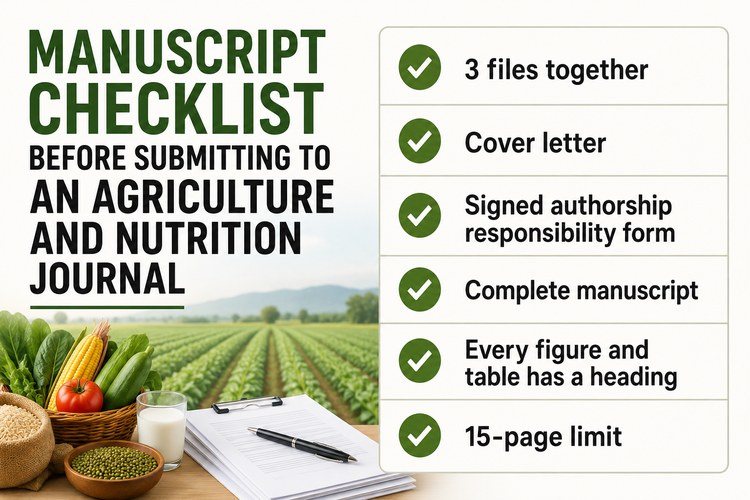
Most manuscripts returned by an agriculture and nutrition journal in the first week fail on things the author could have checked in an afternoon: page count, spacing, a missing file, an unstated sample size, references in the wrong order. This is that afternoon, in the order worth doing it.
Do the page count last, after figures and tables are in place. This is the limit an agriculture and nutrition journal checks first. A manuscript that is 14 pages of text becomes 19 once the tables are added, and the limit applies to what you submit.
Sample files for all three can be downloaded from the instructions to authors page. Send them together. A submission missing one file waits until somebody notices it is missing.
The nine sections above are in the order that wastes least time, and the order matters more than it looks.
Scope comes before everything — there is no point formatting a manuscript for an agriculture and nutrition journal that will return it in a week for being outside the subject. Read two recent issues first, then start the list.
Formatting comes early because it is mechanical and can be done while the science is still settling. References come late because they change every time you add a citation. The page count comes last, after tables and figures are in, since that is what decides whether you are inside the 15-page limit.
Doing it in the reverse order — polishing references first, checking scope last — is how authors discover in week three that the paper was never going to fit.
Not the person who wrote the paper, if you can avoid it. After weeks with a manuscript you read what you meant rather than what is on the page, and the errors this list catches are exactly the ones that become invisible to the author.
A co-author with an hour, or a colleague in the same department, will find things you cannot. For research students it is worth agreeing this explicitly with a supervisor: one full pass against the checklist before submission, treated as a job rather than a courtesy read.
The alternative is a nutrition journal editorial office running the same list for you, which they will do, at a cost of one to two weeks per item they find.
Two checks that catch what a list cannot.
Read the methods aloud to someone outside the project. If they cannot tell you what you did, a reviewer will not manage it either.
Read the abstract and the conclusion together, nothing else. They should agree, and neither should promise more than the results section delivers. Papers overreach in exactly these two places, because they are usually written last and in a hurry.
A last suggestion: keep the version of this list that matches the journal you are submitting to. Page limits, abstract lengths and referencing styles differ, and a checklist built for one agriculture and nutrition journal will quietly mislead you at the next. Five minutes reading the instructions and updating the numbers is part of choosing where to submit, not a separate task.
It removes avoidable rejections. It does not make a weak study strong. If the design cannot answer the question — no control, no replication, a sample too small for the claim — no amount of formatting will save it, and a nutrition journal reviewer will say so in the first paragraph of the report.
Used properly, though, it changes the kind of reply you get. Instead of a return in week one for formatting, you get reviewer comments about the science, which is the conversation worth having.
Not more than 15 pages for a regular manuscript, in MS Word, Times New Roman 12, single spaced, one column, with one-inch margins. A review article should not exceed 4,500 words.
A cover letter in MS Word, a signed authorship responsibility form, and the complete manuscript with all figures and tables carrying headings. Samples of all three can be downloaded from the instructions to authors page.
It applies to the manuscript you submit, so count the pages after everything is in place. This is why the page count belongs at the end of the checklist rather than the beginning.
Yes. Every submission is screened anyway, and finding a problem yourself costs an hour while finding it at screening costs the submission. Pay particular attention to method text reused from your own earlier papers, which must be cited.
Open the last two issues in the archives. If nothing there resembles your subject in method or topic, the paper will be returned before review however good it is. Two recent issues tell you more than any scope statement.
References in alphabetical order in a Vancouver journal, closely followed by a missing authorship responsibility form. Both take minutes to fix beforehand and cost a week each when they are found by the office instead.
The individual sections, explained:
Created by Lucia Moretti • 10 Aug 2026
P-ISSN: 2664-6064
E-ISSN: 2664-6072

International Journal of Agriculture and Nutrition