
- Printed Journal
- Indexed Journal
- Refereed Journal
- Peer Reviewed Journal


P-ISSN: 2664-6064
E-ISSN: 2664-6072

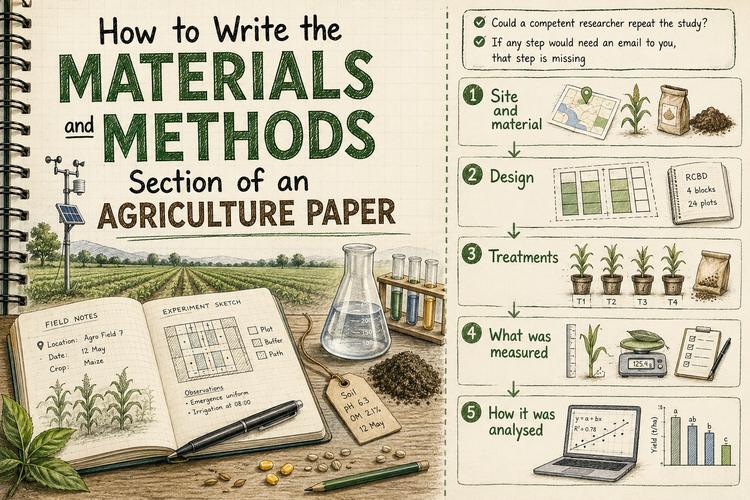
The test for a materials and methods section is simple: could a competent researcher in your field repeat the study from what you wrote, and get a comparable answer? If any step would need an email to you, that step is missing. This is the section reviewers at an agriculture and nutrition journal read first, and the one that decides whether the results can be believed at all.
A nutrition journal reviewer cannot assess results without knowing how they were produced. A yield difference means nothing until a reader knows the plot size, the replication and the season; a nutrient value means nothing until they know the analytical method.
This is also where most major-revision requests originate. Papers are rarely rejected because the finding is uninteresting. They are sent back because nobody can tell what was done.
“Recommended dose” and “standard package of practices” are the two phrases that most often trigger a comment. They mean different things in different states and different years, so write the actual numbers.
The food composition source is the single most commonly omitted item, and it is not a formality. The same food can differ by a third between tables, so a nutrient intake figure without its source cannot be compared with anything.
Not enough:
“Iron content was estimated using standard methods. Data were analysed statistically.”
Enough:
“Iron was determined by atomic absorption spectrophotometry after wet digestion in nitric and perchloric acid (9:4 v/v), following AOAC method 999.11. Recovery from certified reference material was 97.4 per cent. Analyses were run in triplicate and means compared by one-way analysis of variance with Tukey's test at p = 0.05, using the statistical package named below.”
The second is four times the length and removes four reviewer comments before they are written. That is the trade every time.
Field results in any agriculture and nutrition journal are conditional on the season, and a paper that omits the weather cannot be interpreted or compared. This is a small paragraph with a large effect on how useful your work is to somebody else.
Give total rainfall over the crop period and how it was distributed, mean maximum and minimum temperature, and any unusual event — a dry spell at flowering, unseasonal rain at harvest, hail. Say where the data came from: an on-site weather station, the nearest meteorological station with its distance, or a gridded dataset.
Two sentences here let a reader in another state judge whether your result is likely to hold for them. Without it, a yield response to nitrogen is a number from an unknown year, and a reviewer who works on the same crop will say so.
The equivalent in a dietary study is season and food availability. Intake measured in one month is not habitual intake, particularly where the diet follows the harvest calendar, and stating the month is what allows another author to compare their figures with yours.
Past tense throughout, because you are describing what was done. Most agriculture and nutrition journal style guides say so explicitly. Present tense creeps in around software and standing facts and reads oddly next to the rest.
On voice, follow the journal's convention and be consistent. Passive is traditional here (“samples were digested”), but an occasional active sentence is not an error and often reads better.
Order the section as the work happened: site and material, design, treatments, what was measured, how it was analysed. A reader following your sequence can hold the study in their head; one jumping between analysis and design cannot.
Any agriculture and nutrition journal submission involving human participants needs an ethics statement: which committee approved it, the reference number if there is one, and how consent was obtained. For work with children, say who gave consent and whether the children assented.
Studies involving animals need equivalent approval. Work on farmers' fields needs the landholder's permission, and studies collecting plant material may need a permit depending on where it came from. A nutrition journal will ask for these before publication, so write them in from the start.
Eight questions. An agriculture and nutrition journal reviewer is asking the same ones, and answering them yourself first turns a major revision into a minor one.
One more habit worth building: write the methods section while the work is happening, not months later. Sowing dates, instrument settings, the exact digestion time, the batch of reference material — these are all obvious at the time and gone by the time you sit down to write. A running file kept alongside the experiment turns the hardest section of an agriculture and nutrition journal paper into a tidying job.
Detailed enough for a competent researcher in the field to repeat the study without contacting you. Standard published methods can be cited rather than described in full, but any modification you made must be written out.
Yes, if it is published and accessible — give the reference and note any change you made. Citing a method that appears only in an unpublished thesis or an inaccessible local report is not enough, because the reader cannot reach it.
Yes, along with the version where it matters. Different packages implement post-hoc tests and mixed models differently, so the software is part of the method rather than a footnote.
In the methods, usually at the end or immediately after the description of participants. Give the approving committee, the reference number if there is one, and how informed consent was obtained.
Cite the original, then state precisely what you changed and why in one or two sentences. “Following Smith et al., with digestion time extended from 45 to 90 minutes to allow for the higher fibre content” is complete and takes a line.
Only with citation. Method sections legitimately repeat between papers from the same laboratory, but reproducing your own published wording without acknowledging it is treated as a form of plagiarism by any nutrition journal that screens submissions, and screening is routine.
What comes next in the manuscript:
Created by Ishaan Malhotra • 10 Aug 2026
P-ISSN: 2664-6064
E-ISSN: 2664-6072

International Journal of Agriculture and Nutrition