
- Printed Journal
- Indexed Journal
- Refereed Journal
- Peer Reviewed Journal


P-ISSN: 2664-6064
E-ISSN: 2664-6072

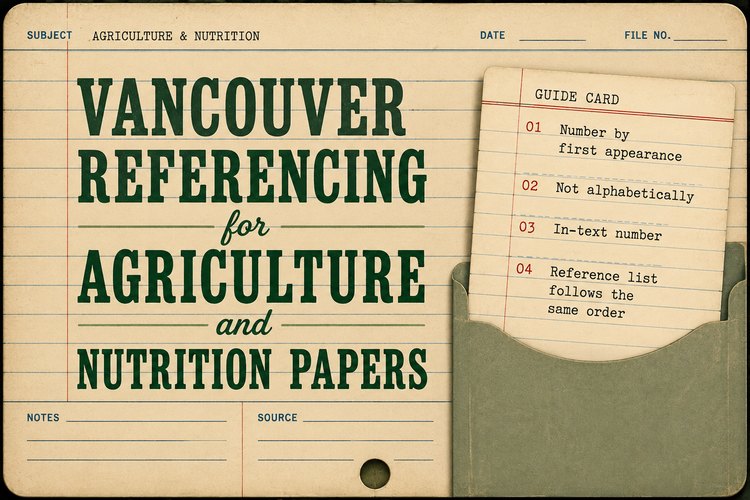
Vancouver style numbers references in the order they are first cited in the text, not alphabetically. The number goes in the text, and the reference list runs 1, 2, 3 in that same order. This agriculture and nutrition journal uses Vancouver, and the commonest error in submitted manuscripts is a list assembled alphabetically by a reference manager left on its default setting.
Citation order, not alphabetical order. Every agriculture and nutrition journal using Vancouver works this way. The first source you cite is reference 1 wherever it appears in the paper, and it keeps that number every time you cite it again.
This has a practical consequence people forget: if you insert a new citation into the introduction after the paper is written, every subsequent number changes. Which is why you let software renumber and never type the numbers by hand.
Some journals use superscript numbers and some use square brackets. Follow whichever your target journal shows in its recent issues, and be consistent throughout.
Sharma R, Patel K, Devi S. Zinc and iron content of biofortified pearl millet under two irrigation regimes. Int. J. Agric. Nutr. 2026;8(1):01-05.
List the first six, then et al. Do not list three and add et al.; that is APA habit leaking in.
Gopalan C, Rama Sastri BV, Balasubramanian SC. Nutritive value of Indian foods. Hyderabad: National Institute of Nutrition; 2016.
Rao P. Post-harvest losses in millets. In: Kumar A, editor. Millet processing and value addition. New Delhi: Publisher; 2023. p. 112-30.
Food and Agriculture Organization. The state of food security and nutrition in the world. Rome: FAO; 2024 [cited 2026 Aug 10]. Available from: URL
Note the two dates on a web source: the year it was published and the date you looked at it. Both are needed, because online documents change.
Vancouver uses abbreviated journal titles following the standard index abbreviation, so an agriculture and nutrition journal appears in your list under its short form. This journal's own abbreviation is Int. J. Agric. Nutr., shown on the home page.
Where you cannot find an official abbreviation, write the title in full rather than inventing one. A made-up abbreviation is worse than a long title, because a reader cannot resolve it back to the journal.
Most reference lists arriving at a nutrition journal were exported from Zotero, Mendeley or EndNote with the style left on APA or a house style from another journal. The result is alphabetical order, author-date citations in the text, or ampersands where none belong.
Step 3 catches the error nobody expects: reference managers import wrong page numbers, wrong years and occasionally wrong journals, and a reviewer who finds one assumes the rest are equally reliable.
Here is what an exported list usually looks like, and what it should look like. Three sources, cited in the text in the order Gopalan, then Sharma, then Rao.
As exported (APA style left on):
Gopalan, C., Rama Sastri, B. V., & Balasubramanian, S. C. (2016). Nutritive value of Indian foods. National Institute of Nutrition.
Rao, P. (2023). Post-harvest losses in millets. In A. Kumar (Ed.), Millet processing and value addition (pp. 112–130).
Sharma, R., Patel, K., & Devi, S. (2026). Zinc and iron content of biofortified pearl millet. International Journal of Agriculture and Nutrition, 8(1), 1–5.
Alphabetical, author-date, ampersands, full journal title, page range with an en dash. Every one of those is wrong for a Vancouver journal, and the in-text citations will be wrong too.
As it should be:
1. Gopalan C, Rama Sastri BV, Balasubramanian SC. Nutritive value of Indian foods. Hyderabad: National Institute of Nutrition; 2016.
2. Sharma R, Patel K, Devi S. Zinc and iron content of biofortified pearl millet under two irrigation regimes. Int. J. Agric. Nutr. 2026;8(1):01-05.
3. Rao P. Post-harvest losses in millets. In: Kumar A, editor. Millet processing and value addition. New Delhi: Publisher; 2023. p. 112-30.
Numbered in citation order, initials without full stops between them, abbreviated journal title, semicolon before the volume, colon before the pages. The whole change is one style setting plus five minutes of reading.
| What they see | What they conclude |
|---|---|
| Alphabetical list in a Vancouver journal | The author did not read the instructions |
| Twelve references, eight over fifteen years old | The recent literature has not been read |
| Every reference from one country | The international context has been ignored |
| Heavy self-citation | Padding, unless the earlier work is genuinely central |
| A DOI that does not resolve | The list was assembled without checking |
| A citation in the text with no entry in the list | Carelessness that may extend to the data |
No nutrition journal sets a fixed number, but proportions matter. A research paper of the length this journal accepts usually carries 20 to 40 references. A review article, which can run to 4,500 words here, will carry considerably more.
On recency: your field decides. Fast-moving areas need most references from the last five years. A paper on a classical analytical method reasonably cites work from the 1970s. What draws comment is a list with nothing from the last three years in a field that has moved.
One layout point specific to this agriculture and nutrition journal: tables are placed after the references in the manuscript, using horizontal lines only, each with a self-descriptive heading. Figures follow the same numbering-by-citation-order rule as references — Figure 1 is the first one mentioned in the text, wherever it ends up on the page.
Three source types come up constantly in this field and are handled badly.
Food composition tables. Cite them as books, with the edition or year, because values change between editions. “Values were taken from the Indian Food Composition Tables” without an edition is not a citation a reader can use.
Statistical software. Name it with its version in the methods and cite it if the developers ask you to. A post-hoc test implemented differently in two packages can change which means share a letter.
Standards and official methods. Give the method number and the year of the edition — AOAC 999.11 is a citation, “AOAC methods” is not. The same applies to Bureau of Indian Standards methods and to any recommended dietary allowance you compare intakes against.
A nutrition journal reviewer reads these particularly closely, because they are the sources that let your numbers be compared with anyone else's. A missing edition year is the difference between a comparable result and an isolated one.
Vancouver. References are numbered in the order they are first cited in the text, and the reference list follows that same numerical order rather than alphabetical order.
List the first six followed by et al. Listing three and adding et al. is an APA convention and will be marked as an error.
Include them where they exist. A DOI lets a reader reach the source in one step and lets the publisher link your reference list through Crossref, which is how citations to those papers get counted.
Give author, title, the type of document, the institution and the year. Be cautious about relying on sources a reader cannot obtain — a reviewer may ask you to replace an inaccessible local report with published work.
Usually yes, provided you label it as a preprint with its DOI or server, so the reader knows it has not been peer reviewed. Do not present a preprint as though it were a published paper.
It comes back for correction, which costs a round. Since the fix is a two-minute change of style setting in your reference manager, it is the cheapest rejection reason to eliminate before submitting to any nutrition journal.
The other formatting rules that go with referencing:
Created by Elena Vasquez • 10 Aug 2026
P-ISSN: 2664-6064
E-ISSN: 2664-6072

International Journal of Agriculture and Nutrition