
- Printed Journal
- Indexed Journal
- Refereed Journal
- Peer Reviewed Journal


P-ISSN: 2664-6064
E-ISSN: 2664-6072

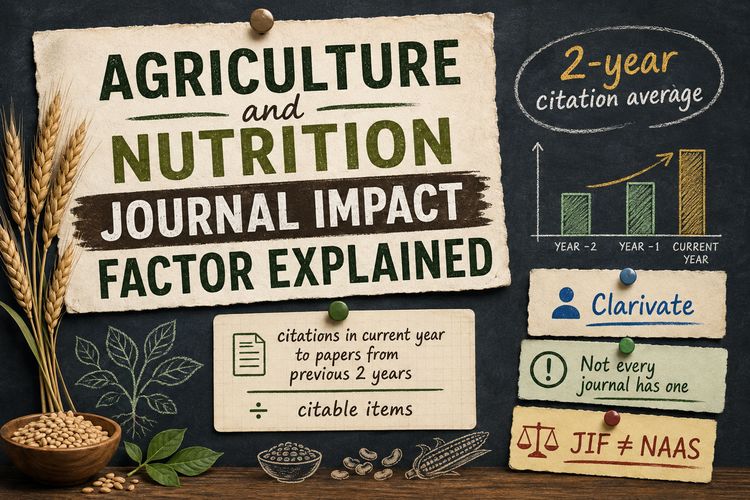
A Journal Impact Factor is one number from one company: the average number of citations that articles published in a journal over the previous two years received in the current year, calculated by Clarivate for journals in specific Web of Science collections. Most journals in the world do not have one, and several numbers that look like impact factors are not.
JIF for 2026 = (citations in 2026 to items published in 2024 and 2025) ÷ (citable items published in 2024 and 2025)
Two consequences fall straight out of that formula and explain most misunderstandings.
It is an average, and citations are not evenly spread. In a typical journal a small number of papers collect most of the citations, so the average describes almost none of the individual articles. Your paper does not inherit the number.
It measures two years. That suits fast-moving fields where work is cited quickly. Agronomy, soil science and nutrition often cite over much longer horizons — a variety trial or a food composition study can still be cited fifteen years later — so a two-year window systematically undersells these disciplines.
| Name | Who publishes it | What it is |
|---|---|---|
| Journal Impact Factor (JIF) | Clarivate | The one described above, for Web of Science journals only |
| CiteScore | Elsevier | A similar ratio over four years, for Scopus journals |
| NAAS rating | National Academy of Agricultural Sciences, India | An annual rating for agriculture and allied sciences |
| h-index | Various tools | A measure for an author or a journal, calculated differently by each tool |
| “Global Impact Factor”, “Universal Impact Factor” and similar | Unknown companies | Sold to journals; no methodology, no standing |
The last row is the one that matters for choosing where to submit. Several businesses sell impact-factor-shaped numbers to any journal that pays. They are designed to look like a JIF to an author who has not seen a real one, and displaying one is a reliable marker of a publisher to avoid.
Do this before you believe any number on any journal website, including the one you are reading now. The check is free, takes two minutes, and is the only way to tell a JIF from something shaped like one.
This is not an argument that metrics are worthless. It is an argument that one metric answers one narrow question, and authors routinely ask it to answer four.
| Your question | What to look at |
|---|---|
| Will my institution count this? | Their list — UGC-CARE, a NAAS minimum, Scopus, or an internal whitelist |
| Is the journal genuine? | ISSN resolves, DOIs resolve, board members real, review process described |
| Will the right people read it? | Which databases index it, and whether it is open access |
| Does it fit my paper? | The last two issues |
| Is it well cited in my field? | Search a few of its recent articles in Google Scholar and look at the counts |
That last one is worth doing and almost nobody does it. Five minutes of looking at real citation counts on real articles in an agriculture and nutrition journal tells you more than any headline metric, because you are looking at papers like yours rather than an average across everything.
It is worth working through with numbers, because the effect is larger than most authors realise.
Take two papers published in the same year. One is a molecular biology method that fifty groups adopt within eighteen months. The other is a multi-location varietal performance study that becomes a standard reference for a decade, cited two or three times a year, every year.
Over fifteen years the second paper may collect more citations than the first. Inside a two-year JIF window, the first contributes heavily and the second contributes almost nothing. The metric is not wrong; it is measuring early citation speed, and then being read as though it measured worth.
This is why comparing an agriculture and nutrition journal with a biomedical one on JIF alone is meaningless. Citation habits differ by field: reference lists are longer in some disciplines, older in others, and the JIF makes no adjustment for either. Comparisons are only informative within a field, between journals whose readers cite at similar speed.
Pressure to publish in high-metric journals is real and largely comes from committees rather than from science. Two practical points.
First, a rejection from a high-metric journal costs months, and three of them can cost a year. If a paper is a modest but sound contribution, sending it to a well-matched nutrition journal that will review it properly and publish it is not settling; it is finishing.
Second, work that is read gets cited. A paper in an open access agriculture and nutrition journal that district officers, extension staff and students can actually open accumulates citations from people who would never have seen it behind a paywall. Reach is not the same as prestige, and over a career it is worth more.
When you list publications, name the metric and its source: “NAAS 5.2 (2026)” is checkable, “IF 5.2” is not, and an assessor who spots the substitution will discount everything else on the page.
Never quote a number whose source you cannot name. If a journal displays an impact factor without saying who calculated it, treat it as unverified and leave it out of your file rather than repeating it.
A last practical note. If a committee asks you for “the impact factor” of a nutrition journal that has none, say so plainly and give what does exist — the NAAS rating with its year, the databases that index it, and the DOI of the paper. An honest “this title is not in the Master Journal List, so it has no JIF; its NAAS rating for the current year is X” is a complete answer, and a far better one than a number copied from a website whose source nobody can name.
Search the exact title at mjl.clarivate.com. If it is not in the Master Journal List, it is not in Web of Science and has no Journal Impact Factor, whatever number appears on its website.
No. Most journals worldwide have no JIF, including many sound regional and national titles. Judge the review process, the board, the verifiable registrations and whether your institution counts it.
Different bodies and different coverage. Clarivate calculates a JIF from citation data for Web of Science journals; NAAS assigns an annual rating to agricultural and allied-science journals in India. Quoting one as if it were the other is a common and easily spotted error.
They are numbers, but not Journal Impact Factors. Several companies sell impact-factor-shaped figures to journals that pay, with no published methodology. A nutrition journal displaying one is telling you something about itself.
Not reliably. Citations concentrate in a minority of articles, so the journal average predicts an individual paper poorly. What your paper is about, and whether the people who need it can read it, matter more.
Only after your institution's requirement, the journal's legitimacy and subject fit have been settled. Used as a tie-breaker between two suitable journals it is reasonable. Used as the first filter it produces desk rejections and wasted months.
The metrics this one is most often confused with:
Created by Samuel Adeyemi • 10 Aug 2026
P-ISSN: 2664-6064
E-ISSN: 2664-6072

International Journal of Agriculture and Nutrition