
- Printed Journal
- Indexed Journal
- Refereed Journal
- Peer Reviewed Journal


P-ISSN: 2664-6064
E-ISSN: 2664-6072
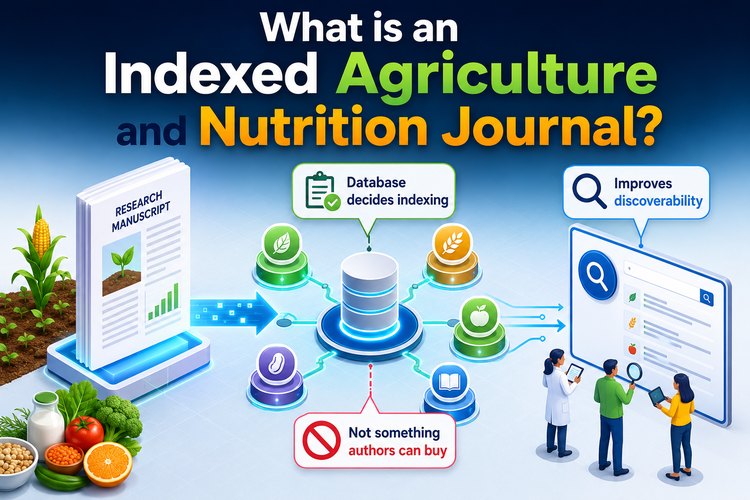
An indexed agriculture and nutrition journal is one whose articles are listed in an external database, so a reader searching that database finds your paper without ever visiting the journal's website. Indexing is a decision made by each database, about the journal, over years — not something a publisher can buy, and not something an author can arrange.
A database keeps its own record of articles: title, authors, abstract, keywords, and where the full text sits. When a journal is indexed there, every new issue is collected and added, so the paper becomes findable through that database's search.
The distinction that confuses people is between indexed and listed. A directory that accepts any journal that fills in a form has listed you. A database that evaluated the journal and then began collecting its content has indexed you. Only the second changes who reads your paper.
| Type | Examples | What it does for you |
|---|---|---|
| Selective citation databases | Scopus, Web of Science | Selective entry, used by many ranking and promotion systems |
| Discipline databases | PubMed, AGRIS, CAB Abstracts | Reach the specialists who search that database first |
| Registration agencies | Crossref | Registers the DOI and links citations |
| Broad crawlers | Google Scholar | Widest reach; picks up most journals with readable metadata |
| Author networks | ResearchGate, Academia.edu | Distribution rather than indexing |
| Aggregators and discovery | Science Gate, SciSpace | Surface abstracts to readers browsing by topic |
| Open directories | Various “index” sites | Frequently meaningless; entry is automatic |
This nutrition journal lists ISSN, Google Scholar, Crossref, Science Gate, Open Access, Academia.edu, ResearchGate and SciSpace on its indexing page, and states directly that it is not in Scopus, Web of Science or PubMed. That last sentence is the useful one.
Anybody can print a row of database logos. Almost nobody checks them, which is exactly why predatory operations print them.
A journal that volunteers what it is not in has made a choice against its own short-term interest, and that is a signal you cannot fake. When you are comparing two agriculture and nutrition journal websites and one of them says plainly “not in Scopus”, treat that as evidence in its favour rather than against.
Do this before submitting, not after. An indexing claim you cannot verify at the database's own website is a claim the journal has made about itself.
This is the part authors most often get wrong, and it costs the most.
Your university, funding body or promotion committee works from its own list — UGC-CARE, a NAAS minimum score, an internal whitelist, or a Scopus requirement. A journal indexed in five databases that are all outside that list will not count for you, and a journal on the list counts whether or not you are impressed by it.
So the order is: get your institution's list first, filter journals against it, then apply the quality checks. Choosing an agriculture and nutrition journal on reputation and discovering afterwards that it is not on the list is the most expensive avoidable mistake in this whole process.
These two are constantly conflated in India. A NAAS score is a rating assigned to agricultural journals by the National Academy of Agricultural Sciences, reviewed annually. Indexing is a database collecting your articles.
A journal can have a NAAS rating and be in almost no databases, or be widely indexed with no NAAS rating at all. This journal holds a NAAS rating of 4.69 (2026) and lists its databases separately, because they answer different questions. If your institution asks for a minimum NAAS score, that is the number to check; if it asks for Scopus, the rating is irrelevant.
It helps to think about where different readers actually start.
A journal indexed in Google Scholar and registered with Crossref reaches the first and last of those. It does not reach the middle three, and no amount of good work in the paper changes that. This is the practical meaning of an indexing list: it is a map of which readers can stumble across you, and which ones need to be handed your citation directly.
Which is also why the honest thing to do with a paper in a less widely indexed nutrition journal is to distribute it yourself — deposit it in your institutional repository, put the DOI in your email signature, and cite it in your own later work. Reach that the journal cannot give you, you can partly supply.
Not in the way the question usually means. A publisher can apply, and applications succeed on evidence: a consistent publication schedule over several years, real peer review, complete and machine-readable metadata, DOIs, and an editorial board that stands up to inspection.
What a publisher cannot do is pay for entry to a selective database. Any site suggesting your paper will enter Scopus because the journal paid a fee is describing something that does not happen, and it is a reliable marker of an operation to avoid.
One further point that catches people out at the end of a degree. Indexing is checked at the moment your file is assessed, not at the moment you published. A journal that was on a national list when you submitted can be off it two years later, and the committee looks at the list in front of them. Nothing protects you from that entirely, but publishing in a nutrition journal with a long, consistent record is a better bet than one that appeared last year with an impressive list of claims.
It means an external database collects and lists its articles, so readers searching that database can find them. It says nothing on its own about review quality — and the claim should always be verified at the database's own site rather than taken from the journal's page.
For being read, it is the single most valuable listing, because it is where most researchers start. For institutional credit it is often not enough, since many committees ask specifically for Scopus, Web of Science or a UGC-CARE listing. Check what your institution requires.
Search the journal title in the Sources list at scopus.com, which is free to search. If the title is not there, it is not indexed, regardless of what the journal's website displays.
No. A Clarivate Journal Impact Factor is calculated only for journals in specific Web of Science collections, so most indexed journals worldwide have no impact factor at all. The two are unrelated for the great majority of titles.
Usually timing — crawling can take several weeks after publication. If months pass with nothing appearing, the journal's metadata may be incomplete or the pages may not be crawlable. Write to the editorial office with the article title and DOI and ask them to check.
Not in a selective database, no — those index journals, not individual articles. What you can do is deposit the published version in an institutional or subject repository, which makes it findable and is permitted here under the Sherpa/Romeo Green policy with no embargo.
The metrics that are often confused with indexing:
Created by Thomas Brenner • 10 Aug 2026
P-ISSN: 2664-6064
E-ISSN: 2664-6072

International Journal of Agriculture and Nutrition