
- Printed Journal
- Indexed Journal
- Refereed Journal
- Peer Reviewed Journal


P-ISSN: 2664-6064
E-ISSN: 2664-6072

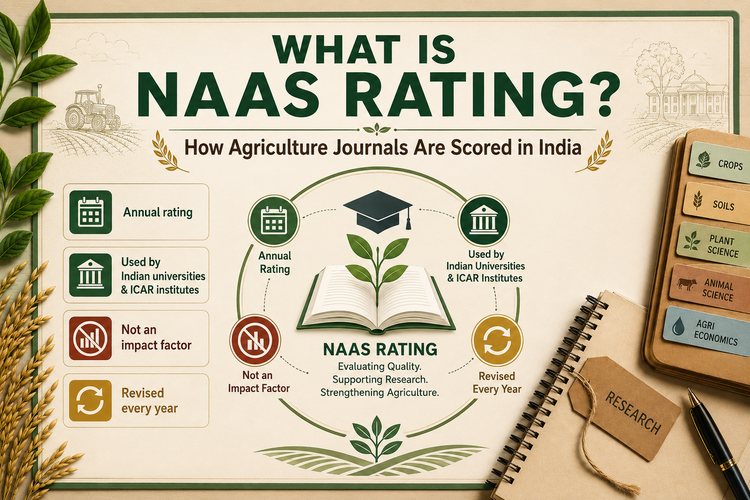
The NAAS rating is a score assigned to agricultural and allied-science journals by the National Academy of Agricultural Sciences, India, and revised every year. Many Indian universities and ICAR institutes use it to decide which publications count towards a degree, an assessment or a promotion. It is not an impact factor, not an indexing listing, and not a measure of how carefully a journal reviews.
NAAS publishes an annual list of rated journals covering agriculture and allied sciences, which is where any agriculture and nutrition journal published in India will appear if it is rated at all. The purpose is administrative: Indian institutions needed a single reference for judging publications across a field where much of the important work appears in regional and national journals that global databases never picked up.
That origin explains both its usefulness and its limits. It was built to be a filter for Indian agricultural institutions, and it works well as one. It was never designed as a global measure of journal quality, and it does not behave like one.
NAAS revises the list annually and publishes the methodology alongside it, and the route by which an agriculture and nutrition journal is scored depends on one thing. Two things authors should understand:
This is why the scale is not evenly populated, and why comparing a 4.7 with a 9.2 is not comparing two similar things measured on one ruler. They may have been placed by different routes entirely.
Check the current year's methodology document before quoting a score. NAAS has changed how it assigns ratings more than once, and guidance written three years ago is often wrong today. This is the single most common error in advice about NAAS scores online.
| Question | What the NAAS score tells you |
|---|---|
| Will my university count this journal? | Often yes — if it sets a minimum score, this is the number |
| Is the review careful? | Nothing |
| Is the journal indexed in Scopus? | Nothing directly |
| Will my paper be widely read? | Nothing |
| Is the journal genuine? | Weak evidence at best; check ISSN, DOIs and the board separately |
This agriculture and nutrition journal holds a NAAS rating of 4.69 (2026), shown on the journal home page. The year matters as much as the number, because the list is revised annually — a score quoted without its year is incomplete.
| Assigned by | Covers | Revised | |
|---|---|---|---|
| NAAS rating | National Academy of Agricultural Sciences, India | Agriculture and allied sciences | Annually |
| Journal Impact Factor | Clarivate | Journals in specific Web of Science collections | Annually |
| Indexing | Each database separately | Whatever that database selects | Continuously |
Three different organisations answering three different questions. A nutrition journal can hold a NAAS rating and appear in no selective database; another can be widely indexed with no NAAS rating at all, because the list only covers agriculture and allied sciences.
The order matters. Starting with the score and ending with fit is how authors end up in a well-rated journal whose readers do not work on their subject.
A postgraduate student is told the department counts publications in any agriculture and nutrition journal with a NAAS score of 4.0 or above. Three journals are on the shortlist.
The highest score is the wrong choice: Journal A will desk-reject on scope in a week, and a rejection counts for nothing. Journal C is a good scientific fit but will not satisfy the department, so the paper would not count towards the degree.
Journal B clears the threshold and fits the subject, which makes it the only one that satisfies both constraints. Notice that the winning journal has the lowest qualifying score of the three. That is the normal outcome once fit is taken seriously, and it is why choosing by score alone produces bad decisions.
“NAAS 5.2” on a CV means nothing without the year, and an assessor who checks the current list and finds a different number will assume the worst.
They are different measures from different bodies. Writing “impact factor 4.69 (NAAS)” in a thesis conflates two things and is the kind of error an examiner notices.
A rating is not a fraud check. Run the ISSN, DOI, Scholar and board checks regardless.
Scores change and journals are added and removed. Always work from the current year's list, downloaded from NAAS rather than from a forwarded file.
A NAAS score attaches to the agriculture and nutrition journal, not to your paper. This sounds obvious and is routinely forgotten in practice.
A weak study in a 6.0-rated journal is still a weak study. It will be counted by your department, and it will also sit in your publication list for the rest of your career, readable by anyone assessing you later. Committees that look past the count read the papers, and the paper is what carries your name.
The practical implication is unglamorous: spend the effort on the study and the manuscript, use the rating as a filter at the end, and resist the temptation to choose a journal because its number is impressive. A well-made paper in a nutrition journal rated 4.69 does more for a career than a thin one in a journal rated 6.5.
Plenty of legitimate journals are not NAAS-rated, particularly outside agriculture and allied sciences, and being unrated is not evidence of anything. But if your institution requires a minimum score, an unrated agriculture and nutrition journal will not count for you, however good it is.
In that case the honest sequence is: check the requirement, accept it, and choose from journals that satisfy it. Arguing after the fact that a journal deserved a rating it does not have is a conversation nobody wins.
4.69 for 2026, assigned by the National Academy of Agricultural Sciences, India. The list is revised annually, so quote the score with its year whenever you use it.
No. A NAAS rating is assigned by an Indian academy to agricultural and allied-science journals. A Journal Impact Factor is calculated by Clarivate for journals in specific Web of Science collections. Different bodies, different coverage, different meaning.
Whatever your institution requires. Many Indian universities set a minimum for counting a publication, and that threshold is the only number that matters for your file. Asking in the abstract whether 4.7 is “good” has no useful answer.
Annually. Scores are revised and journals are added or removed, which is why a score quoted from an old PDF can be wrong. Always check the current year's list.
It is not a guarantee. Verify the review process from the journal's own published description — how many reviewers, single- or double-blind, who decides — and run the ISSN and DOI checks as well.
No. If the requirement is Scopus, only Scopus indexing satisfies it, and you should check the journal title in the Sources list at scopus.com before submitting. A NAAS score does not substitute for it.
How the rating compares with the other numbers:
Created by Marco Ferretti • 10 Aug 2026
P-ISSN: 2664-6064
E-ISSN: 2664-6072

International Journal of Agriculture and Nutrition