
- Printed Journal
- Indexed Journal
- Refereed Journal
- Peer Reviewed Journal


P-ISSN: 2664-6064
E-ISSN: 2664-6072
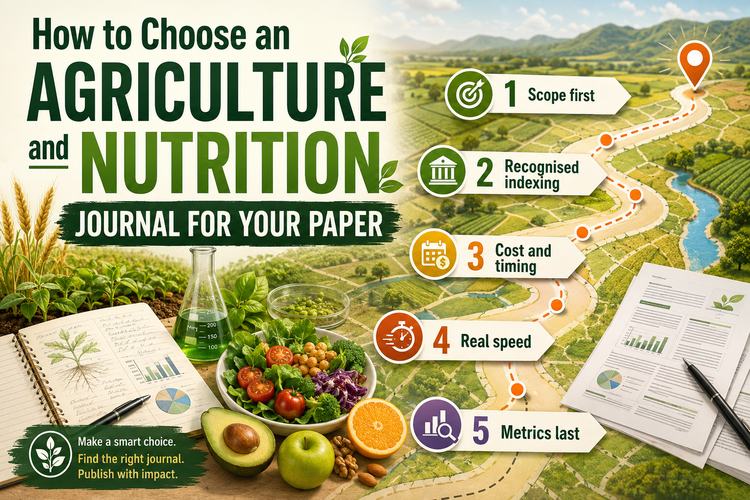
Choose an agriculture and nutrition journal by matching four things in this order: scope, indexing your institution recognises, what it costs and when, and how fast it actually moves. Impact metrics come last, and for most authors they matter far less than whether the journal will still be there in five years with your paper still readable.
A paper is rejected fastest when it is simply in the wrong place. Editors call this a desk rejection and it happens in days, without review.
Read the scope statement, then do something more useful: open the last two issues in the journal's archives and look at the actual papers. A scope statement that says “all aspects of agricultural and food sciences” tells you nothing. Two issues of published titles tell you everything — what methods the editors accept, what sample sizes get through, whether they publish survey work or only controlled trials.
For work that sits between disciplines, ask which half is the contribution. A study measuring iron and zinc in biofortified pearl millet grown under two irrigation regimes is an agriculture and nutrition journal paper. The same grain analysed only for a new spectrophotometric method belongs in an analytical chemistry journal, however agricultural the sample was.
This is where authors waste the most time. Your university, funding body or promotion committee has a list — UGC-CARE, NAAS, Scopus, a departmental whitelist. Get that list first, then filter journals against it. Choosing a journal and then discovering it does not count is the single most expensive mistake in this process.
Every agriculture and nutrition journal claims to be indexed somewhere. Verify the claims yourself rather than trusting the website:
Three checks, about five minutes. A journal that fails any of them does not belong on your shortlist. This journal lists its databases plainly on the indexing page and states outright that it is not in Scopus or Web of Science — that kind of statement is more useful than a long unverifiable list.
Open access journals recover costs from authors rather than readers. The question is not whether there is a charge but when it falls due and what happens if you are rejected.
| Model | What it means for you |
|---|---|
| No submission fee, charge after acceptance | You risk nothing if rejected. Most reputable open access journals work this way. |
| Submission fee, non-refundable | You pay to be considered. Rare and worth questioning. |
| Charge quoted only after acceptance, not published anywhere | Warning sign. A journal that will not publish its rate before you submit has a reason. |
For reference, this agriculture and nutrition journal charges 2,500 INR for Indian authors and 55 USD for international authors, payable only after acceptance, with no submission fee at all. The figures are on the open access policy page rather than sent privately on request.
The board is the clearest signal an agriculture and nutrition journal gives about how it reviews. Open the board page and pick three names at random. Search each one. Do they exist, do they work where the page says, and do they publish in this subject? A board padded with people who have no connection to agriculture or nutrition, or who cannot be found at all, tells you what the review will be worth.
Also check the spread. A board drawn entirely from one institution reviews like one institution. This journal's board covers agronomy, horticulture, soil science, plant protection, food science and human nutrition, with members based in India and abroad — you can see the whole list with affiliations on the editorial board page.
Speed claims are the least reliable thing on an agriculture and nutrition journal website. “Publication within 72 hours” means there was no peer review. Real review takes weeks because reviewers are unpaid academics fitting it around teaching.
What you can check is the process, which a serious journal publishes. Here it is stated openly: an editor screens first, two reviewers do a double-blind review, comments come back to you, and you return the revision within one week. Then a second reviewer round and the subject editor's decision. Knowing the shape of the process is worth more than a promised number of days.
One thing nobody tells first-time authors: the biggest delay is usually the author, not the journal. A revision that sits for a month because everyone is busy adds a month to your own publication date.
Before submitting, find out who will own the paper. Some publishers still ask for a full copyright transfer, which means you need permission to reuse your own figures in your own thesis.
Check three things: do authors keep copyright, what licence is applied, and can you deposit the published version in your institutional repository. Here authors keep the copyright, articles carry a CC BY-NC 4.0 licence, and deposit is allowed under Sherpa/Romeo Green with no embargo. If a journal cannot answer those three questions from its own website, that is an answer in itself.
Any one of these is enough to walk away. You are not being offered a favour; you are being sold a receipt.
Instead of searching for journals, work backwards from your own reference list. Take the ten papers you cite most, note where each was published, and remove the ones outside your institution's approved list. What remains is a shortlist of journals that already publish work like yours, whose editors already know your subject, and whose readers already cite the literature you are building on.
Rank the shortlist by fit rather than prestige, and submit to the best fit first. A well-matched agriculture and nutrition journal that accepts your paper in three months is worth more than a prestigious one that desk-rejects it in three days.
Compare four things side by side: whether each is on your institution's approved list, when the charge falls due, whether authors keep copyright, and how the review process is described. If they tie on all four, choose the one whose recent issues contain papers closest to yours — those editors already understand your subject.
It means a higher score on one Indian rating system, which many universities use when counting publications. It says nothing about whether the journal fits your subject or how carefully it reviews. Use it as a filter if your institution requires a minimum score, not as a measure of quality on its own.
No. Two independent reviewers cannot read, assess and report on a manuscript in a week alongside their own work. A journal advertising that timeline is either skipping review or not doing it properly, and a paper published there carries no weight with any committee that looks closely.
Yes, and a good editorial office answers. A short email asking whether your topic fits the scope, with your title and a two-line summary, can save you a desk rejection. Use the contact page rather than writing to individual board members.
Read the reports, fix what is fixable, and submit elsewhere. Reviewer comments from one journal usually improve a paper for the next. Do not send the same manuscript unchanged to a second journal; the same reviewer may well see it again.
Write to the editorial office as soon as you decide, before review is complete. Withdrawing after acceptance, or after reviewers have spent weeks on the manuscript, is discourteous and some journals record it.
Before you settle on a journal, these three are worth reading together:
Created by Keshav Gupta • 10 Aug 2026
P-ISSN: 2664-6064
E-ISSN: 2664-6072

International Journal of Agriculture and Nutrition