
- Printed Journal
- Indexed Journal
- Refereed Journal
- Peer Reviewed Journal


P-ISSN: 2664-6064
E-ISSN: 2664-6072

Editorial · Research Integrity
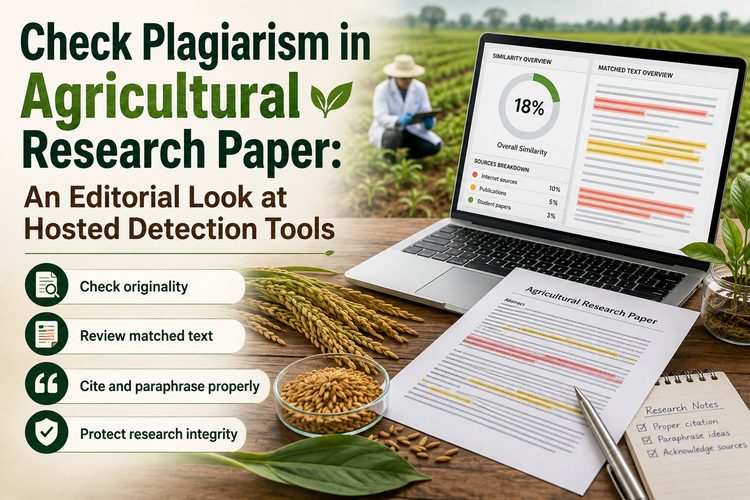
Why originality matters in field studies, food technology, and crop science publishing — and how a hosted plagiarism checker fits into the writing process for the modern agricultural author.
Agricultural and food science research occupies a uniquely practical corner of academia. Findings travel quickly from journal pages to field demonstrations, extension services, policy briefs, and farmer training programmes. Because the work has direct downstream effects on cropping decisions, food safety standards, and rural livelihoods, the credibility of each published paper carries weight that extends well beyond academic reputation alone.
That credibility rests on originality. When a study reports a yield response, a microbial isolation, or a post-harvest treatment, readers assume the data, methods, and conclusions are the author's own work. Plagiarism — whether of text, data, or imagery — undermines that assumption, and once it surfaces, it tends to follow the paper for the rest of its life on indexing databases. The International Journal of Agriculture and Nutrition (IJAN) has responded to this reality by hosting a plagiarism and AI detection tool — Red Paper — directly on its homepage, putting the simplest possible answer to a structural problem at the exact point where authors encounter the problem.
This editorial is written for authors, postgraduate scholars, reviewers, and editorial teams working in the agricultural sciences. It looks at where plagiarism most often appears in this discipline, what a modern tool to check plagiarism is actually doing when it scans an agricultural manuscript, and how researchers can integrate the practice into a normal writing workflow.
Most general advice on plagiarism is written with the humanities and theoretical sciences in mind. Agricultural and food science research is shaped by a different set of constraints, and these constraints create overlap risks that other disciplines do not face in the same way.
The first is the heavy reliance on standardised methodology. Soil sampling protocols, yield calculations, antioxidant assays, proximate composition analyses, and statistical procedures such as RBD or factorial ANOVA are described almost identically across the literature. A researcher who copies a methods paragraph verbatim because the procedure is standard may still trigger a high similarity score, even when the underlying experiment was carried out independently.
The second is the visual nature of the field. Drone imagery, plot photographs, microscopy panels, gel electrophoresis images, and pathology slides are central to many manuscripts. Reusing such images, cropping them, or rotating them across multiple papers is now treated as misconduct by most journals, and image-checking tools are expanding rapidly to flag this kind of reuse.
The third is the multilingual nature of the literature. Important findings in Indian agricultural research often appear first in regional journals, departmental bulletins, or extension publications written in Hindi, Marathi, Tamil, or other languages. Translating these findings into English for a new paper without crediting the original source is a form of plagiarism that text-only checkers have historically struggled to catch — though newer tools handle it better.
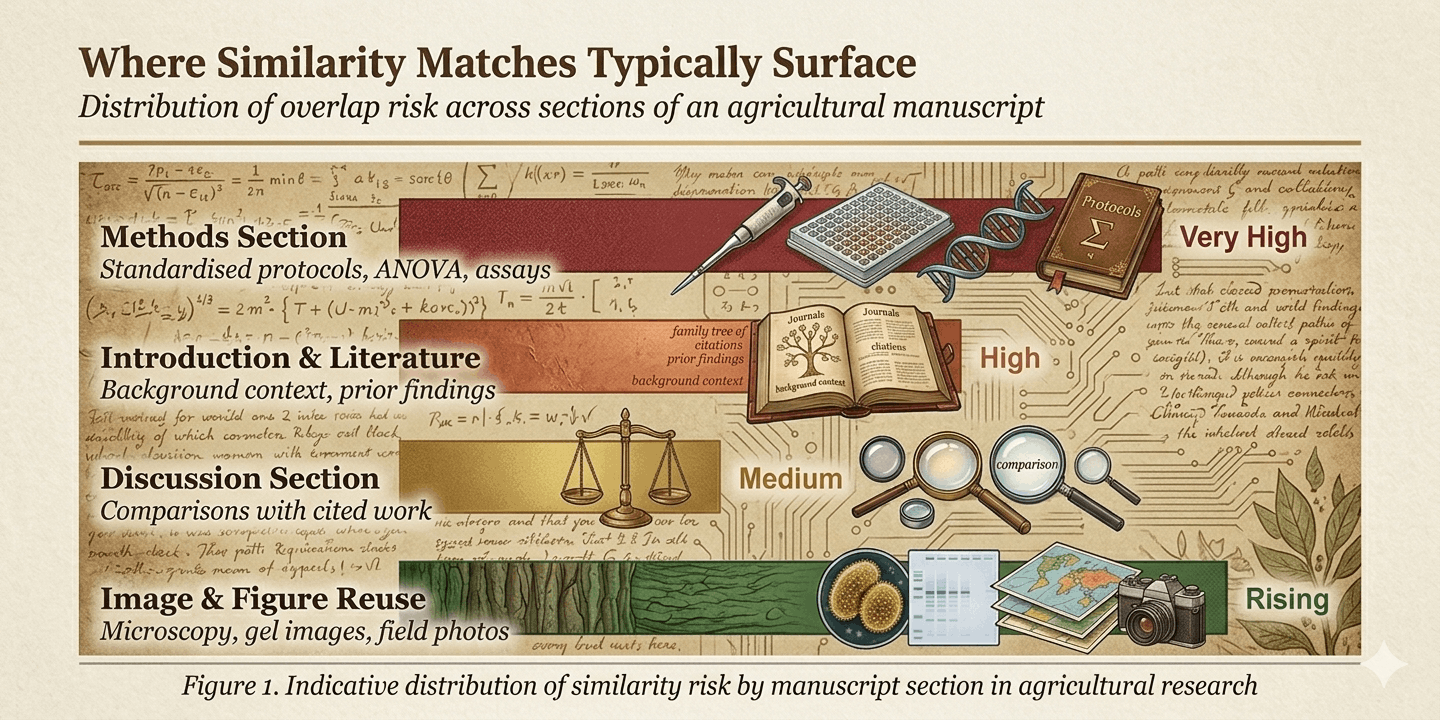
Recognising these patterns is the first step. They are not always intentional — much of the overlap in agricultural papers happens because the writer is genuinely focused on the experiment and treats the surrounding text as routine. The role of a plagiarism checker is partly to surface those routine passages so the author can rewrite them before a reviewer or editor flags them instead.
Plagiarism in agricultural research rarely takes the form of dramatic, paragraph-long copying. It more often shows up in smaller, easier-to-miss patterns that mirror how academic-integrity offices around the world classify offences.
Reusing a methods paragraph from an earlier paper — either someone else's or one's own — without paraphrasing or attribution is the most common single source of similarity hits in agricultural manuscripts. Standard procedures still need to be described in the author's own words, with the original method paper cited.
Introductions and review sections often contain summaries of crop physiology, climate-impact data, or food-safety statistics that closely follow the structure of well-known sources such as FAO reports, ICAR publications, or earlier review papers. Even when a citation is added, structural copying — keeping the same order of arguments and the same key phrases — counts as paraphrasing plagiarism.
It is common in agricultural research for one experiment to produce two or three related papers — for example, a yield study, a quality study, and an economic analysis from the same field trial. Reusing identical introduction, materials, or site-description sections across these papers without disclosure is a form of self-plagiarism that journals increasingly flag.
Charts of yield data, photographs of disease symptoms, and microscopy of microbial cultures may be reused across publications by the same group, sometimes with minor adjustments. Image-checking systems are now advanced enough to identify rotated, cropped, or recoloured versions of the same source figure.
Universities have published detailed guidance on the boundary between acceptable paraphrasing and patchwriting. The Massachusetts Institute of Technology Academic Integrity Handbook remains one of the most accessible Tier-1 references on this distinction, with worked examples that translate directly to agricultural manuscript writing.
The basic mechanism is the same regardless of discipline: the tool compares the submitted text against a reference corpus and reports passages that overlap, along with the likely sources. What varies between checkers is the breadth of that corpus, the sophistication of the matching, and the additional layers of detection that sit alongside the core text comparison.
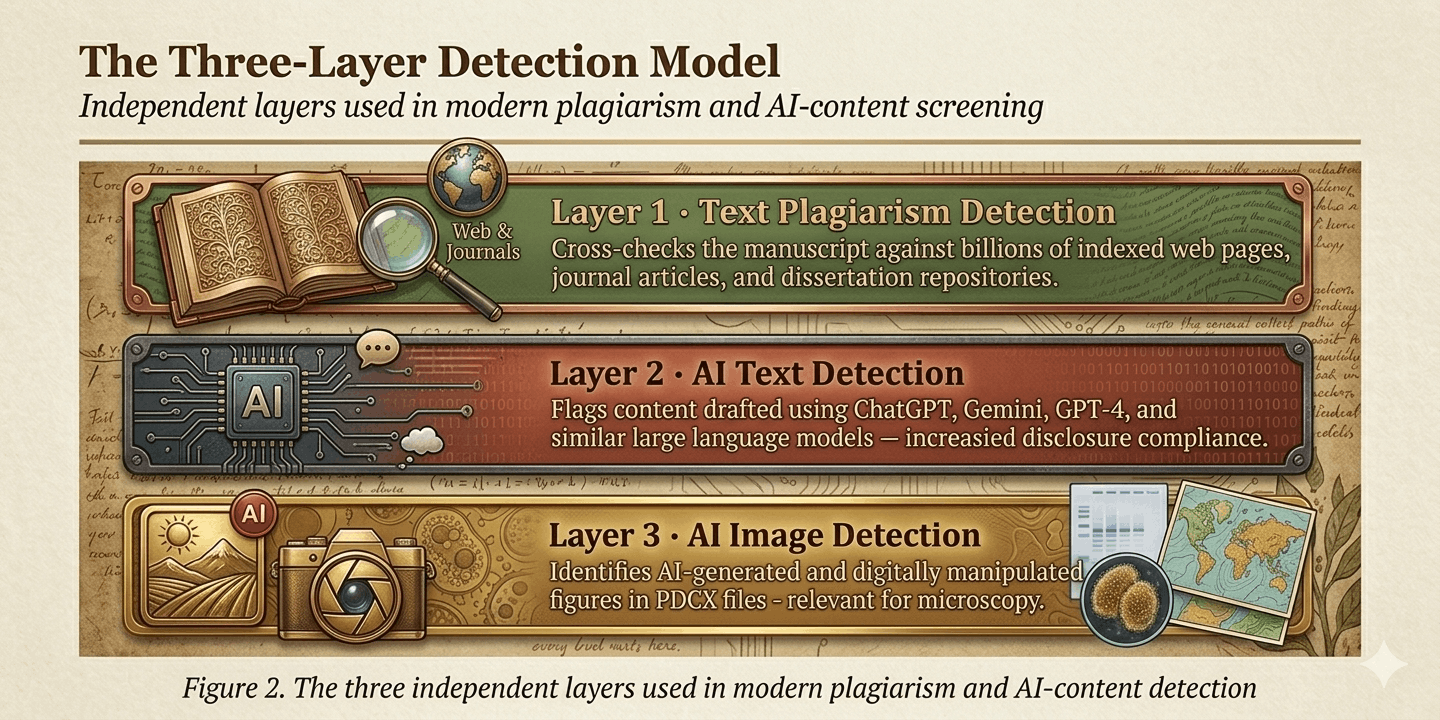
For an agricultural paper, the practical workflow looks like this. The author uploads the manuscript, usually as a DOCX or PDF. The system breaks the text into segments and compares each segment against indexed content — open web pages, journal articles, theses, conference proceedings, and the tool's internal repositories. Modern checkers also compare against agricultural-specific databases such as AGRIS, ICAR institutional repositories, and major publisher archives. The output is a similarity report that highlights matched passages, lists the matching sources with URLs or DOIs, and gives an overall similarity percentage.
Two important points are worth holding on to. First, the similarity percentage is a starting point, not a verdict. A methods section may legitimately match standard procedures; a discussion section drawing on heavily cited prior work may show overlap on widely used phrases. The author still needs to read the report and judge each match on its merits. Second, the checker does not understand the meaning of agricultural terms — it cannot tell whether "leaf area index" in a matched sentence is being used as a stock phrase or as a specific borrowed claim. That judgement remains with the writer.
Most journals expect authors to take care of plagiarism screening on their own, somewhere off-site, and to declare the result on a submission form. The IJAN approach is a quiet shift in that pattern. The Red Paper banner appears on the journal's homepage, in its sidebar, and within its author information panel — meaning a researcher reading the submission guidelines is one click away from running the check itself, on the same domain ecosystem.
For a NAAS-rated journal that publishes across crop physiology, agronomic modelling, plant–soil interactions, post-harvest physiology, plant nutrition, breeding innovations, and storage technologies, the volume and disciplinary spread of submissions is wide. Many submissions arrive from postgraduate scholars working in regional Indian agricultural universities, where institutional access to subscription-based plagiarism tools may be limited. Hosting a checker like Red Paper on the journal site closes that access gap. Authors who would otherwise submit without checking — usually because they had no convenient way to check — now have one.
Red Paper itself runs on the three-layer model described above and adds a citation generator, end-to-end encryption of uploaded documents, and full GDPR compliance — the latter being meaningful for European authors and for Indian institutions handling data subject to cross-border review.
Detection often happens after a paper has already been published — when a reviewer of a related paper notices the overlap, when a reader runs the published text through a checker, or when an automated post-publication audit is conducted by the journal. The consequences, by that stage, are difficult to limit.
A pre-submission plagiarism check costs less, in time and effort, than dealing with a retraction notice that follows a paper across every indexing database it appears on.
Retracted manuscripts remain visible on indexing databases such as Crossref and PubMed, and the retraction notice typically references the reason. For early-career agricultural researchers, this can affect thesis acceptance, promotion decisions, and eligibility for fellowships. For senior researchers, it can affect grant renewals and the credibility of an entire research group's publication record. For institutions, it can affect accreditation reviews, including NAAS evaluations and ranking exercises that take research integrity into account.
The frameworks used internationally to define and adjudicate research misconduct are themselves worth understanding. The U.S. Office of Research Integrity (ORI), operating under the Department of Health and Human Services, treats plagiarism, fabrication, and falsification as three distinct but linked pillars. Its published guidance on research misconduct is the framework most North American funding agencies and many international journals defer to. For an Indian agricultural researcher, reading the ORI material before running a similarity scan on a draft makes both steps more meaningful.
In India, the regulatory framework for plagiarism in agricultural research has tightened steadily over the past several years. The University Grants Commission's regulations on academic integrity classify plagiarism by similarity percentage and link it to specific consequences for theses and dissertations. The Indian Council of Agricultural Research and the Indian Council of Medical Research have issued guidelines that align with international standards on authorship and originality. NAAS, in its journal rating exercise, evaluates editorial practices including plagiarism screening.
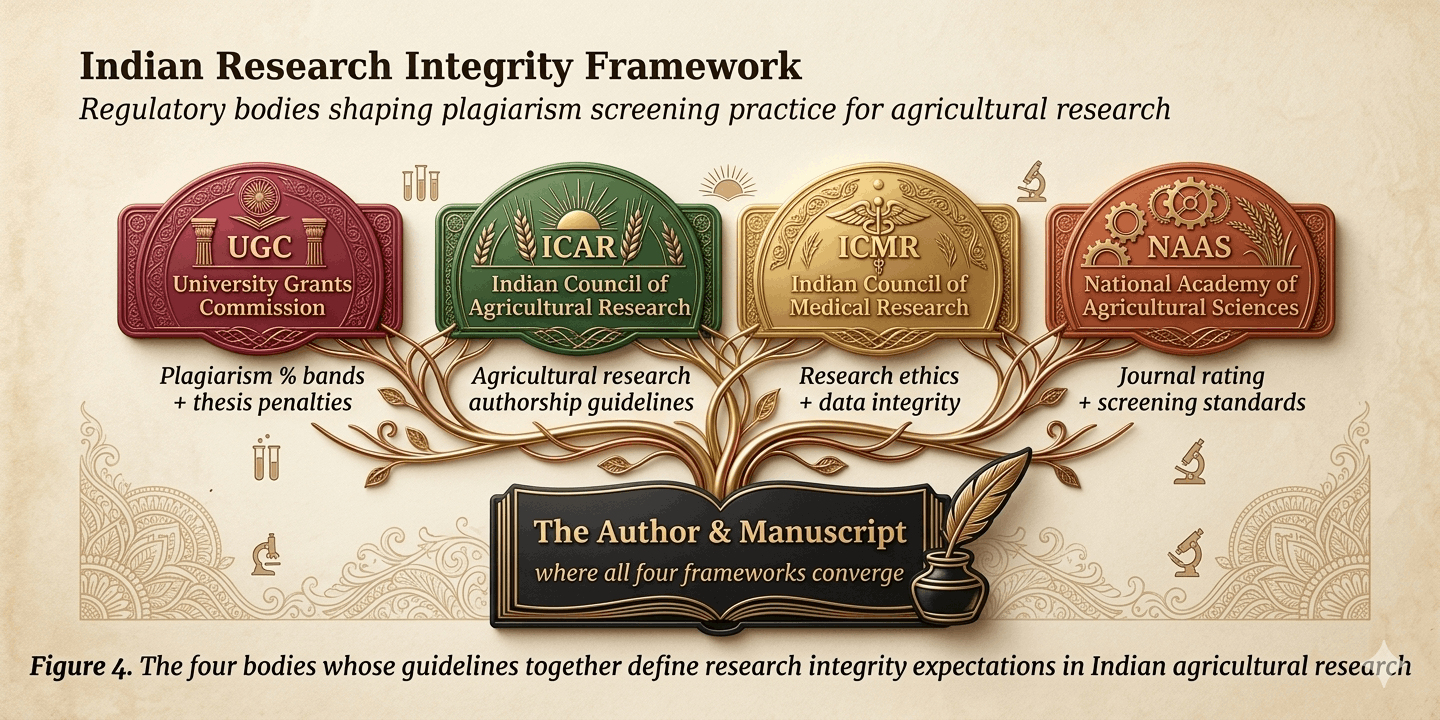
In practical terms, this means that a plagiarism report is now an expected accompaniment to most agricultural manuscript submissions. NAAS-recognised journals routinely ask authors to declare that their work has been checked, and many run an additional check at the editorial stage. For postgraduate scholars, university-level plagiarism screening is often a mandatory step before thesis acceptance. This regulatory environment has made routine pre-submission checking a normal part of postgraduate training in agricultural universities, and Indian-developed tools alongside long-established international platforms have made the practice more affordable for individual researchers and smaller departments — a meaningful change for the broader research community.
The decision to check plagiarism is most useful when it is treated as part of the writing process rather than as a final hurdle. A few habits make it more effective for agricultural researchers in particular.
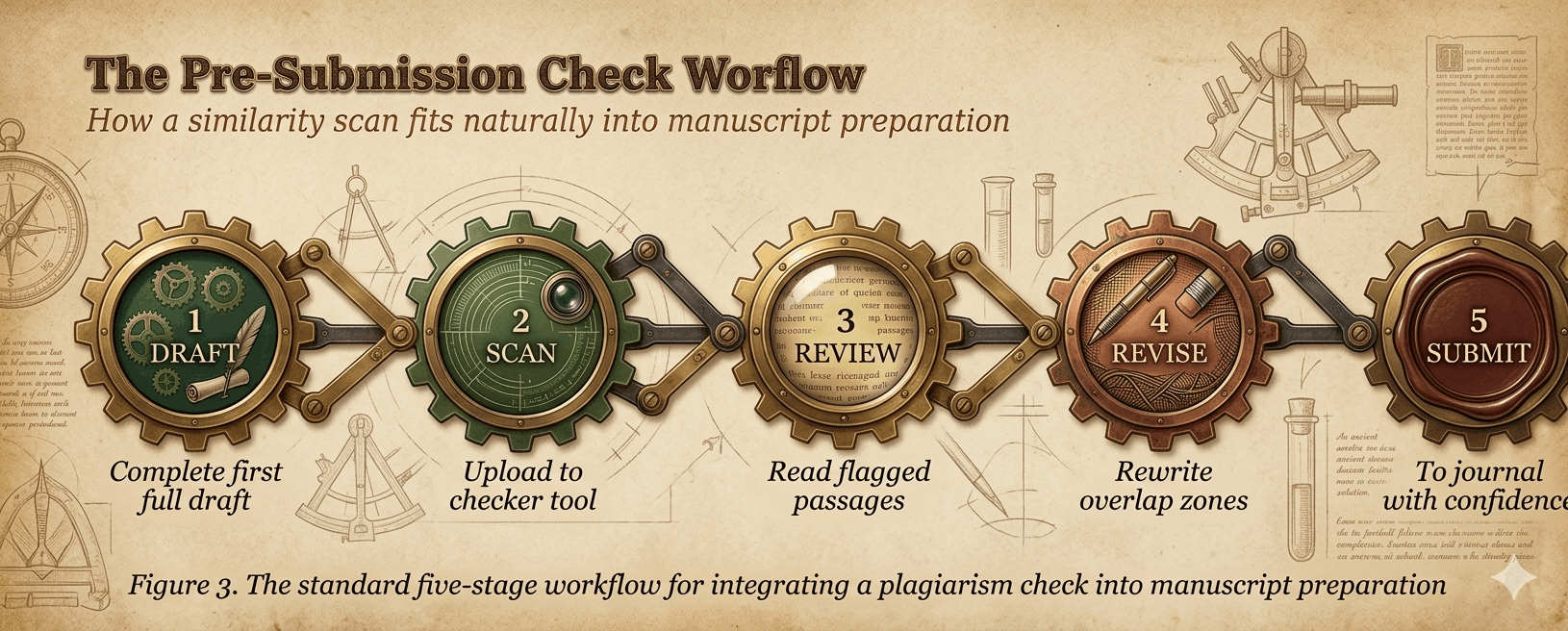
Run an early check after the first complete draft, not only before submission. Catching an over-copied methods section or an overly close introduction at this stage gives the author time to rewrite calmly. Pay closer attention to the highlighted passages than to the overall percentage. A 14% score driven by correctly cited quotations and standard procedures may be entirely acceptable, while a 6% score concentrated in the discussion section may need substantial rewriting. Treat AI-detection output with the same care; technical agricultural writing often shares structural patterns with AI-generated text simply because both rely on standardised phrasing.
For collaborative work — common in agricultural research, where field trials typically involve multiple co-authors across departments — agreeing on a plagiarism check at a defined stage helps ensure that no one introduces uncited material at the last minute. A short note in the corresponding author's checklist is usually enough.
Finally, the most reliable safeguard is the habit of citing as you write. Retroactive citation, attempted at the end of a long writing session, is where most unintentional plagiarism originates. Recording every source at the moment a sentence is drafted, even informally, almost eliminates that risk.
Plagiarism awareness in agricultural research has matured from being a compliance exercise to being a normal part of the writing craft. The reasons are practical rather than ideological — the volume of literature has grown, the tools available to readers and reviewers have grown with it, and the cost of a missed overlap has grown too. A plagiarism checker, used early and read carefully, is the simplest response to these shifts.
For an agricultural or food science researcher, the working takeaway is straightforward. Treat the checker as a draft-stage aid. Read the report rather than reacting to the score. Pay attention to methods and introduction sections, where most legitimate overlap risk sits. And cite as you write, so that the report mainly confirms what you already know about your manuscript: that the work is yours, the sources are credited, and the paper is ready for the journal that will eventually carry it into the wider research community.
Editorial Note
This article is part of an ongoing editorial series on research integrity practices in agricultural and nutritional sciences. It is intended as a general guide for authors, reviewers, and editors and does not constitute paid promotion of any specific tool or service.
Published 01 May 2026 · International Journal of Agriculture and Nutrition Editorial Desk
Related reading on getting a manuscript through screening and review:
Created by Dr. David Cruz • 01 May 2026
P-ISSN: 2664-6064
E-ISSN: 2664-6072

International Journal of Agriculture and Nutrition