
- Printed Journal
- Indexed Journal
- Refereed Journal
- Peer Reviewed Journal


P-ISSN: 2664-6064
E-ISSN: 2664-6072

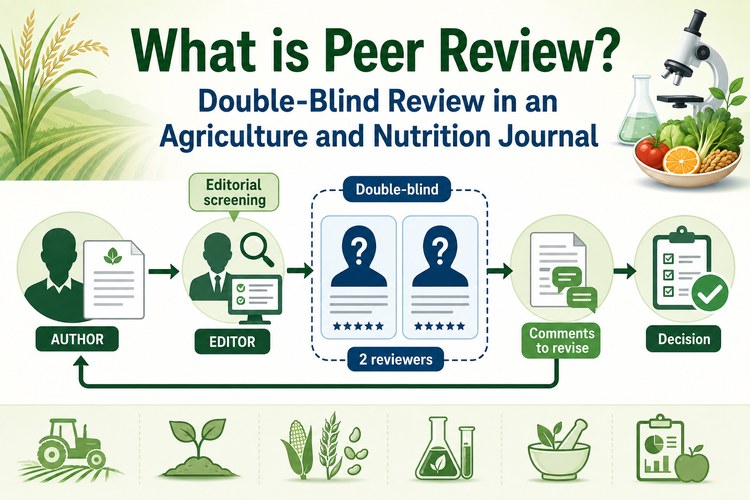
Peer review is the process where independent researchers in your field read your manuscript and advise the editor whether it should be published, and what must change first. In an agriculture and nutrition journal it is usually double-blind: you do not know who reviewed you, and they do not know who wrote it. This guide explains what happens at each stage and what reviewers in this field actually check.
Not every nutrition journal uses the same system, and the one in force decides what you can and cannot know about your own review.
| Type | Author knows reviewer | Reviewer knows author |
|---|---|---|
| Single-blind | No | Yes |
| Double-blind | No | No |
| Open | Yes | Yes |
| Post-publication | Yes, afterwards | Yes |
Double-blind peer review is the norm in agricultural and nutritional sciences, and it is what this agriculture and nutrition journal uses. Identifying information is stripped from the manuscript before it goes out, and reviewer comments are made anonymous before they reach you.
The point is not secrecy. It is that a reviewer who does not know whether a paper comes from a national institute or a district college judges the work rather than the letterhead. It is imperfect — a specialist can often guess the group from the study site — but it removes the easiest form of bias.
A reviewer for an agriculture and nutrition journal is reading for four things, roughly in this order.
Peer review starts with the methods, not the findings. A reviewer reads your methods before your findings, because a result from a flawed design cannot be rescued by analysis. For a field trial they look for replication, randomisation, plot size and season. For a dietary study they look at the sampling frame, how the sample size was arrived at, and whether the recall method suits the population.
Nutrient values in particular. If you report iron intake per capita, the reviewer wants to know which food composition table produced those values and from which year, because the same food can differ by a third between tables. Analytical results need the method and its reference, not just the instrument name.
This is the most common substantive comment. A study on 60 households in one block cannot conclude anything about a district. A yield response measured in one season cannot be described as stable. Reviewers do not usually object to the finding; they object to the size of the claim built on it.
A reference list of twelve papers, eight of them over fifteen years old and none from the last three years, tells a reviewer the author has not read the recent work. In fast-moving areas such as biofortification or gut microbiome research this alone can trigger a major revision.
Peer review reports from a genuine nutrition journal are specific and often blunt. A typical major-revision comment:
“Section 2.3: the analytical method for zinc is not stated. Give the method and its reference, and report the recovery percentage from the certified reference material. Table 2: means are given without standard deviation and without the number of replicates. Figure 1 duplicates Table 3; keep one.”
If the response you receive contains nothing you have to act on, the manuscript was not reviewed. That is the clearest practical difference between a genuine agriculture and nutrition journal and one that only appears to be.
A response document that a reviewer can check line by line in ten minutes gets a faster second round than one that says “all comments have been incorporated”.
The same reviewer comment, answered two ways. Reviewer: “The protein values in Table 2 are not comparable with those cited from Rao et al. Explain.”
Weak response:
“The values are correct. Different studies report different values. This has been clarified in the revised manuscript.”
Response that ends the discussion:
“Rao et al. report protein on a dry-weight basis; ours are fresh-weight. Recalculated to dry weight our mean is 11.8 g/100 g against their 12.1 g/100 g. We have added the basis to the Table 2 heading and a sentence in Section 3.2 (lines 178–181) giving both figures.”
The second answer takes ten minutes longer to write and removes the comment entirely. The first invites the reviewer to ask again, which costs another full round — usually two to three weeks.
Peer review is unpaid work. They are academics fitting your manuscript around teaching, their own research and administration. Two of them have to agree to read it, then find several uninterrupted hours.
So when a journal promises a decision in 72 hours, the arithmetic does not work. Nothing in the list above can be compressed into three days except by removing it. The one part of the timeline you control is your own revision — and that is where most of the delay in a real journal comes from.
It is worth being honest about the limits of peer review. Peer review does not verify your raw data, repeat your experiment, or guarantee the finding is correct. Reviewers see what you wrote, not what you did.
Peer review at any nutrition journal catches unclear methods, unsupported conclusions, missing controls and misused statistics. It does not reliably catch fabricated data or a subtle error in a spreadsheet. Treating a published paper as proven rather than reviewed is a mistake readers make more often than authors.
Both sides are anonymous. Identifying information is stripped from the manuscript before it goes to reviewers, and the reviewers' names are never disclosed to the author. Comments are made anonymous before the editor passes them on. The aim is that the work is judged on its content rather than its institution.
Two, at this journal. The subject editor decides between them if the reports disagree, and can ask for a third opinion in difficult cases. Split recommendations are common and are not the same as a rejection.
Many journals allow both. If you suggest names, choose researchers who work on the same problem but have no connection to you — not co-authors, supervisors or colleagues from your own department. If you ask to exclude someone, give a brief professional reason.
Accept means publishable as it stands, which is rare on a first submission. Minor revision means the science is sound and the changes are presentational or small. Major revision means something substantive must change — usually analysis, missing method detail, or the size of the conclusions — and the paper will be reviewed again.
No. It is an invitation to fix specific problems, and most papers that reach major revision are eventually published. A rejection says the work does not fit or cannot be repaired within this submission; a major revision says the opposite.
Write to the editorial office before the deadline rather than after. A short message explaining the delay is almost always accommodated. Silence for weeks is what causes a submission to be treated as withdrawn.
What happens either side of review:
Created by Nikhil Gupta • 10 Aug 2026
P-ISSN: 2664-6064
E-ISSN: 2664-6072

International Journal of Agriculture and Nutrition