
- Printed Journal
- Indexed Journal
- Refereed Journal
- Peer Reviewed Journal


P-ISSN: 2664-6064
E-ISSN: 2664-6072

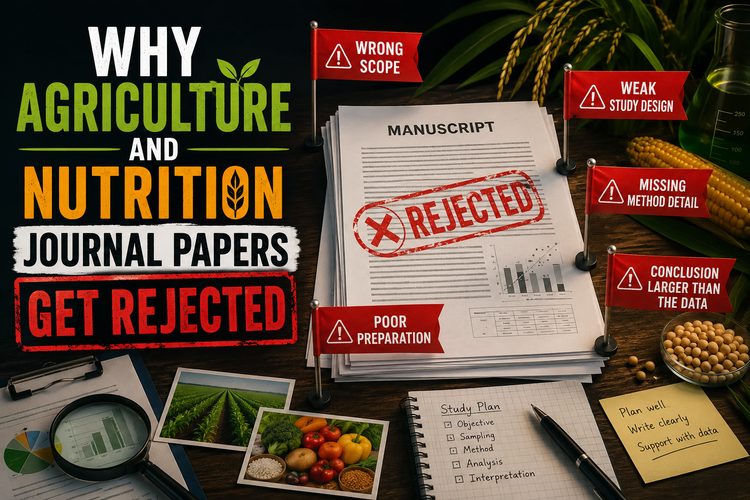
Most papers rejected by an agriculture and nutrition journal are not rejected for bad science. They are rejected for wrong scope, a design that cannot support the claim, missing method detail, or a conclusion larger than the data. All four are visible to the author before submission, which is why rejection says more about preparation than about ability.
The commonest desk rejection. A paper on the tensile strength of a harvesting blade is agricultural engineering; it is not an agriculture and nutrition journal paper however agricultural the machine. Read two recent issues before you decide, not the scope statement.
A 22-page manuscript when the limit is 15. Double spacing when single is asked. A PDF when Word is required. Figures pasted at screen resolution. None of this touches your science and all of it sends the file back on day one.
Three files are required: cover letter, signed authorship responsibility form, complete manuscript. Two arrive and the submission waits until someone notices.
Every submission is screened with Red Paper Plagiarism and AI Detector. Standard method descriptions and correctly attributed quotations are disregarded, so a report is not a percentage race — but unattributed text, including your own earlier published wording, ends the submission there.
Once a paper reaches review, design is what reviewers examine first. Four failures recur across agriculture and nutrition journal submissions.
Three plots of the same treatment in one field, sampled three times, is one plot measured three times. Pseudo-replication is the single most common statistical objection in field trial papers, and it cannot be fixed after the season is over.
A dietary survey of 45 respondents may be perfectly publishable — if you say how 45 was arrived at and confine the conclusions to what 45 can support. A survey of 45 that draws district-level conclusions will be rejected, and rightly.
A fertiliser trial without an unfertilised control cannot show a response. A feeding study whose control group differs in age, sex ratio and baseline status is not a control group.
Single-season data is publishable when described as single-season. It becomes a rejection when the abstract says the treatment “improves yield” with no qualification. Weather does not repeat itself.
These are the comments that fill a review report. Individually each looks minor; together they are why an agriculture and nutrition journal returns a paper for major revision rather than accepting it.
| What reviewers see | Why it is fatal |
|---|---|
| Means without SD, SE or n | The reader cannot judge the variation, so the number means nothing |
| Nutrient values with no food composition table named | The same food differs by a third between tables; the value is unverifiable |
| Analytical result with instrument but no method | A zinc figure without the method and its reference cannot be compared with anything |
| p-values with no test named | Nobody can tell whether the test was appropriate |
| A figure that repeats a table | Wastes space and suggests the author is padding |
| Reference list assembled alphabetically | This journal uses Vancouver, numbered in citation order |
This is the objection authors argue with most and should argue with least. Reviewers rarely dispute the result; they dispute the size of the claim.
Rejected:
“Supplementation with the fortified flour significantly improved the nutritional status of rural school children.”
Publishable, same data:
“Over 90 days, mean haemoglobin rose from 10.6 to 11.4 g/dL (p < 0.05) in 78 children aged 7–11 in two schools in one block. Effects on other indicators were not measured, and the sample is not representative of the district.”
The second version is the more impressive claim, because it can be defended. Naming your own limitation reads as competence, not weakness — reviewers respond to it far better than authors expect.
A split-plot trial analysed as a completely randomised design gives the wrong error term and inflated significance. Reviewers who run field trials themselves spot this in one look at the ANOVA table. State the design, then state the model you fitted to it.
Twelve t-tests between treatment pairs will produce a “significant” result by chance alone. Use an appropriate post-hoc test after a significant ANOVA and name it, rather than testing every pair and reporting the ones that worked.
A yield difference of 0.06 t ha⁻¹ can be statistically significant with enough replication and agronomically meaningless to the farmer. Report the effect size alongside the p-value and say plainly whether the difference matters in practice. Papers that confuse the two are asked to rewrite the discussion.
None of these three require a statistician to avoid. They require writing down the design before the analysis, and describing both in the methods.
“Rejected for poor English” is often a polite summary of something else, and it is worth reading an agriculture and nutrition journal decision letter carefully to see which it is. Genuinely unreadable text is rejected, but most language comments are about precision rather than grammar: “significant” used to mean “large”, “dose” and “concentration” used interchangeably, or tenses that make it unclear what you did and what somebody else did.
Practical fix: write results in the past tense, keep one term per concept throughout the paper, and have a colleague outside your group read the methods and tell you what they think you did.
A rejection from one agriculture and nutrition journal is not a verdict on the work. Scope mismatch means wrong address. A major-revision request you cannot complete in time is not a rejection at all.
What matters is what you do with the reports. Reviewer comments from a rejecting journal are free expert review, and the next submission is almost always stronger. What you must not do is send the identical manuscript to a second journal without changing anything — the pool of reviewers in a specialised field is small, and the same person may well open it again.
Ten questions, most answerable in an afternoon. They will not make a weak study strong, but they remove almost every avoidable rejection an agriculture and nutrition journal issues.
Scope mismatch, and it happens before review. The paper is sent to a journal whose recent issues contain nothing similar, and a subject editor returns it in days. Reading two recent issues before choosing prevents most of these.
You can write to the editorial office setting out a specific factual error in a review. An appeal that simply disagrees with the assessment rarely succeeds. If the rejection was on scope, an appeal is not the right route — another journal is.
No. A rejected paper is a rejected paper, not a mark against the author. A different manuscript is assessed on its own merits, and editors do not keep a list.
You do not have to, and most authors do not. What you must not do is submit the same version unchanged. Use the reports, revise properly, and describe the paper honestly in the new cover letter.
The number does not decide it; the type does. Twenty comments about clarity, tables and missing method detail is a major revision. Two comments saying the design cannot answer the question is a rejection, because no amount of rewriting fixes a missing control.
Usually yes, provided the underlying problem really was expression. Get someone outside your group to read the methods first. If they cannot tell you what you did from what you wrote, editing has not finished.
How to remove the avoidable rejections before you submit:
Created by Rahul Jha • 10 Aug 2026
P-ISSN: 2664-6064
E-ISSN: 2664-6072

International Journal of Agriculture and Nutrition