
- Printed Journal
- Indexed Journal
- Refereed Journal
- Peer Reviewed Journal


P-ISSN: 2664-6064
E-ISSN: 2664-6072

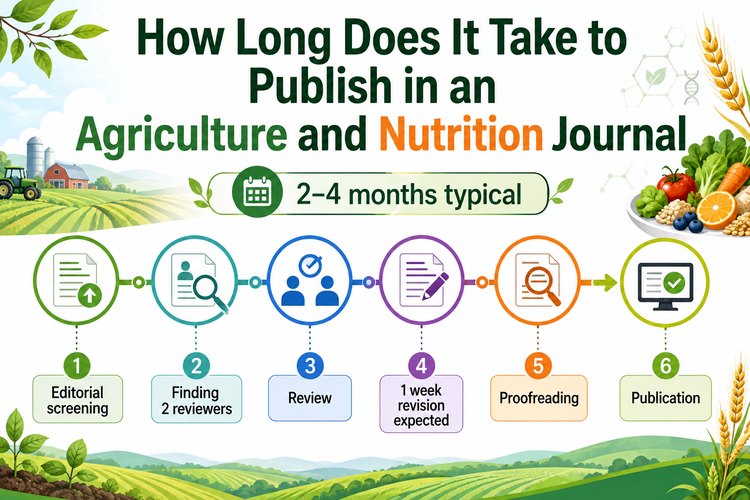
Publishing in an agriculture and nutrition journal usually takes two to four months from submission to online publication, and the biggest single variable is not the journal — it is how fast you return your revision. No honest journal can promise a fixed number of days, because two unpaid reviewers and one author are involved. What a journal can publish is the process, and that is what you should judge it on.
| Stage | Who is working | Typical time |
|---|---|---|
| Editorial screening | Subject editor | Days |
| Finding two reviewers | Editorial office | Often the slowest step |
| Review | Two reviewers | Weeks |
| Your revision | You | One week is expected here |
| Second review round | Same reviewers | Shorter than the first |
| Decision | Subject editor | Days |
| Proofreading | You | Days |
| Publication | Journal | With the next issue |
Notice that two of the eight rows are you. In practice authors account for a large share of the elapsed time, and it is the part nobody plans for.
An agriculture and nutrition journal editor needs two people who work on your specific problem, have no conflict of interest with you, and are willing. For a paper on zinc biofortification in pearl millet under rainfed conditions, that may be a pool of a few dozen people worldwide. Several will be on fieldwork, several will decline, and each invitation-and-decline cycle costs days.
This is invisible to the author, which is why the wait after submission feels unexplained. Nothing is wrong; the office is working through a list.
When reviewer comments arrive, this agriculture and nutrition journal expects the revised manuscript back within one week. That is the published expectation, not a suggestion.
Authors routinely take a month. The reason is predictable: the comments arrive, the corresponding author forwards them to three co-authors, two are travelling, one disagrees with a statistical point, and nobody owns the deadline. Meanwhile the reviewers who agreed to look at the revision move on to other work, and re-recruiting them costs more time.
Two things prevent this. Before you submit, agree with your co-authors who will own the revision and roughly when. And when the comments arrive, read them the same day — even if you cannot start — so you know whether they need a week or an afternoon.
Take the same paper with a four-week revision and two rounds of unclear responses, and week 11 becomes week 20. Same journal, same reviewers, same science.
Three delays account for most of the time authors lose, and none of them are the review itself.
A manuscript that is 22 pages, or double-spaced, or arrives as a PDF, goes back before it reaches an editor. That is a week gone for something that takes twenty minutes to fix beforehand.
Two files arrive, the authorship responsibility form does not. The submission sits until someone in the office notices and writes to ask. Send all three together and this never happens.
Comments are sent, nothing comes back, a reminder is sent. This is far more common than it should be, usually because the address given belongs to a departmental account rather than a person. Give an address you check, and tell the office if it changes.
None of these three involve reviewers, editors or the journal being slow. All three are avoidable in the hour before you press submit.
Emailing an agriculture and nutrition journal weekly for a status update does not move a manuscript up the queue, and it consumes the time of the person who would otherwise be chasing your reviewers. Ask once after a reasonable period, quoting the article title and corresponding author's name.
Paying more does not make it faster either. The article handling charge falls due after acceptance and covers formatting, publication and site maintenance — there is no expedited option to buy, and a journal that offers one for a fee is selling you a place in a queue that should not exist.
Two situations are worth a polite enquiry. If you have heard nothing at all for several months with no status change, ask. If the paper was accepted and has not appeared in an issue after a long gap, ask — and quote the acceptance date.
The reverse is also worth noticing. If an agriculture and nutrition journal accepts your paper in three days without a single reviewer comment, that is not efficiency. Nobody read it.
An agriculture and nutrition journal publishes online and in print on different dates. Articles appear online with a DOI when the issue is published, and the print copy follows by post. If you need the citation for a submission deadline, the online version with its DOI is what you quote: journal name, volume, issue, year, pages and the DOI under prefix 10.33545/26646064. Waiting for the printed copy to arrive before listing the paper is a mistake students make often.
One more thing worth planning for: if the paper is rejected after review, the clock restarts at another agriculture and nutrition journal. Build that possibility into a thesis timeline rather than assuming the first submission will be accepted. Reviewer reports from the first journal usually make the second submission stronger and faster.
Typically two to four months from submission to online publication, assuming one revision round and a prompt author. The editorial stages are broadly fixed; the variable parts are how quickly two reviewers can be recruited and how quickly you return your revision.
Most often the office is still recruiting reviewers. Finding two researchers who work on your exact problem, have no conflict of interest and are free to read a manuscript can take several weeks of invitations and declines. It is normal and it is invisible from the author's side.
You can explain the deadline in your cover letter, and a considerate office will bear it in mind, but it cannot compel unpaid reviewers to read faster. Plan backwards from the deadline instead: a paper needed in April should be submitted by December, not February.
No. The charge falls due after acceptance and pays for formatting, publication and website maintenance. There is no expedited track to buy, and any journal that sells one is charging for something that should not exist.
Format correctly before submitting, send all three files together, choose a journal whose scope genuinely matches so you are not desk-rejected, and return the revision inside the one-week window with every comment answered. Authors who do those four things routinely publish in half the time of those who do not.
No. Two independent reviewers cannot read, assess and report on a manuscript in that time alongside their own work. A one-week turnaround means the review step has been removed, and a paper published there carries little weight with any committee that looks closely.
The stages that decide the timeline:
Created by Gopal Singh • 10 Aug 2026
P-ISSN: 2664-6064
E-ISSN: 2664-6072

International Journal of Agriculture and Nutrition