
- Printed Journal
- Indexed Journal
- Refereed Journal
- Peer Reviewed Journal


P-ISSN: 2664-6064
E-ISSN: 2664-6072

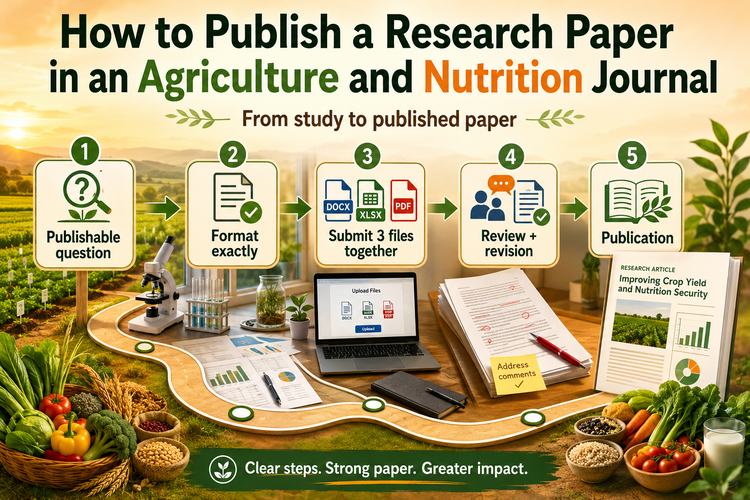
To publish a research paper in an agriculture and nutrition journal you need four things: a study that answers a question nobody has answered in that form, a manuscript formatted exactly as the journal asks, three files submitted together, and the patience to handle two rounds of reviewer comments. Everything else is detail. This guide walks through that detail using the actual requirements of the International Journal of Agriculture and Nutrition (P-ISSN 2664-6064, E-ISSN 2664-6072), so the numbers below are real rather than generic.
Most rejections happen before review even starts, and they happen for reasons the author could have spotted. Ask three questions honestly.
Does it answer something? A fertiliser trial that reports yield at three nitrogen levels is data. A trial that shows yield plateaus above 120 kg N ha⁻¹ while nitrate leaching keeps climbing is a finding. Data gets rejected; findings get published.
Is the design defensible? A dietary intake survey with 40 respondents from one village cannot support a claim about a district. A field trial without replication cannot support a claim about a treatment. Reviewers at an agriculture and nutrition journal look at design first and results second.
Has it been done already? Search the exact treatment and the exact crop or food group before you write. If three papers have reported the same thing from the same agro-climatic zone, you need a different angle — a different season, a different population group, or a mechanism nobody has measured.
Scope is the first filter, not impact. A paper on the protein and mineral profile of a fermented millet product belongs in an agriculture and nutrition journal; the same laboratory work framed purely as microbiology does not. Read the scope statement on the journal's about page and check the last two issues in the archives — if nothing there resembles your subject, the editor will desk-reject it however good the work is.
Then check the practical points: is the journal indexed where your institution counts publications, does it have an ISSN and a DOI on every article, and what does it charge? The indexing page of this journal lists Google Scholar, Crossref, Science Gate, ResearchGate, Academia.edu and SciSpace, and states plainly that it is not in Scopus or Web of Science. That kind of plain statement is worth more than a long list you cannot verify.
Formatting is the cheapest thing to get right and the most common reason a submission bounces back on day one. For this agriculture and nutrition journal the requirements are specific:
| Requirement | Value |
|---|---|
| File format | MS Word (.doc / .docx) |
| Font | Times New Roman, size 12 |
| Spacing | Single line |
| Layout | One column |
| Margins | One inch (2.5 cm) on all four sides |
| Length | Not more than 15 pages |
| Abstract | Not more than 300 words |
| Keywords | 3 to 6 |
| References | Vancouver style |
Two rules inside the abstract catch people out. No abbreviations, and no taxonomic authorities — write Vigna radiata, not Vigna radiata (L.) R. Wilczek. References do not belong in the abstract either.
Sample files for all three can be downloaded from the instructions to authors page. Submit through the online form or by email to the managing editor; either route is accepted, but send all three files at once. A submission with a missing authorship form sits in the office queue until someone chases it.
Most agriculture and nutrition journals handle a new submission the same way, and this one is no exception. The file goes to a subject editor first. If it fits the scope and clears a minimum quality level, it goes out to two reviewers for double-blind review — your name is stripped from the document, and the reviewers' names never reach you. Their comments come back through the editor, anonymised.
Then comes the part authors underestimate: you are expected to return the revised manuscript within one week. That is a working week, not a month. Block the time before you submit, not after the email arrives. The revision goes back to the same reviewers, and the subject editor takes the final decision using both rounds of reports.
Accepted papers come back once more in ready-to-print format for proofreading. This is the last chance to fix anything. Once the article is published no changes are made, and any mistake that survives proofreading stays in the record with your name on it.
Charges differ widely between one agriculture and nutrition journal and the next, and the useful question is not how much but when. There is no submission fee here. An article handling and processing charge becomes payable only after peer review is complete and the paper has been accepted:
If the manuscript is rejected, nothing is payable. The charge covers manuscript formatting, the publication process and website maintenance, because the journal receives no governmental or non-governmental funding. Full detail is on the open access policy page.
Every submission is screened for textual similarity using Red Paper Plagiarism and AI Detector. There is no magic percentage that triggers rejection — standard method descriptions, instrument names, correctly attributed quotations and the reference list are all disregarded when the report is read. What gets a paper rejected is unattributed text, and that includes reusing your own earlier published wording without citing it.
Authors found responsible for plagiarism are debarred from submitting for six months, and longer in repeated cases. Run your own check before submitting; it costs an hour and saves a rejection.
This is where nutrition papers are won or lost. State the sampling frame, the sample size and how it was arrived at, the analytical method with its reference, and the software used. If you measured haemoglobin, say by which method. If you calculated nutrient intake, name the food composition table you used and its year. A reviewer cannot accept a nutrient figure without knowing which table produced it.
Past tense, no references, no interpretation. Give numbers with their variation and their test:
Mean grain yield rose from 3.42 to 4.18 t ha⁻¹ (22.2%) at 120 kg N ha⁻¹ (p < 0.01), with no further gain at 150 kg N ha⁻¹.
Compare that with “yield increased significantly with nitrogen application”, which tells a reader nothing they can use or check.
Explain what the result means and where it agrees or disagrees with earlier work. Say what the study cannot show. A discussion that admits a limitation reads as competent; one that claims the study proves more than it can reads as inexperienced, and reviewers say so.
Figures go in as JPG or JPEG inside the Word file, at 75 mm or 155 mm width and 300 dpi. Anything screenshotted from a spreadsheet at screen resolution will look blurred in print, and the editorial office will ask for it again. Tables are placed after the references, use horizontal lines only, and are numbered in the order they are cited.
References follow Vancouver: numbered in citation order, not alphabetically. The commonest error is a reference list assembled alphabetically from a reference manager set to APA. Change the style before you export, then read the list once by hand.
An agriculture and nutrition journal that registers DOIs gives your work a permanent address, and this one does. Your article gets a Crossref DOI under the prefix 10.33545/26646064 and appears in the archives immediately, free to read. You keep the copyright; the journal does not ask for a transfer. Under the CC BY-NC 4.0 licence you can deposit the published version in your institutional repository with no embargo, reuse it in your thesis, and put it on a departmental page — see the content licensing policy for what commercial reuse needs.
A publication certificate is posted separately. For a viva or a promotion file, quote the full citation with the DOI rather than the certificate — that is what a committee can verify independently.
It depends mostly on you. The editorial stages are fixed — initial editor read, two reviewers, one revision round, proofreading — but the one-week revision window is where authors lose the most time. A manuscript that is well formatted and revised promptly moves through far faster than one that needs three reminders.
Check three things yourself: search the exact journal title in Google Scholar and see whether recent full-text articles come up, look up the ISSN at portal.issn.org and confirm the title and publisher match, and paste any DOI into doi.org to see whether it resolves to the article page. A journal that cannot pass those three checks should not be on your list, whatever its website claims.
No. The cover letter you sign states the work is not under consideration elsewhere. Simultaneous submission is a breach of publication ethics and, if discovered after publication, leads to retraction.
No. There is no submission fee. The article handling and processing charge of 2,500 INR for Indian authors or 55 USD for international authors becomes payable only after the paper has been accepted, and nothing is payable if it is rejected.
A review article should not be more than 4,500 words. Short communications are for concise new findings and preliminary results. Case reports should be unique and describe a real diagnostic or practical challenge. Formatting rules are the same for all of them.
You do. Authors keep the copyright in their own work and the journal does not ask for a transfer. The CC BY-NC 4.0 licence gives readers permission to reuse the article non-commercially with credit; it does not move ownership to the publisher.
The subject editor decides, using both reports and the revised manuscript. Split reviews are common and are not a rejection. Address every comment from both reviewers in your response, including the ones you disagree with, and say why you disagree rather than ignoring them.
If you are working through a first submission, these cover the next decisions:
Created by Akhil Gupta • 10 Aug 2026
P-ISSN: 2664-6064
E-ISSN: 2664-6072

International Journal of Agriculture and Nutrition