
- Printed Journal
- Indexed Journal
- Refereed Journal
- Peer Reviewed Journal


P-ISSN: 2664-6064
E-ISSN: 2664-6072

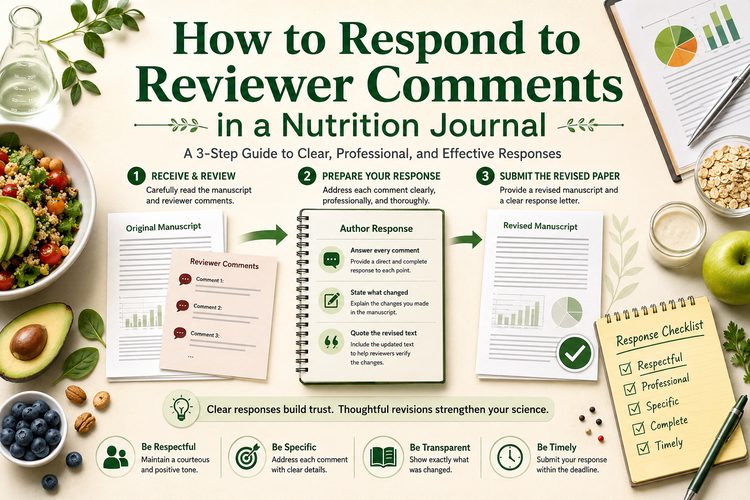
Answer every comment, quote it, say what you changed and where, and give a reason with evidence when you disagree. At this nutrition journal the revised manuscript is expected back within one week, so the work is as much about organisation as about science. A response a reviewer can check line by line in ten minutes gets a faster second round than one that says everything has been incorporated.
Read the comments the day they arrive, then leave them alone. This is the single most useful habit in the whole process. The first reading is emotional even for experienced authors, and the reply written that evening is the one that causes trouble.
Read again the next morning and sort each comment into one of three piles: things you will change, things you will change partly, and things you will argue against. Most authors find the third pile is smaller than it felt the night before.
Send a separate response document with the revised manuscript, numbered to match the reviewer's numbering. Every nutrition journal editor works through it the same way. For each point: quote it, state the change, and give the location.
Reviewer 1, comment 3: “The sample size of 42 households is not justified.”
Response: Agreed. We have added the basis for the sample size in Section 2.2 (lines 96–101), including the assumed prevalence and precision, and have restricted the conclusions in Section 4 to this sample rather than the district.
Three elements: the quote so nobody has to hunt, what you did, and where to look. Reviewers assess a revision by checking their own comments, so a document organised around their numbering is the one that gets through fastest.
Disagreement with a nutrition journal reviewer is legitimate and common. What decides the outcome is whether you give a reason with evidence or an opinion.
Ineffective:
“We do not agree with the reviewer. Our method is standard and widely used.”
Effective:
“We have retained the single 24-hour recall. A repeat recall on a sub-sample was not possible within the field schedule, and the method is standard for group-level intake estimation at this scale [reference]. We have added a sentence in Section 4.3 stating that the figures are group estimates and cannot describe habitual individual intake, which we agree is a real limitation.”
The second concedes what is true, gives a reason, cites support and adds something to the paper. Reviewers accept disagreement of that shape almost every time.
This is rarely about novelty and usually about the introduction. The reviewer cannot see what gap you are filling because the last paragraph before the objectives does not name it. Fix it by adding two sentences that say what is known, what is not, and which of those your study addresses — then point to them in the response.
Ask which sections. Where the comment is general, the usual cause is precision rather than grammar: one concept named two ways, tense shifting between what you did and what others did, or “significant” used to mean “large”. Have someone outside the project read the methods and tell you what they think you did, then fix what they got wrong.
Check the list before defending it. If eight of twelve references are over fifteen years old in a field that has moved, the reviewer is right. Add recent work that genuinely bears on your study rather than padding with anything from the last three years, which reviewers notice immediately.
None of these three require new experiments, and all three are commonly answered badly — by arguing rather than by making the small change that removes the objection.
Common, and not a problem for you to solve alone. Say plainly that the comments conflict, quote both, explain which you followed and why, and note that you are happy to follow the other if the editor prefers.
That last clause matters. The subject editor takes the final decision at this agriculture and nutrition journal, and inviting them to arbitrate is faster than trying to satisfy two incompatible requests in one manuscript.
Sometimes a reviewer asks for an experiment you cannot run — another season, a biochemical assay you have no access to, a larger sample. Do not ignore it and do not pretend.
Say what is not possible and why in one sentence, then offer the nearest thing you can do: reduce the scope of the claim, add the limitation explicitly, present the existing data differently, or cite work that partly covers the gap. A reviewer who sees the constraint acknowledged and the conclusion narrowed usually accepts it.
What they will not accept is a conclusion that still assumes the missing evidence.
The expectation here is a revised manuscript back within a week. That is achievable for most revisions and it is where authors lose the most time, usually for organisational reasons rather than scientific ones.
If a change genuinely needs longer — a re-analysis, a co-author abroad — write to the office before the deadline rather than after. A short message asking for a few more days is almost always accommodated. Silence for three weeks is what causes a submission to lapse.
Ten minutes on this list saves a round. A round at any agriculture and nutrition journal costs two to three weeks, which is far more than the check costs.
One thing worth remembering while you write the response: the reviewer is not your opponent. Two people who work on your subject have read your manuscript closely and written down what they think is wrong with it, for no payment and no credit. Most of what they say will make the paper better, and the parts that will not are usually places where you have not explained yourself yet.
Within one week of receiving the reviewer comments. The revised manuscript then goes back to the same reviewers, and the subject editor takes the final decision.
No. You must respond to every one, but you may decline with a reason supported by evidence or a citation. Declining with reasoning is normal; declining without it reads as evasion.
Treat it as a signal that the text is unclear rather than that the reviewer is careless. Explain the point in the response, then change the manuscript so the next reader cannot make the same mistake.
Yes, in one document with clear sections — Reviewer 1, Reviewer 2 — each following that reviewer's numbering. Where a point is raised by both, answer it in full once and cross-refer.
No. A major revision is an invitation to fix identified problems, and most papers that reach it are eventually published. Rejection means the work cannot be repaired within this submission, which is a different message.
Yes, before the deadline. State the reason and give a realistic date. Any reasonable nutrition journal office would rather grant a week than lose a good paper, but they cannot act on a request that arrives after the manuscript has gone quiet.
How review works, and what else affects the decision:
Created by Anna Kowalski • 10 Aug 2026
P-ISSN: 2664-6064
E-ISSN: 2664-6072

International Journal of Agriculture and Nutrition