
- Printed Journal
- Indexed Journal
- Refereed Journal
- Peer Reviewed Journal


P-ISSN: 2664-6064
E-ISSN: 2664-6072

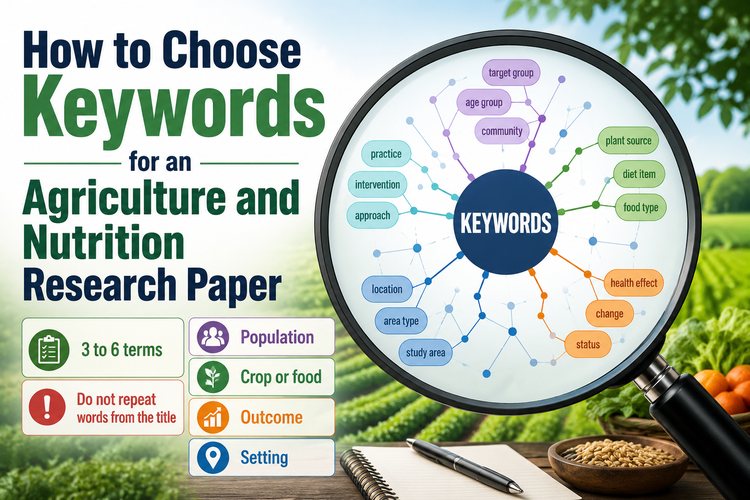
Keywords are how somebody who has never heard of your paper finds it. Choose 3 to 6 terms that a searcher would type but that do not already appear in your title, covering the population, the crop or food, the outcome and the setting. Repeating the title in the keyword list is the commonest mistake and wastes the only free reach your paper gets.
When a nutrition journal publishes your paper, databases and search engines index the title, abstract and keywords, often nothing else. Your title carries a handful of terms. The keyword list is a second, independent set of doors into the same paper.
So the question is not “what is my paper about?” — the title answered that. It is “what would somebody type who needs this paper but does not know it exists?” Those are different questions and they produce different lists.
This agriculture and nutrition journal asks for 3 to 6 keywords, placed immediately after the abstract, and most other journals in the field ask for something similar. Fewer than three wastes reach; more than six is usually a sign that the author has not decided what the paper is about.
A useful way to build an agriculture and nutrition journal keyword list is to cover four different angles, so the paper is reachable from four directions.
| Slot | Example terms |
|---|---|
| Subject or intervention | biofortification, integrated nutrient management, complementary feeding |
| Crop, food or organism | pearl millet, finger millet, cowpea, fermented foods |
| Outcome measured | micronutrient status, grain yield, dietary diversity, shelf life |
| Population or setting | school children, rainfed agriculture, tribal households, semi-arid tropics |
Four slots, four to six terms, no overlap with the title. That covers a searcher coming from the intervention, from the commodity, from the outcome and from the context.
Title: Iron and zinc content of biofortified pearl millet under two irrigation regimes.
Wasted list: pearl millet, iron, zinc, irrigation, biofortified pearl millet. Every one of these is already in the title, so the list adds nothing at all.
Working list: biofortification, micronutrient density, rainfed agriculture, food composition, Pennisetum glaucum, water stress.
The second list reaches a reader searching for biofortification across crops, one searching by scientific name, one working on water stress, and one compiling food composition data — none of whom would have found the paper through the title alone.
Now the same exercise on a nutrition journal paper. Title: Dietary diversity and anaemia among adolescent girls in two blocks of southern Tamil Nadu.
Wasted list: dietary diversity, anaemia, adolescent girls, Tamil Nadu. All four are in the title.
Working list: haemoglobin, iron bioavailability, 24-hour recall, food frequency questionnaire, rural nutrition, micronutrient deficiency.
Consider who each term reaches. Haemoglobin catches clinical readers who do not use the word anaemia in searches. The two method terms catch researchers looking for studies that used the same instrument, which is how method comparisons get built. Iron bioavailability catches the mechanism literature. Rural nutrition catches programme people rather than academics.
None of those readers would have arrived through the title. That is six extra doors for the cost of ten minutes' thought, which is the best return available anywhere in the manuscript.
Modern search engines handle both, so this matters less than it did. Two practical habits: follow the form used by the papers in your own reference list, and be internally consistent. Where a hyphenated term is standard in the field, keep the hyphen.
Do not list both forms of the same word to fill slots. “Micronutrient, micronutrients” is one keyword with a wasted slot next to it.
It is worth saying plainly, because advice written for websites leaks into advice for nutrition journal papers. Stuffing a keyword list with popular terms that your paper does not address does not raise you in search results; it brings the wrong readers, who leave immediately, and it irritates reviewers.
The reader you want is the one who needs precisely your paper. Six accurate terms serve that reader better than six fashionable ones, and an agriculture and nutrition journal editor will ask you to change a list that promises something the paper does not deliver.
Step 5 is the one worth doing and the one nobody does. It takes thirty seconds and it is the only check that tests the list against the real world rather than against your own intentions. If searching your own keyword returns nothing resembling your work, it is the wrong keyword.
Keywords are one of four things that decide whether your nutrition journal paper is found, and they are the only one you can improve in ten minutes.
A well-chosen keyword list cannot compensate for a vague title or an abstract with no numbers in it. What it can do is reach the reader who searches from an angle your title does not cover, and in a specialised field that is often the reader who cites you.
Give the list the same ten minutes you would give a figure caption. It is the last part of the manuscript most authors think about and one of the first parts a database uses.
Between 3 and 6, placed immediately after the abstract. Fewer than three limits how the paper can be found; more than six usually means the list has lost focus.
No. Databases already index the title, so a keyword that repeats it adds no reach. Use the slots for terms a searcher might use that the title does not contain.
Use whichever the title does not. If the title says pearl millet, put Pennisetum glaucum in the keywords, and the reverse if the title carries the binomial. Readers search both ways.
Yes, and short phrases are often better. “Dietary diversity score” or “integrated nutrient management” are how people search. Avoid phrases longer than four words, which nobody types.
Indirectly. They affect whether the right people find the paper, and papers that are found are more likely to be cited. They do nothing for a paper nobody needs, and they cannot rescue one that is hard to find because the abstract is vague.
Not normally. Once an article is published no changes are made, so the keyword list is fixed at proofreading — which is the last practical moment to look at it properly before it becomes permanent.
Where keywords fit with the rest of the front matter:
Created by Farhan Qureshi • 10 Aug 2026
P-ISSN: 2664-6064
E-ISSN: 2664-6072

International Journal of Agriculture and Nutrition