
- Printed Journal
- Indexed Journal
- Refereed Journal
- Peer Reviewed Journal


P-ISSN: 2664-6064
E-ISSN: 2664-6072

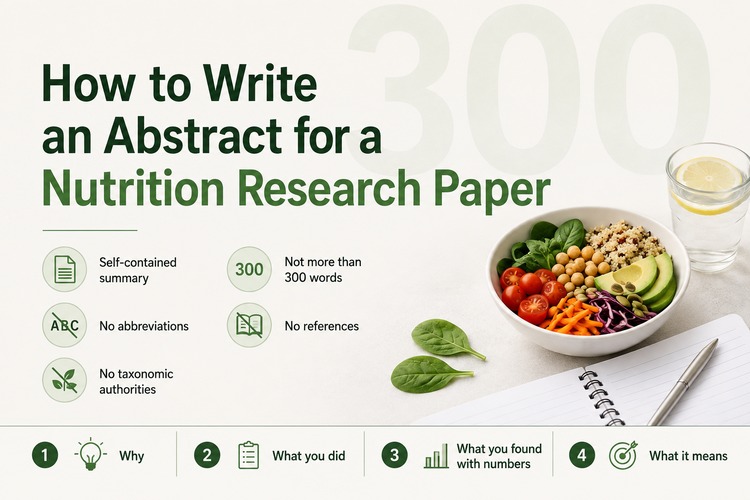
An abstract for a nutrition research paper is a self-contained summary of not more than 300 words that states why the study was done, what you did, what you found with numbers, and what it means — with no abbreviations, no references and no taxonomic authorities. It is the only part of your paper most people will ever read, and the part that decides whether anyone opens the rest.
| Rule | Detail |
|---|---|
| Length | Not more than 300 words |
| Keywords | 3 to 6, immediately after the abstract |
| Abbreviations | None — write terms out in full |
| References | None |
| Taxonomic authorities | None — Vigna radiata, not Vigna radiata (L.) R. Wilczek |
| Content | Must stand alone; a reader who sees only the abstract should understand the study |
These are the requirements of this agriculture and nutrition journal, listed on the instructions to authors page. Other journals differ, sometimes on the word limit and often on whether structured headings are wanted — check before you write, not after.
Every nutrition journal wants the same four things from an abstract, in the same order. A useful split of 300 words:
If your results section takes fewer than a third of the words, the abstract is a summary of your introduction rather than of your study. That is the most common structural fault.
This is what separates a nutrition journal abstract that gets cited from one that gets skipped.
Weak:
“The intervention significantly improved the nutritional status of the children studied.”
Usable:
“After 90 days, mean haemoglobin rose from 10.6 to 11.4 g/dL (p < 0.05) in 78 children aged 7–11, while mean weight-for-age z-score changed by 0.12 (not significant).”
The second version is the same length and carries the study. A reader can decide from it whether your work applies to their population, which the first version makes impossible.
Report the effect that did not appear as well. An abstract that reports only the significant result and quietly omits the outcome that did not move is the kind of selective reporting reviewers look for.
Space is short in a nutrition journal abstract, so choose the detail that changes how the result is read:
Leave out: equipment brand names, buffer concentrations, questionnaire administration detail. Those belong in the methods section, and each one costs words your results need.
Here is the 300-word agriculture and nutrition journal budget applied to a real-shaped study. First, the version most first drafts look like:
“Malnutrition is a major problem in developing countries and affects millions of children. Many studies have been conducted on this important topic. The present study was undertaken to assess the nutritional status of school children. A survey was conducted in selected schools. Data were collected and analysed using appropriate statistical methods. The results showed that the nutritional status of the children was poor. It is recommended that further studies be conducted and that appropriate interventions be implemented.”
Ninety words, and a reader learns nothing they can use: no place, no period, no sample size, no measurement, no number. Now the same study written to the four moves:
“Anthropometric data on school children in rural blocks of southern Tamil Nadu are limited, and existing surveys predate the current midday meal composition. This study assessed the nutritional status of 412 children aged 6–12 years across nine government schools in two blocks between July and October 2025. Height and weight were measured in triplicate and converted to height-for-age and weight-for-age z-scores. Dietary intake was assessed by a single 24-hour recall, with nutrient values calculated from the Indian Food Composition Tables. Stunting was present in 28.4 per cent of children and underweight in 21.1 per cent, with stunting significantly higher in boys than girls (31.9 against 24.8 per cent, p < 0.05). Mean energy intake was 1,412 kcal per day against a recommended 1,690, while mean protein intake met the recommendation. Iron intake was below the recommended level in 71 per cent of children. Stunting was not associated with household size or maternal education in this sample. The findings indicate that energy and iron intake, rather than protein, are the limiting factors in this population, and that any supplementary feeding programme should be designed accordingly. Single-recall dietary data cannot describe habitual intake, so the intake figures should be read as group estimates rather than individual assessments.”
That is roughly 200 words and it carries the whole study: place, period, sample, methods, four numbered findings including one that was not significant, an interpretation sized to the data, and the limitation. There is room left inside the 300-word budget, which is a better position to be in than cutting.
The no-abbreviation rule feels restrictive until you see why it exists. Abstracts are read stripped of the paper by databases and search engines, where a reader has no definitions list. “FFQ” and “WAZ” mean nothing to somebody scanning search results.
Write “food frequency questionnaire” and “weight-for-age z-score” in full. If the phrase is so long that it eats the budget, mention it once and refer to it generically afterwards — “the questionnaire”, “the score”. Standard units are not abbreviations: g/dL, kg ha⁻¹ and mg/100 g are all fine.
Keywords are how your nutrition journal paper is found by somebody who does not know it exists, so do not waste them repeating the title.
If your title is “Iron and zinc content of biofortified pearl millet under two irrigation regimes”, then biofortification, micronutrients, rainfed agriculture and food composition add reach. Repeating pearl millet and iron adds none.
Draft the abstract after the paper is finished, from the finished results rather than from the plan. This is the last thing you write before an agriculture and nutrition journal submission, not the first. Then cut, because a first draft is usually 380 words and the limit is 300.
What to cut first, in order: the second sentence of background, any phrase beginning “this study aims to”, adjectives on results, and the sentence recommending further research. What never gets cut: the sample size, the main number, and the test.
Then read it aloud to somebody who does not work on your topic. If they cannot tell you what you measured and what happened, the abstract is not finished, whatever its word count.
Not more than 300 words, followed by 3 to 6 keywords. Abbreviations, references and taxonomic authorities are not used in the abstract.
It depends on the journal. This one asks for a single paragraph giving the gist of the entire work rather than labelled sections. Follow the logical order — why, what you did, what you found, what it means — even when no headings are used.
No. The abstract must stand alone, and a citation points to something the reader of a database record cannot see. Put the citation in the introduction instead.
They add length without helping the reader identify the organism, and they belong with the first mention in the main text. Write the binomial alone in the abstract and give the authority once in the materials and methods.
Report them plainly, with the numbers. A non-significant result is a finding, and an abstract that reports it honestly is more useful than one that buries it. Reviewers at any nutrition journal notice when the abstract mentions only the outcome that worked.
Heavily. Databases and search engines index the title, abstract and keywords, and often nothing else. Most readers will decide from the abstract alone whether to open the full paper, so the specific numbers in it do more work than any other part of the manuscript.
The sections either side of the abstract:
Created by Peter Lindqvist • 10 Aug 2026
P-ISSN: 2664-6064
E-ISSN: 2664-6072

International Journal of Agriculture and Nutrition