
- Printed Journal
- Indexed Journal
- Refereed Journal
- Peer Reviewed Journal


P-ISSN: 2664-6064
E-ISSN: 2664-6072

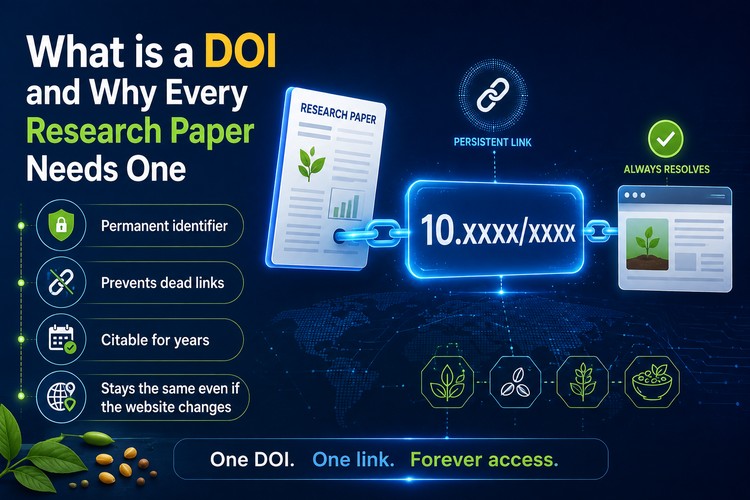
A DOI is a permanent identifier for a published article — a short code like 10.33545/26646064.2026.v8.i1a.001 that always resolves to that paper, even if the journal redesigns its website or moves servers. It is the difference between a citation someone can follow in ten years and a dead link.
Every DOI has two halves separated by a slash.
| Part | Example | Meaning |
|---|---|---|
| Prefix | 10.33545 | Assigned to the publisher by a registration agency. Every article from this publisher starts with it. |
| Suffix | 26646064.2026.v8.i1a.001 | Chosen by the publisher to identify the article. Here it encodes the journal ISSN, year, volume, issue, part and article number. |
The prefix always begins with 10. That is not decoration; it is the namespace of the DOI system itself. Any “DOI” that does not begin with 10. is not a DOI.
This agriculture and nutrition journal registers under the prefix 10.33545, with the E-ISSN built into the suffix so the code carries the journal identity as well as the article's position in the archive.
Authors reasonably ask why a link to the agriculture and nutrition journal page will not do. Because links break, and they break for ordinary reasons: the site is redesigned, the CMS changes its URL structure, the journal moves to a new host, or the article is renumbered.
A DOI survives all of that because it is a pointer, not an address. The publisher updates where the DOI points; the DOI itself never changes. Your citation from 2019 keeps working after a 2026 site rebuild.
This matters most to the person you will never meet: the reader who finds your paper in someone else's reference list five years from now.
Three practical rules that people get wrong when citing an agriculture and nutrition journal article.
Current Crossref guidance is to present the DOI as a full URL: https://doi.org/10.33545/26646064.2026.v8.i1a.001. The older doi: prefix style still appears in journals but is being phased out. Follow whichever style your target journal's instructions specify.
A DOI is case-insensitive but otherwise exact. Dropping a segment, changing a dot to a slash or introducing a line break with a hyphen all produce a code that resolves to nothing. When a reference list is exported from a reference manager, spot-check three DOIs by pasting them into doi.org.
A direct link to a PDF file bypasses the article page and is exactly the kind of link that dies in a site migration. Cite the DOI.
This is the most useful thing a DOI does for an author choosing which agriculture and nutrition journal to submit to. Registering DOIs costs the publisher money per article and requires a formal agreement with a registration agency, so it is a commitment a fly-by-night operation will not make.
A working DOI does not prove the review was careful. But an agriculture and nutrition journal that registers DOIs on every article has paid for infrastructure, and that rules out a whole category of fake publishers in about thirty seconds.
Take the example above and pull it apart:
10.33545 / 26646064 . 2026 . v8 . i1a . 00110.33545 — the publisher prefix26646064 — the journal's E-ISSN without the hyphen, so the code identifies the title2026 — year of publicationv8 — volume 8i1a — issue 1, part A001 — article number within that partYou do not need to decode a DOI to use one, and no reader ever will. But it is worth seeing that the suffix is structured rather than random, because it explains why the code is long and why altering any segment breaks it.
Different publishers structure suffixes differently. Some use a running number with no meaning at all. Both are valid; the DOI system only requires the code to be unique and stable.
On a well-run nutrition journal article page the DOI is visible in three places: near the title, in the suggested citation block, and inside the machine-readable metadata that Google Scholar and reference managers read.
That last one is why a DOI sometimes appears automatically when you import a paper into Zotero or Mendeley. If the import comes back without a DOI while the page displays one, the metadata is incomplete on the journal's side — a small sign that the technical setup is not being maintained.
Treat a DOI as evidence of permanence and traceability. Anything beyond that has to be judged separately.
There is a practical career reason to prefer a nutrition journal that registers DOIs. Crossref links your reference list to the papers you cite, and links other people's reference lists to yours. That machinery is how citation counts are built in Google Scholar and elsewhere.
A paper with no DOI still gets cited, but the citation is harder to match automatically, and matching is what feeds the counts your institution looks at. Publishing in a nutrition journal that registers DOIs is the cheapest thing you can do for your own citation record.
Occasionally a newly published agriculture and nutrition journal article's DOI returns an error. Usually it is timing — registration can lag publication by a few days. Wait, then check again.
If it still fails after a couple of weeks, write to the editorial office with the article title, volume and issue, and the DOI as printed. Registration errors do happen and are fixable, but only if someone reports them. Do not quietly cite the article without a DOI; ask for it to be corrected.
The same reference, written two ways. Without a DOI:
Sharma R, Patel K. Zinc and iron content of biofortified pearl millet under two irrigation regimes. Int. J. Agric. Nutr. 2026;8(1):01-05.
With it:
Sharma R, Patel K. Zinc and iron content of biofortified pearl millet under two irrigation regimes. Int. J. Agric. Nutr. 2026;8(1):01-05. DOI: 10.33545/26646064.2026.v8.i1a.001
A reader with the first version has to search a title that may be abbreviated, mistyped or shared with another paper. A reader with the second pastes one line and arrives. The difference costs you fifteen characters and saves every future reader several minutes — which is the whole argument for DOIs in one sentence.
Digital Object Identifier. It is a permanent code assigned to a published item, most often a journal article, that always resolves to that item regardless of where it is hosted.
It depends on the journal. Here articles are registered with Crossref under the prefix 10.33545, and the DOI appears on the article page. A journal that publishes without DOIs is not registering with any agency, which is worth knowing before you submit.
The DOI itself is permanent by design. What can change is where it points, which the publisher updates when a site moves. If an article is retracted, the DOI continues to resolve — usually to a retraction notice, so the record remains visible rather than disappearing.
Look on the article page, usually near the title or in the citation block. If it is not shown, search the exact title at search.crossref.org, which returns the registered DOI where one exists.
No. An ISSN identifies the journal as a whole; a DOI identifies one article. A journal has one or two ISSNs for its lifetime and thousands of DOIs, one per article.
Yes, many do. Preprint servers and data repositories register DOIs the same way publishers do, which is why a dataset can be cited independently of the paper that used it.
The other identifiers and where they are used:
Created by Daniel Okoro • 10 Aug 2026
P-ISSN: 2664-6064
E-ISSN: 2664-6072

International Journal of Agriculture and Nutrition