
- Printed Journal
- Indexed Journal
- Refereed Journal
- Peer Reviewed Journal


P-ISSN: 2664-6064
E-ISSN: 2664-6072

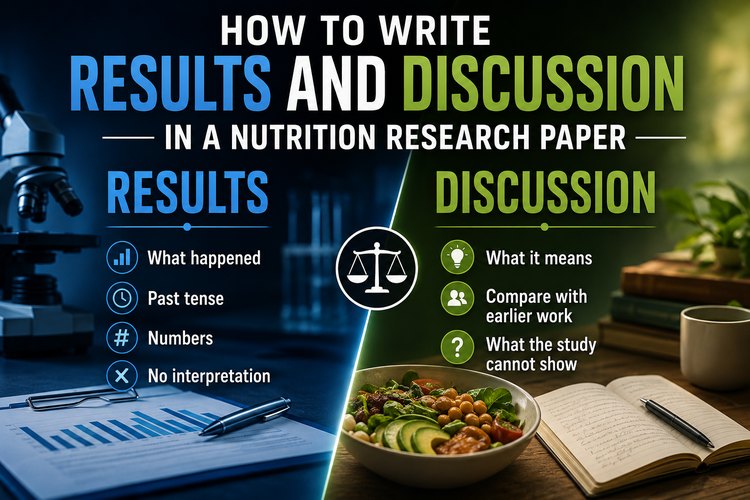
Results state what happened, in the past tense, with numbers and no interpretation. The discussion explains what it means, compares it with earlier work, and says what the study cannot show. Mixing the two is the commonest structural fault in papers sent to a nutrition journal, and it is the easiest to fix.
| Results | Discussion | |
|---|---|---|
| Tense | Past | Present for established knowledge, past for your findings |
| References | None | Throughout |
| Numbers | Yes, with variation and test | Only to make a comparison |
| Interpretation | None | The whole point |
| Limitations | No | Yes |
| Tables and figures | Presented here | Referred to, not repeated |
A mean on its own is not a result. Weak: “Grain yield was higher under the higher nitrogen level.” Usable: “Grain yield rose from 3.42 ± 0.18 to 4.18 ± 0.21 t ha⁻¹ (22.2 per cent) at 120 kg N ha⁻¹ (p < 0.01, n = 4), with no further increase at 150 kg N ha⁻¹.”
If a table gives twelve means, the text should pick out the two or three that matter, not walk through all twelve. Text that restates a table wastes the words your discussion needs, and reviewers say so.
Non-significant results belong in the paper. An agriculture and nutrition journal reviewer who sees five outcomes measured and three reported will ask about the other two, and the question is never comfortable.
Present results in the sequence you described the measurements. A reader following one order can hold it; one jumping between sections cannot.
An agriculture and nutrition journal will not print the same data twice, so never present it as both. Use a table when exact values matter and a figure when the shape of a relationship matters. A yield response across five nitrogen levels is a figure; the composition of six varieties is a table.
Every table needs a self-descriptive heading, the number of replicates, and a measure of dispersion. Tables go after the references with horizontal lines only, and figures come in at 75 mm or 155 mm width and 300 dpi. Those are this journal's requirements, on the instructions to authors page.
Not a summary. A nutrition journal discussion answers four questions, in roughly this order.
Question three is where good papers separate from adequate ones. “Our values are lower than those of Rao et al.” is an observation. “Our values are lower than Rao et al., who reported on a dry-weight basis; recalculated to dry weight the two are within 3 per cent” is a discussion.
Before you write that your result disagrees with somebody's, check three things: the basis of measurement (fresh or dry weight, per capita or per consumption unit), the method, and the units. A surprising proportion of apparent disagreements in nutrition papers are unit or basis mismatches, and a reviewer who spots one that you did not will lose confidence in the rest.
When a genuine difference remains, offer a mechanism rather than a shrug. Different soil zinc status, a different cultivar, a different season, a population with different baseline intake — name the likely cause and say it is a hypothesis.
Here is a discussion paragraph as it usually arrives, and as it should read. The study measured iron intake in school children.
As submitted:
“Iron intake was found to be low in the present study. Similar findings were reported by several workers. Iron deficiency is a major public health problem in India and affects a large number of children. Therefore, appropriate steps should be taken to improve the iron intake of school children.”
Four sentences and not one of them uses the study. Sentence one repeats the result, two cites nobody in particular, three is a textbook fact, four is a recommendation with no basis in the data.
Rewritten:
“Mean iron intake of 8.1 mg per day met 62 per cent of the recommended level, close to the 58 per cent reported by Kumar and Devi from an adjoining district using the same food composition tables. The shortfall persisted despite adequate cereal intake, which suggests that the limiting factor is bioavailability rather than quantity: the diet was dominated by rice and wheat with little vitamin C at the same meal. This is consistent with the low intake of citrus and green leafy vegetables recorded here, and it points to meal composition rather than total food quantity as the useful intervention point in this group.”
Same finding, same length. The second version compares like with like, offers a mechanism, supports it with the study's own data, and lands on something a programme could act on. That is what a discussion is for.
Late in the discussion, before the conclusion, in two or three sentences. Every nutrition journal expects them somewhere, and this is the least disruptive place. Name the limitation, say which conclusions it constrains, and stop.
Weak: “Like all studies, this one has certain limitations.” That is a sentence about the existence of limitations, not a limitation.
Useful: “Dietary intake was assessed by a single 24-hour recall, which cannot describe habitual intake. The intake figures should therefore be read as group estimates rather than individual assessments.”
Authors fear that naming a limitation invites rejection. In practice the opposite happens: the reviewer was going to find it anyway, and finding it already stated reads as competence.
One or two sentences, sized to the data. This is where papers overreach, and where a nutrition journal editor most often asks for a rewrite.
Ask yourself: if a district officer acted on this sentence, would my data support what they did? A study of 78 children in two schools supports “energy and iron intake, rather than protein, were the limiting factors in this group”. It does not support “supplementary feeding programmes should be redesigned”.
“Further research is needed” adds nothing unless you say what research and why. Usually it is better deleted.
Run these eight questions over the two sections before an agriculture and nutrition journal reviewer does.
Some journals allow it and this one states that results, discussion and conclusion may be combined where that seems appropriate. If you combine them, keep the discipline: report the number first, then interpret it, rather than blurring the two inside one sentence.
No. Results are your findings and need no support from the literature. Comparisons with other work belong in the discussion, where the citation makes sense.
Two or three that genuinely constrain the conclusions. A long list reads as either padding or a study that should not have been submitted. Choose the ones a reader needs in order to use your result correctly.
Results in the past tense throughout. In the discussion, use past tense for what you and others found, and present tense for established knowledge and for what your finding indicates.
Yes, provided the design could have detected an effect. State the sample size and, where available, the power, so a reader can tell the difference between no effect and not enough data to see one.
Long enough to do the four jobs and no longer. In a paper limited to 15 pages, a discussion running longer than the results usually means the study is being talked up rather than explained.
How to present and support the numbers:
Created by Clara Mendes • 10 Aug 2026
P-ISSN: 2664-6064
E-ISSN: 2664-6072

International Journal of Agriculture and Nutrition