
- Printed Journal
- Indexed Journal
- Refereed Journal
- Peer Reviewed Journal


P-ISSN: 2664-6064
E-ISSN: 2664-6072
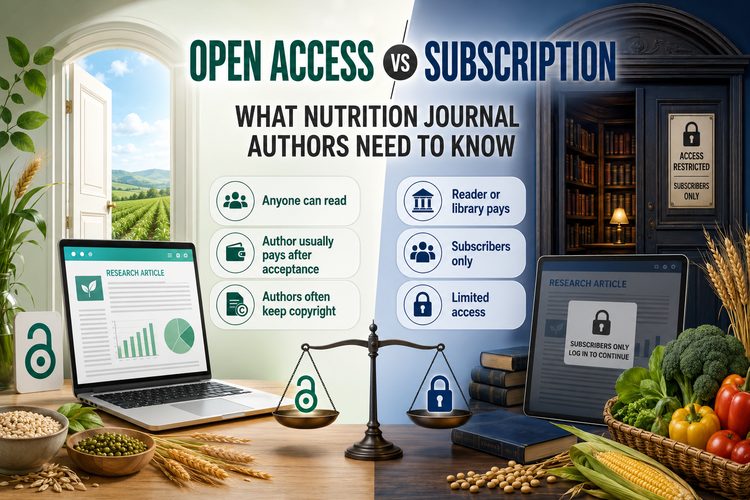
In an open access nutrition journal the author pays once and everyone reads free; in a subscription journal the reader or their library pays and the author usually pays nothing. The cost has not disappeared — it has moved to a different person. Which model suits you depends on who you want to read the paper and who is paying.
| Open access | Subscription | |
|---|---|---|
| Who pays | Author, usually after acceptance | Reader or their library |
| Who can read it | Anyone with a browser | Subscribers only |
| Cost to author | An article processing charge | Usually nothing |
| Cost to a reader in a small college | Nothing | Often out of reach |
| Reach | Global and immediate | Limited to subscribing institutions |
| Copyright | Often stays with the author | Often transferred to the publisher |
| Repository deposit | Usually allowed immediately | Often embargoed for 6–24 months |
A nutrition journal has a different readership from most disciplines. In many fields the readers are all at well-funded universities, and a paywall is an inconvenience rather than a barrier. Agriculture and nutrition is not one of those fields.
The people who need a paper on complementary feeding practices, or on a locally adapted variety, are often at a district agriculture office, a KVK, a state college, an NGO running a nutrition programme, or a hospital dietetics department. Very few of those have a journal subscription. A paywalled paper is, in practical terms, a paper those readers will never see.
That is the strongest argument for open access here, and it is not about metrics. It is about whether the work reaches the people whose decisions it was meant to inform.
Three misunderstandings about open access nutrition journal publishing are worth clearing up, because they cause bad decisions.
The payment model and the review model are independent. This nutrition journal is open access and still uses double-blind review by two reviewers with a required revision round. Plenty of subscription journals review less carefully than plenty of open access ones.
Under CC BY-NC 4.0 here, authors keep copyright. Readers get permission to reuse the work non-commercially with credit. That is more control than a traditional copyright transfer leaves you, not less.
Formatting, running the review system, registering a Crossref DOI for each article, hosting and archiving all cost money. Open access moves who pays; it does not remove the cost.
“Open access” on its own tells you very little. The licence tells you what readers may actually do:
Before submitting, find the licence name and check that the deed link, the badge and the description all say the same thing. Sites that name one licence and link to another are commoner than they should be, and it is the description that usually tells you what was actually meant.
Some journals do both, and it confuses authors. A nutrition journal can be fully open online and still sell a printed edition. Here every article is free to read online from the day it is published, while the printed edition is sold by subscription to libraries and individuals.
These are separate transactions and neither pays for the other. A library buying the print run is not covering your publication charge, and your charge is not producing their copy. If a librarian asks whether they need a subscription to give students access, the answer is no — the online article is already free.
It helps to picture the person your paper is actually for. Consider a district nutrition officer planning a supplementary feeding programme for anganwadi centres. She has a budget, a target group and three weeks to decide between two approaches.
She searches for evidence on locally available foods. Two relevant papers exist. One is in a subscription nutrition journal and shows her an abstract and a price of 39 USD for the full text, which is not something a district office can pay. The other is open access, and she reads the methods, the sample and the limitations that evening.
The second paper shapes the programme. The first might have been the better study; it was simply unavailable at the moment the decision was made. This is what open access means in practice in this field, and it is a stronger argument than any citation count.
Authors compare an article processing charge against zero and conclude that subscription publishing is cheaper. That comparison leaves out the institution.
A single subscription journal can cost a university library a substantial annual sum, renewed every year, for access that ends the day the subscription lapses. An open access charge is paid once per article, and the article stays readable permanently — to that university, to every other institution, and to readers with no institution at all.
Neither figure is wrong. They are simply paid by different budgets, which is why the debate feels different depending on whether you are the author, the librarian or the reader.
Work through four questions before choosing a nutrition journal, in this order.
Notice that the fee is not the first question. An author processing charge you can plan for is a smaller problem than a paper nobody in your field can open.
These are not a third publishing model, but they change the calculation. If you can deposit the accepted version in an institutional repository immediately, a subscription journal's paywall matters less. If deposit is embargoed for a year, it matters a great deal.
This journal follows the Sherpa/Romeo Green policy: the published version may be deposited in an institutional or subject repository with no embargo and no separate permission. Ask any journal you are considering the same question, and ask it before you submit rather than after.
No. The payment model says nothing about the review model. Judge the journal by how it describes its review process, its editorial board and its verifiable registrations — not by who pays for it.
They are separate products. Libraries buy the printed edition for shelf reference, accreditation records and long-term holdings. Readers who only need the content do not need to buy anything, because the online article is free.
Not here. Authors keep copyright and the journal does not ask for a transfer. The CC BY-NC 4.0 licence gives readers permission to reuse the work non-commercially with credit, which is a permission granted rather than ownership surrendered.
Under the Sherpa/Romeo Green policy applied here, yes — the published version can be deposited with no embargo and no separate permission. Check the policy of any other journal individually, because embargoes of six to twenty-four months are common elsewhere.
Studies disagree, and the honest answer is that it depends on the field and the paper. What is not in dispute is reach: a paper anyone can open has more potential readers than one behind a paywall, particularly in a field where many readers work outside universities.
Commercial reuse without permission — reproducing the article in a paid course pack, a product catalogue or any publication sold for profit. Teaching, research, extension work and repository deposit are all unaffected. Commercial users can still ask the journal, and charges apply.
The money and the rights, in more detail:
Created by Meera Raghavan • 10 Aug 2026
P-ISSN: 2664-6064
E-ISSN: 2664-6072

International Journal of Agriculture and Nutrition