
- Printed Journal
- Indexed Journal
- Refereed Journal
- Peer Reviewed Journal


P-ISSN: 2664-6064
E-ISSN: 2664-6072
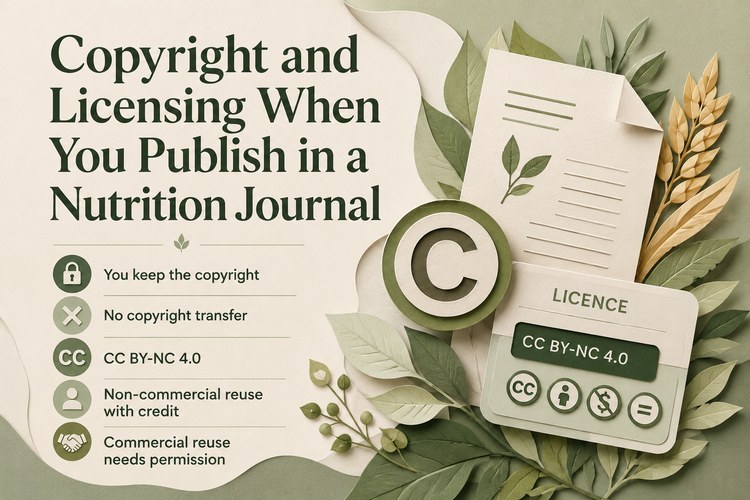
When you publish in this nutrition journal you keep the copyright in your own work. The journal does not ask for a transfer. What you grant is a licence — Creative Commons Attribution-NonCommercial (CC BY-NC) 4.0 — which lets readers reuse the article for non-commercial purposes with credit. Those are two different things, and confusing them is why authors ask permission for work they already own.
| Copyright | Licence | |
|---|---|---|
| What it is | Ownership of the work | Permission granted to others |
| Who holds it here | The authors | Granted by the authors to readers |
| Can it be given away? | Yes, by transfer — not required here | It is a grant, not a transfer |
| What it decides | Who may authorise a use | What anyone may do without asking |
Under a copyright transfer, which many journals outside the open access nutrition journal model still require, you would need the publisher's permission to reuse your own figure in your thesis. Here you do not, because you never gave the copyright away.
Once an agriculture and nutrition journal applies this licence, anyone, anywhere, without asking and without paying, may:
Two conditions attach. Attribution: credit the original authors and the journal, and indicate whether you changed anything. Non-commercial: none of the above extends to commercial use.
This is where authors and readers most often need a decision, and the line is about the context rather than about money changing hands generally. A nutrition journal gets asked about the same handful of cases repeatedly.
| Use | Covered by the licence? |
|---|---|
| A university lecture, including at a private college | Yes |
| A government extension leaflet given free to farmers | Yes |
| An NGO training manual distributed without charge | Yes |
| A thesis or dissertation | Yes |
| A paid training package or course pack sold for profit | No — permission needed |
| A seed, fertiliser or product catalogue | No — permission needed |
| A textbook sold commercially | No — permission needed |
For anything in the lower half, write to the editorial office in advance through the contact page. Charges are applicable and permission is given in writing. The full policy is on the content licensing policy page.
Since you keep the copyright in an agriculture and nutrition journal paper, the answer is almost everything:
That last one has a policy attached. This journal follows Sherpa/Romeo Green, so the published version may be deposited with no embargo and no separate permission. Many subscription journals impose six to twenty-four months, so it is worth checking for every journal you publish in rather than assuming.
Creative Commons licences are built from a few components, and the letters tell you exactly what is permitted. It is worth being able to read them, because the difference between two of them decides whether you may adapt somebody's figure.
| Code | Means | What it allows |
|---|---|---|
| BY | Attribution | Reuse anything, including commercially, with credit |
| BY-NC | NonCommercial | Reuse and adapt for non-commercial purposes, with credit — this journal |
| BY-ND | NoDerivatives | Share the work unchanged; no adaptations, no translations |
| BY-NC-ND | Both | Share unchanged, non-commercially only |
| BY-SA | ShareAlike | Reuse, but derivatives must carry the same licence |
The two that catch people are ND and SA. Under an ND licence you cannot translate an article or redraw a figure at all, even non-commercially. Under SA, anything you build from it must be released under the same terms, which matters if you were planning to include it in something licensed differently.
Check the label before you plan a use, and check it on the article rather than on the journal home page. Some publishers apply different licences to different article types.
A correct attribution names the authors, the article title, the journal with volume, issue and year, and the DOI. Every article here carries a Crossref DOI under the prefix 10.33545/26646064.
Sharma R, Patel K, Devi S. Zinc and iron content of biofortified pearl millet under two irrigation regimes. Int. J. Agric. Nutr. 2026;8(1):01-05. DOI: 10.33545/26646064.2026.v8.i1a.001. Licensed under CC BY-NC 4.0.
If you adapted a figure rather than reproducing it, say so alongside the credit — “adapted from” rather than “reproduced from”. Readers need to know which version they are looking at, and it takes two words.
A nutrition journal licence covers what the authors created. It does not cover material they borrowed.
If an article reproduces a figure, photograph, map or table from another publication, that item keeps its own original licence. Before reusing such an item, read the caption and the acknowledgements, and go to the original rights holder where required. This catches people compiling review articles, who reasonably assume that everything inside an open access paper is open.
The same applies when you are the author. Material you did not create needs permission and attribution at the time you submit, not after a reader asks about it.
Authors sometimes ask why an agriculture and nutrition journal chooses NC rather than plain CC BY, which permits everything. The answer is a trade-off rather than a principle, and it is worth understanding before you decide it matters to you.
Plain BY maximises reuse: anyone can put the article in a commercial product without asking. NC keeps that one route under the journal's control, which means a company reproducing research in a catalogue or a paid course has to ask and pay, while every non-commercial use stays free and unrestricted.
For a reader in a district office, a college or an NGO, the two licences are identical in practice — both allow reading, copying, teaching and adaptation. The difference only appears at the commercial boundary.
Where it can matter to an author is funder policy. Some funders require CC BY specifically for work they paid for. If yours does, check before you submit rather than after acceptance, because the licence applied to a published article is not something that can be changed afterwards.
Licensing decides reuse; it does not decide the permanence of the record, and the two get confused. A licence tells you what may be done with an article that exists; preservation is what keeps it existing. If an article is retracted the DOI keeps resolving, normally to a retraction notice, so the history stays visible rather than disappearing.
Preservation is separate again. Electronic content here is held on three separate sources — one live, one backup, and the metadata held by abstracting and indexing services — with every issue also kept in printed form at the society office.
The authors. The journal does not require a copyright transfer. What is granted is a CC BY-NC 4.0 licence allowing readers to reuse the work non-commercially with credit.
Yes. Under the Sherpa/Romeo Green policy the published version can be deposited with no embargo and no separate permission. A link back to the article page is appreciated but not required.
Yes. You hold the copyright, so no permission is needed. Cite the published version with its DOI so an examiner can see where it appeared.
Reuse in something sold for profit — a paid course pack, a product catalogue, a commercial textbook. Teaching, extension work, repository deposit and research use are all unaffected. Commercial users can ask the journal, and charges apply.
Yes for non-commercial purposes, with attribution, and state clearly that it is a translation and who made it. A translation sold commercially needs permission first.
No. Third-party material keeps its own licence, so check the caption and acknowledgements and go to the original rights holder. This is the commonest mistake made by authors assembling review articles from open access sources.
The publishing model behind the licence:
Created by Devika Iyer • 10 Aug 2026
P-ISSN: 2664-6064
E-ISSN: 2664-6072

International Journal of Agriculture and Nutrition