
- Printed Journal
- Indexed Journal
- Refereed Journal
- Peer Reviewed Journal


P-ISSN: 2664-6064
E-ISSN: 2664-6072

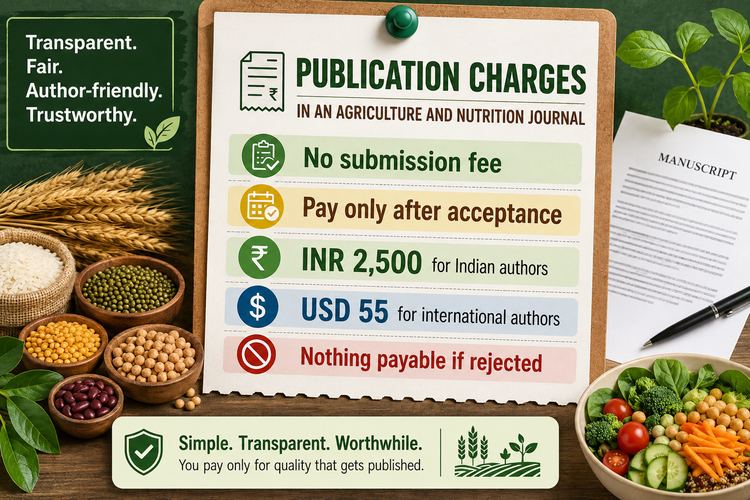
Publication charges in an agriculture and nutrition journal are the fee an open access journal takes from authors instead of from readers. At the International Journal of Agriculture and Nutrition there is no submission fee at all; 2,500 INR for Indian authors or 55 USD for international authors becomes payable only after a paper has passed peer review and been accepted, and nothing is payable if it is rejected.
The question authors rarely ask is what an agriculture and nutrition journal actually does with the fee. In an open access model the reader pays nothing, so the running costs sit with the publisher: manuscript formatting and typesetting, running the submission and review system, registering a Crossref DOI for every article, hosting and maintaining the site, and keeping the archive online and backed up.
This journal receives no governmental or non-governmental funding, which is stated on the instructions to authors page. That is the reason the charge exists, and it is a more honest explanation than most sites give.
| Who | Charge | When |
|---|---|---|
| Indian authors | 2,500 INR | After acceptance (w.e.f. 01.10.2022) |
| International authors | 55 USD | After acceptance (w.e.f. 01.10.2022) |
| Any author, at submission | Nothing | There is no submission fee |
| Any author, if rejected | Nothing | No charge is payable |
The timing matters more than the amount. A charge that falls due only after acceptance means you risk nothing by submitting, and it removes the incentive a journal would otherwise have to accept weak papers.
An agriculture and nutrition journal on this model charges for one thing only. Being clear about the rest saves confusion later:
The print subscription is a separate product entirely. A library paying for the printed journal is not paying your publication charge, and you are not paying for their copy. Details are on the subscription page.
| Open access (this journal) | Subscription journal | |
|---|---|---|
| Who pays | The author, after acceptance | The reader or their library |
| Who can read it | Anyone, immediately | Only subscribers |
| Cost to a farmer, extension officer or small college | Nothing | Often unaffordable |
| Cost to the author | 2,500 INR / 55 USD | Usually nothing |
| Reach of your paper | Everyone with a browser | Institutions with a subscription |
Neither model is morally superior; they move the cost to different people. What matters for you is that the model is stated openly before you submit.
Research students are the group most often caught out by agriculture and nutrition journal charges, usually a week before a viva deadline. Three practical points.
Many funded projects include a publication line. If yours does, the charge is claimable and your supervisor or project office can tell you how. Ask at the start of the write-up, not after acceptance.
If you expect two papers from a thesis, that is a known figure at the start of the year. Two papers at 2,500 INR is 5,000 INR, and it is a great deal easier to arrange with three months' notice than three days'.
Institutions that reimburse publication charges usually want the acceptance letter, the payment record and the article citation together. Filing them at the time saves an unpleasant hour later.
This is the part worth being blunt about, because it is where misunderstanding causes real trouble.
It does not buy acceptance. The charge arises after two reviewers have reported and a subject editor has decided. Paying it earlier, or offering to, changes nothing except your position if the paper is later rejected.
It does not buy speed. Review time is set by how quickly two unpaid academics can read a manuscript. No fee shortens that, and a journal offering to shorten it for money is offering to skip it.
It does not buy indexing. Whether an agriculture and nutrition journal appears in a database is decided by that database, on the journal's record over years. Any site suggesting your paper will enter Scopus because you paid is describing something that does not happen.
It does not transfer your copyright. You keep it. Under CC BY-NC 4.0 readers get permission to reuse the paper non-commercially with credit; ownership stays with you either way.
A research student in India plans two papers from a thesis, submitting in March and July. The budget question is simple to answer in advance and unpleasant to answer late.
The figure that surprises people is how small it is against the cost of the research itself. What causes the problem is timing, not amount: 5,000 INR arranged in January is routine, and the same 5,000 INR needed within a week of a viva deadline is a crisis.
What a journal does with its fee tells you a great deal about the journal:
A genuine agriculture and nutrition journal publishes its rate on a public page, applies it after acceptance, and does not sell speed. Everything else deserves a question before you pay.
It is worth stating plainly, because authors new to open access sometimes assume any payment to a nutrition journal is suspect. A publication charge that is public, fixed by category, and payable after independent review is a cost recovery. A payment that varies, is negotiated privately, or is linked to whether the paper will be accepted is something else, and no defensible journal operates that way.
The test is simple: could the amount and its terms be shown to your head of department without explanation? If yes, it is a charge. If it needs explaining, it is not.
2,500 INR for Indian authors and 55 USD for international authors, both effective from 01.10.2022. There is no submission fee, and the charge falls due only after the manuscript has been accepted following peer review.
No. Nothing is payable at submission and nothing is payable on rejection. The charge arises only after acceptance.
No, they are separate. The publication charge is paid once by an author whose paper is accepted. A subscription is paid by a reader or library for the printed edition. The online article is free to read either way.
Often yes. Many funded projects include a publication line, and many institutions reimburse charges on production of the acceptance letter, the payment record and the citation. Ask your supervisor or project office during write-up rather than after acceptance.
There is no expedited option, and you should be wary of any journal that sells one. Reviewers are unpaid academics; their time cannot be purchased, so a paid fast track usually means a shortened review.
Because the reader does not. Formatting, running the review system, registering DOIs, hosting and keeping the archive online all cost money. A journal with no institutional funding recovers those costs from authors, which is why the article can stay free for everyone else.
What the charge pays for, and who pays in the other model:
Created by Dilbag Singh • 10 Aug 2026
P-ISSN: 2664-6064
E-ISSN: 2664-6072

International Journal of Agriculture and Nutrition