
- Printed Journal
- Indexed Journal
- Refereed Journal
- Peer Reviewed Journal


P-ISSN: 2664-6064
E-ISSN: 2664-6072
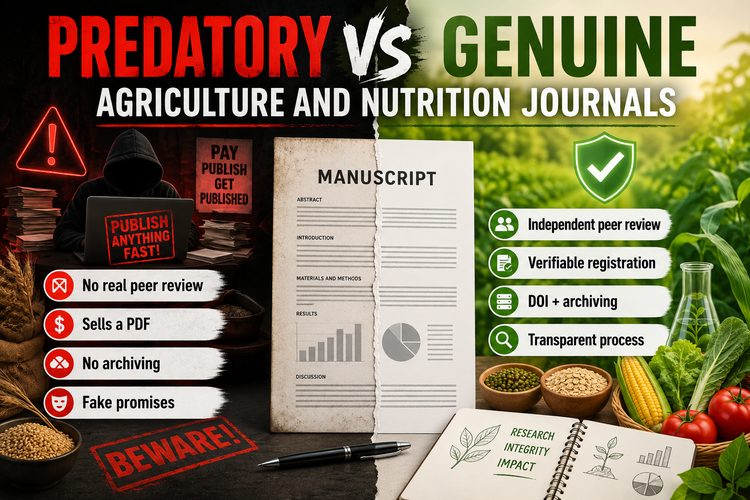
The difference between a predatory and a genuine agriculture and nutrition journal is not quality of design or speed of reply — predatory operations are often better at both. The difference is that one performs peer review and registration it can prove, and the other sells you a PDF. This guide covers how to tell them apart, and what to do if you have already published in the wrong place.
A predatory agriculture and nutrition journal charges a fee to publish while skipping the work that fee is supposed to pay for: editorial screening, independent review, copy-editing, DOI registration, archiving. It is not a low-quality journal. A weak but honest journal reviews your paper badly; a predatory one does not review it at all and hopes you will not notice.
This matters because the cost is not the fee. It is that the paper is now published, cannot be submitted anywhere else, and may not be counted by your institution — and you cannot undo any of that.
| Predatory | Genuine | |
|---|---|---|
| How they reach you | Flattering email about a paper outside your field | You find them by searching, or through a colleague |
| Scope | “All areas of science, engineering and management” | A defined subject, visible in recent issues |
| Review | Accepted in days, few or no comments | Two reviewers, substantive comments, revision required |
| Charges | Revealed after acceptance | Published before you submit |
| ISSN | Missing, or does not resolve at portal.issn.org | Resolves, title and publisher match |
| DOI | Absent, or a link that does not open | Crossref DOI that resolves to the article |
| Editorial board | Names that cannot be found, or listed without consent | Real people, relevant subjects, several institutions |
| Indexing claims | Scopus and Web of Science, unverifiable | Named databases you can check, and honest about what is missing |
| Address | A flat, a PO box, or nothing | Postal address, phone, working hours |
Read one carefully. The tells are consistent: your name misspelled or in a different font, praise for a paper you did not write or that has nothing to do with the journal's subject, a scope covering everything, a deadline a few days away, and a promise of rapid publication.
Genuine journals do occasionally invite submissions, usually for a special issue with a named guest editor and a defined theme. The difference is specificity. An invitation that names your actual paper, explains why it fits a stated theme, and comes from a person you can find at the institution they claim is a different object entirely.
Two independent reviewers have to read a manuscript, check the methods against what they know of the literature, and write a report. They are unpaid academics doing it between teaching and their own work. That is why review takes weeks.
A journal advertising publication in 72 hours has done arithmetic you can do too. Three days does not fit two reviewers, an author revision and an editor decision. So one of those steps is not happening — and the only step that can be silently dropped is the review.
For comparison, this agriculture and nutrition journal describes a process with real durations attached: a subject editor screens, two reviewers report, the author revises within one week, the revision goes back to the reviewers, then the subject editor decides. Nobody promises a total number of days, because it depends on the reviewers and on you.
The commonest lie an agriculture and nutrition journal tells is its indexing list, because it is the thing authors care most about and check least.
An honest journal is specific about what it is not in. This journal's indexing page lists Google Scholar, Crossref, Science Gate, ResearchGate, Academia.edu and SciSpace, then states plainly that it is not in Scopus, Web of Science or PubMed. Volunteering a limitation is something a predatory operation never does.
If you have only published once or twice, you may not know what a genuine agriculture and nutrition journal actually sends back. A genuine reviewer report is specific and often uncomfortable:
“The sample size of 42 households is not justified. State how it was arrived at and add a power calculation, or restrict the conclusions to this sample. Table 3 reports means without any measure of dispersion. The nutrient values in Table 4 need the food composition table and year they came from.”
Compare that with what a predatory journal sends: “Your valuable paper is accepted. Kindly remit the processing charge.” If nobody asked you to change anything, nobody read it.
This happens, most often to research students under pressure to show a publication before a deadline. Practical steps, in order:
Most journals authors worry about are not clearly predatory. They are small, under-resourced titles that do review papers, but thinly — one reviewer, a short report, little copy-editing. These are not frauds, and publishing in one is not misconduct.
Judge a grey-zone agriculture and nutrition journal on what it does rather than what it lacks. Does it register DOIs? Does it describe its review process and follow it? Does it state its charges up front? A small journal that does those three things is doing the job with limited means. One that skips all three while charging the same fee is not.
Where it matters most is your institution's list. A grey-zone journal that appears on the UGC-CARE or NAAS list your university uses will be counted; the same journal off that list will not, whatever you think of its quality. Check the list before the journal, every time.
It is worth naming the real cause, because it is not gullibility. Predatory publishing exists because institutions count publications rather than reading them. A student who needs two papers before a viva, with three months left, is exactly who these emails are written for.
The defence is planning rather than vigilance. Decide where you are submitting before the paper is finished, using the checks above, and keep a second and third choice ready. Authors who choose a journal in a hurry are the ones who choose badly.
Run five checks: ISSN at portal.issn.org, any article DOI at doi.org, the exact title in Google Scholar, three board members searched by name, and whether charges are published before submission. A journal that fails two or more of these should be dropped, however professional the website looks.
No. Open access journals recover costs from authors instead of readers, which is how the article stays free to read. What matters is whether the amount is published openly and when it falls due. A charge stated on a public page and payable only after acceptance is normal practice.
Not automatically, but treat it with suspicion. Check whether the email names your actual work, whether the journal's scope matches your field, and whether the sender exists at the institution given. Generic praise for unnamed “valuable research” sent to a field you do not work in is a mass mailing.
Sometimes, if you ask in writing and the publisher agrees, but many simply do not reply. Assume it cannot be removed and plan accordingly. This is why the checks matter before submission rather than after.
No. Most journals worldwide have no Clarivate Journal Impact Factor, including many sound regional titles. Be more careful about the reverse: a journal displaying an impact-factor-like number from a body you have never heard of, which is a common predatory tactic.
Statistics are easy to invent and hard to check, so they prove little either way. Judge the described review process, the board and the verifiable registrations instead. Most genuine journals publish no acceptance rate at all.
How to verify a journal for yourself:
Created by Brij Mohan Gupta • 10 Aug 2026
P-ISSN: 2664-6064
E-ISSN: 2664-6072

International Journal of Agriculture and Nutrition