
- Printed Journal
- Indexed Journal
- Refereed Journal
- Peer Reviewed Journal


P-ISSN: 2664-6064
E-ISSN: 2664-6072
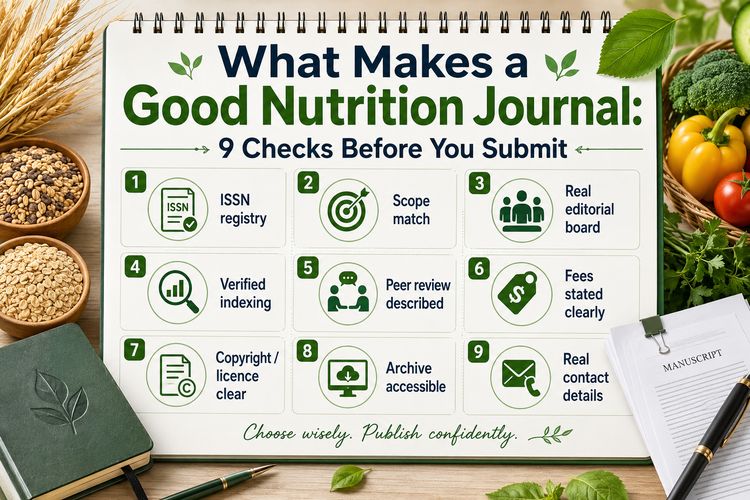
A good nutrition journal can be identified in about fifteen minutes using nine checks, none of which involve trusting anything the journal says about itself. Work through them in order. A journal that fails checks 1 to 3 is not worth the remaining six.
Every legitimate nutrition journal has an ISSN, and one with a print edition has two: one for print, one for online. Take the number from the site and look it up at portal.issn.org. The registered title and publisher must match what the website says.
This catches the crudest fakes immediately. A nutrition journal that displays an ISSN which belongs to a different title, or resolves to nothing, has ended the conversation. For reference, this journal registers P-ISSN 2664-6064 and E-ISSN 2664-6072.
Open any published article and find its DOI. Paste it into doi.org. It should land on the article page.
A DOI is not decoration. It is a registration with Crossref that costs the publisher money per article and creates a permanent link that survives site redesigns. Journals unwilling to pay for it are telling you how long they expect to be around. This journal registers under the prefix 10.33545/26646064.
Search the exact nutrition journal title in Google Scholar. Papers from the last two issues should appear with full text.
If Scholar shows nothing from the last two years while the site shows monthly issues, the content is not being picked up — and content nobody can find is content nobody will cite. This is the single most useful check for an author, because being read is the whole point.
Pick three names at random from the board page and search each. Each should be a real researcher, at the stated institution, publishing in a related field.
Two specific things to look for. Are the board members' subjects spread across the journal's stated scope, or is a nutrition journal staffed entirely by soil scientists? And is the board drawn from more than one institution? A board that is one department under a different name reviews like one department.
Find the number before you submit. It should be on a public page, not sent on request.
| What you see | What it means |
|---|---|
| Charge published, payable after acceptance | Normal open access. Nothing to pay if rejected. |
| Charge published, payable at submission | Unusual. Ask what it buys. |
| No charge mentioned anywhere | Either genuinely free, or you will find out after acceptance. Ask first. |
This journal publishes both rates — 2,500 INR for Indian authors, 55 USD for international — and states that nothing is payable if the manuscript is rejected.
A vague promise of “rigorous peer review” means nothing. A described process means something. Look for: who screens first, how many reviewers, whether review is single- or double-blind, how long you get to revise, and who takes the final decision.
Here the description is specific: a subject editor screens, two reviewers conduct a double-blind review with identifying information stripped out, comments are anonymised before reaching the author, the author returns the revision within one week, and the subject editor decides after a second reviewer round. You can hold a journal to a process it has published.
“All submissions are checked for plagiarism” is a sentence, not a policy. A real policy names the tool, explains what is disregarded when the report is read, and states the consequence.
This journal names Red Paper Plagiarism and AI Detector, explains that standard method descriptions, instrument names, correctly attributed quotations and the reference list are all excluded when a similarity report is assessed, and states that authors found responsible are debarred for six months. Notice what is missing: a fixed percentage. A journal that rejects on a number alone is not reading the reports.
Find out who owns the paper after publication and what you may do with it. Three questions: do authors keep copyright, what licence applies, and can you deposit the published version in a repository?
If a nutrition journal cannot answer those from its own pages, assume the answer is not in your favour. This one keeps copyright with authors, applies CC BY-NC 4.0, and allows repository deposit under Sherpa/Romeo Green with no embargo.
A nutrition journal that publishes a print edition has to be reachable by post. Look for a postal address, a phone number, working hours, and an email that is not a free webmail account for the whole operation. Publishing involves posting things — print copies, certificates — and an organisation that cannot receive post is not doing that.
Two journals invite you in the same week. Site A shows an ISSN that resolves to a different title at portal.issn.org, no DOIs on any article, and a board of eleven people of whom two can be found online, both at the same private college. Charges are not mentioned. The review process is described as “fast-track peer review, decision in 72 hours”.
Site B shows two ISSNs that resolve correctly, DOIs that open the article, recent papers in Google Scholar, a board spread across six institutions and three countries, published charges payable after acceptance, a named plagiarism tool, and a stated one-week revision window. Its indexing page says outright that it is not in Scopus.
Site A fails checks 1, 2, 4, 5 and 6. Site B passes all nine and volunteers a limitation. The honest limitation is the tell: fake operations claim more, not less. The whole comparison took under ten minutes and cost nothing.
None of this measures whether the journal is right for your paper. A journal can pass all nine and still be the wrong place, because its readers do not work on your crop, or its recent issues contain nothing methodologically similar to your study.
Equally, a high rating is not a substitute for these checks. A NAAS score tells your promotion committee something; it does not tell you whether the review will be careful. Run the nine checks first, then judge fit, then look at ratings last.
Nine yeses and you have a nutrition journal worth considering. Anything less than seven and you should be looking elsewhere, whatever else the site promises.
Check the ISSN at portal.issn.org and paste any article DOI into doi.org. Those two checks take three minutes and eliminate most fake operations, because both require registration with an outside body that verifies the publisher.
Only if your institution requires it. Many genuine regional journals are not in Scopus and still carry weight in their field. What matters is whether the journal is on the list your university or funding body actually uses, and whether it states its indexing honestly rather than claiming databases it is not in.
A stated acceptance rate above 90%, or any promise of acceptance before review, is a warning sign. Journals that accept nearly everything are not reviewing. Note that most journals do not publish an acceptance rate at all, and that is normal.
Two independent reviewers is the standard for this field, with the editor deciding between them if reports conflict. One reviewer is thin. What matters more than the number is whether the journal says which system it uses and sticks to it.
No, provided it is published openly and payable after acceptance. Open access journals recover their costs from authors instead of readers; that is how free-to-read publishing works. Worry when the amount is not disclosed until after your paper has been accepted.
Yes. A Clarivate Journal Impact Factor is one metric from one company covering a limited set of journals. Plenty of sound, well-reviewed journals do not have one. Judge the review process, the board and the indexing instead, and be more suspicious of a journal that displays an impact-factor-like number from an unnamed source.
The checks above are explained in more detail here:
Created by Varsha Gupta • 10 Aug 2026
P-ISSN: 2664-6064
E-ISSN: 2664-6072

International Journal of Agriculture and Nutrition