
- Printed Journal
- Indexed Journal
- Refereed Journal
- Peer Reviewed Journal


P-ISSN: 2664-6064
E-ISSN: 2664-6072

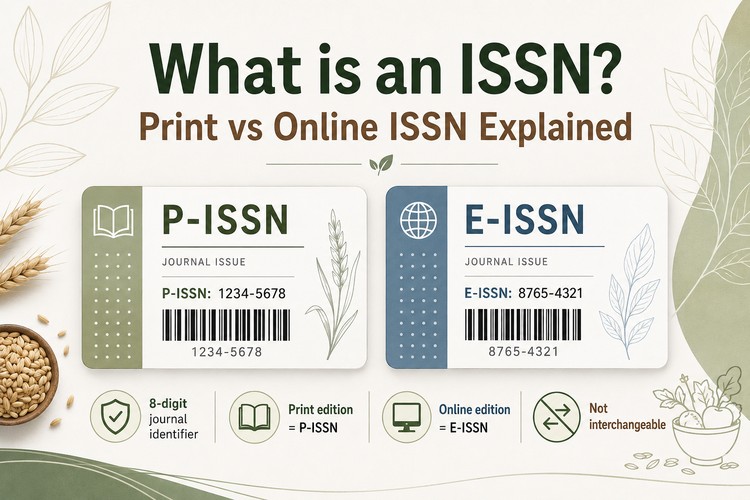
An ISSN is an eight-digit code that identifies a journal as a publication. A journal issued both in print and online needs two of them: a P-ISSN for the printed edition and an E-ISSN for the online one. They are not interchangeable, and quoting the wrong one in a citation or an indexing application causes more trouble than most authors expect.
An ISSN identifies the serial — the nutrition journal itself, across its whole life. It says nothing about quality, indexing, review process or age. A journal launched last month can have an ISSN; so can a journal running since 1950.
What it does prove is that a national ISSN centre accepted an application from a publisher with a verifiable address and a real publication. That is a low bar, but it is a bar, and it is one many fake operations do not clear.
| Identifier | Identifies | How many |
|---|---|---|
| ISSN | The journal | One or two per journal, permanently |
| DOI | One article | Thousands per journal, one each |
| ISBN | One book or edition | One per edition |
An agriculture and nutrition journal that appears in both print and online form is catalogued as two objects, because a library can hold one without the other. A library that subscribes to the printed run needs the P-ISSN in its catalogue; a database that indexes the web edition uses the E-ISSN.
This agriculture and nutrition journal carries P-ISSN 2664-6064 for print and E-ISSN 2664-6072 for online. Note that they are different numbers, not the same number in two places — a common misreading.
Also worth knowing: the E-ISSN often appears inside the DOI suffix. Here the DOIs run 10.33545/26646064..., which is the E-ISSN with the hyphen removed. That is a publisher convention rather than a rule, but it means the two identifiers cross-check each other.
The last character of an ISSN is a check digit calculated from the first seven. It can be a digit or the letter X, which stands for the value 10.
This is why an ISSN ending in X is not a typo, and why an ISSN that has been retyped by hand is worth verifying. A single transposed digit produces a code that fails the check and resolves to nothing.
Steps 3 and 4 are the ones people skip, and they are where the fraud lives. A fake nutrition journal will happily display a real ISSN belonging to a different title, on the assumption that nobody looks it up. Anyone who does look it up sees a completely different journal name and knows immediately.
It is worth being direct, because an agriculture and nutrition journal will sometimes advertise ISSN registration as though it were an achievement.
It does not mean the journal is indexed anywhere. It does not mean articles are peer reviewed. It does not mean a DOI is registered for each paper. It does not mean the journal is on your institution's approved list. A nutrition journal that leads with “ISSN approved!” as its main credential is telling you it has nothing better to advertise.
Use it as one of several checks: ISSN resolves, DOIs resolve, recent issues appear in Google Scholar, board members are real. Any single check on its own proves very little.
Run the procedure on a real number so you know what a pass looks like. Take P-ISSN 2664-6064 to portal.issn.org.
Two numbers, one title, two media, one publisher, one country. That is what a clean registration looks like, and it takes under two minutes to confirm. When any of those four disagree with the website, stop and find out why before submitting anything.
The reverse case is worth naming too. A nutrition journal may show a perfectly valid ISSN whose registered publisher is a company you have never heard of and which does not appear anywhere on the site. That is not automatically fraud — publishers are sold and renamed — but it is a question worth asking the editorial office before you pay a charge.
| What you see | What it usually means |
|---|---|
| One ISSN labelled for both print and online | The publisher has registered only one medium, or is confused about the difference |
| ISSN that returns nothing at portal.issn.org | Either mistyped on the site, or invented |
| ISSN registered to a different title | A borrowed number; treat everything else on the site with suspicion |
| “ISSN applied for” | Not registered. It may become so; it is not now |
| ISSN shown with no hyphen | Cosmetic, but check the number itself resolves |
The first row is more common than outright fraud, particularly among small journals. It is untidy rather than dishonest, but it does mean the print and online editions cannot be catalogued separately by a library.
A new nutrition journal applies to the national ISSN centre for the country where the publisher is based, not to an international office. In India that is the National Science Library at NISCPR. You apply per medium, so a journal planning both editions applies twice and receives two numbers.
Apply once you have a title, a publisher address and a first issue in preparation. Applying for a journal that does not yet exist wastes everyone's time, including yours.
One last practical note for authors at Indian institutions. Some university formats ask for the ISSN in the list of publications and some ask for the journal name and DOI. Give whatever the format asks for, but keep both ISSNs and the DOI of every paper in one file as you go. Assembling them the week before a submission deadline, from memory and old emails, is how the wrong number ends up in a thesis that has already been bound.
P-ISSN identifies the printed edition of a journal and E-ISSN identifies the online edition. They are different numbers for the same title, registered separately, because a library can hold one without the other. This journal carries P-ISSN 2664-6064 and E-ISSN 2664-6072.
It means a national centre registered a publisher with a verifiable address. That eliminates the crudest fakes but proves nothing about peer review, indexing or quality. Always check the registered title and publisher at portal.issn.org actually match the website you are looking at.
The last character is a check digit calculated from the first seven, and X represents the value 10. It is not a typing error and the code should be entered exactly as printed, including the X.
If your university asks for one, give the number for the version you actually used — E-ISSN if you read it online, P-ISSN if you used the printed copy. Listing both, clearly labelled, is safest and is what most agriculture and nutrition journal pages display.
Yes, if it has changed title. A significant title change requires a new ISSN, so a long-running journal may have several across its history, with the old numbers still valid for the issues published under the old name.
No, and confusing the two is the commonest misunderstanding here. Registration is administrative and largely automatic for a legitimate publisher. Indexing is a selection decision made by each database on the journal's record over years.
How ISSN fits with the other identifiers:
Created by Sanjana Pillai • 10 Aug 2026
P-ISSN: 2664-6064
E-ISSN: 2664-6072

International Journal of Agriculture and Nutrition